Emerson G

University of Washington
STEM Dawgs Peer Mentor

Biography

I'm a student at UW majoring in Bioengineering, but I also have a passion for global health and learning languages. Whenever my friends are struggling with any kind of homework, I'll try to help them by explaining it in a different and interesting way. In my free time I enjoy gaming and biking, although the weather is usually pretty bad in Seattle.

Education

BS Bioengineering
University of Washington

Educator Statistics

Numerade tutor for 5 years
66 Students Helped

Topics Covered

Understanding Chemical Bonding: The Key to Molecular Structure
Explore the Fascinating World of Molecular Geometry - Discover More!
Understanding Structure and Bonding: A Comprehensive Guide

Emerson's Textbook Answer Videos

06:19
Chemistry A Molecular Approach

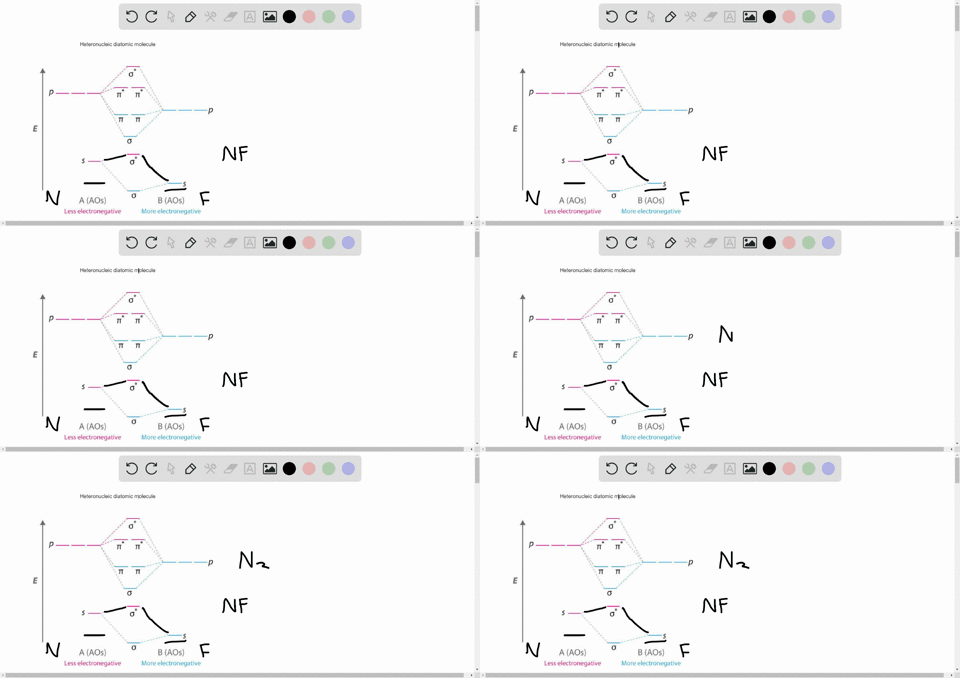
When applying MO theory to heteronuclear diatomic molecules, the atomic orbitals used may be of different energies. If two atomic orbitals of different energies make two molecular orbitals, how are the energies of the molecular orbitals related to the energies of the atomic orbitals? How is the shape of the resultant molecular orbitals related to the shape of the atomic orbitals?

Chapter 11: Chemical Bonding II: Molecular Shapes, Valence Bond
Emerson G
04:22
Chemistry A Molecular Approach

Write a short paragraph describing chemical bonding according to the Lewis model, valence bond theory, and MO theory. Indicate how the theories differ in their description of a chemical bond and describe the strengths and weaknesses of each theory. Which theory is correct?

Chapter 11: Chemical Bonding II: Molecular Shapes, Valence Bond
Emerson G
02:25
Chemistry A Molecular Approach

Write orbital diagrams (boxes with arrows in them) to represent the electron configurations-without hybridization-for all the atoms in $\mathrm{SF}_{2}$. Circle the electrons involved in bonding. Draw a three-dimensional sketch of the molecule and show orbital overlap. What bond angle do you expect from the unhybridized orbitals? How well does valence bond theory agree with the experimentally measured bond angle of $98.2^{\circ} ?$

Chapter 11: Chemical Bonding II: Molecular Shapes, Valence Bond
Emerson G
07:49
Chemistry A Molecular Approach

Write a hybridization and bonding scheme for each molecule. Sketch the molecule, including overlapping orbitals, and label all bonds using the notation shown in Examples 11.6 and 11.7 .
a. $\mathrm{CCl}_{4}$
b. $\mathrm{NH}_{3}$
c. OF $_{2}$
d. $\mathrm{CO}_{2}$

Chapter 11: Chemical Bonding II: Molecular Shapes, Valence Bond
Emerson G
02:03
Chemistry A Molecular Approach

Draw an MO energy diagram and predict the bond order of $\mathrm{Li}_{2}$ and $L_{2}^{-}$. Do you expect these molecules to exist in the gas phase?

Chapter 11: Chemical Bonding II: Molecular Shapes, Valence Bond
Emerson G
1 2

Emerson's Quick Ask Videos

03:58
Chemistry 101

Nitrogen monoxide and oxygen react to form nitrogen dioxide. Consider the mixture of NO and O $_{2}$ shown in the accompanying diagram. The blue spheres represent $\mathrm{N},$ and the red ones represent $\mathrm{O}$ . (a) How many molecules of $\mathrm{NO}_{2}$ can be formed, assuming the reaction goes to completion? (b) What is the limiting reactant? (c) If the actual yield of the reaction was 75$\%$ instead of 100$\%$ , how many molecules of each kind would be present after the reaction was over?

Emerson G
13:48
Chemistry 101

You have seven closed containers, each with equal masses of chlorine gas $\left(\mathrm{Cl}_{2}\right) .$ You add 10.0 $\mathrm{g}$ of sodium to the first sample, 20.0 $\mathrm{g}$ of sodium to the second sample, and so on (adding 70.0 $\mathrm{g}$ of sodium to the seventh sample). Sodium and chlorine
react to form sodium chloride according to the equation
$$
2 \mathrm{Na}(s)+\mathrm{Cl}_{2}(g) \longrightarrow 2 \mathrm{NaCl}(s)
$$
After each reaction is complete, you collect and measure the amount of sodium chloride formed. A graph of your results is shown below.
Answer the following questions:
a. Explain the shape of the graph.
b. Calculate the mass of NaCl formed when 20.0 $\mathrm{g}$ of sodium is used.
c. Calculate the mass of $\mathrm{Cl}_{2}$ in each container.
d. Calculate the mass of NaCl formed when 50.0 $\mathrm{g}$ of sodium is used.
e. Identify the leftover reactant, and determine its mass for parts b and d above.

Emerson G
01:52
Chemistry 101

A charged particle moves between two electrically charged plates, as shown here.$egin{array}{l}{ ext { (a) What is the sign of the electrical charge on the particle? }} \ { ext { (b) As the charge on the plates is increased, would you ex- }} \ { ext { pect the bending to increase, decrease, or stay the same? }}end{array}$$egin{array}{l}{ ext { (c) As the mass of the particle is increased while the speed of }} \ { ext { the particles remains the same, would you expect the bending }} \ { ext { to increase, decrease, or stay the same? }}end{array}$

Emerson G
03:42
Chemistry 101

Mass spectrometry is more often applied to molecules than to atoms. We will see in Chapter 3 that the molecular weight of a molecule is the sum of the atomic weights of the
atoms in the molecule. The mass spectrum of $\mathrm{H}_{2}$ is taken under conditions that prevent decomposition into $\mathrm{H}$ atoms.The two naturally occurring isotopes of hydrogen are $^{1} \mathrm{H}$ (atomic mass $=1.00783$ amu; abundance 99.9885$\% )$ and 2H (atomic mass $=2.01410$ amu; abundance 0.0115$\% ) .$ (a) How many peaks will the mass spectrum have? (b) Give the relative atomic masses of each of these peaks. (c) Which peak will be the largest, and which the smallest?

Emerson G
04:40
Chemistry 101

Which of the following statements about the bonding atomic radii in Figure 7.7 is incorrect? (i) For a given period, the radii of the representative elements generally decrease from left to right across a period. (ii) The radii of the representative elements for the $n=3$ period are all larger than those of the
corresponding elements in the $n=2$ period. (ii) For most of the representative elements, the change in radius from the $n=2$ to the $n=3$ period is greater than the change in radius from $n=3$ to $n=4 .$ (iv) The radii of the transition elements generally increase moving from left to right within a period. (v) The large radii of the Group 1 A elements are due to their relatively small effective nuclear charges.

Emerson G
04:51
Chemistry 101

Determine the number of atoms and the mass of zirconium, silicon, and oxygen found in 0.3384 mol of zircon, Zrsio_, a semiprecious stone.

Emerson G
1 2 3 4 5 ... 10