I am a fourth-generation teacher. After receiving my Bachelor of Science degree in Mathematics Education, I taught middle school math for four years. I then went back to school at Oklahoma State University, where I received a Master of Science degree in Mathematics. I have been teaching at the college level for 12 years, and have taught everything from developmental-level mathematics courses through the Calculus sequence and Linear Algebra.
In Exercises $1-26,$ assume that the coordinates of the points $P$, $Q, R, S,$ and $O$ are as follows:$$P(-1,3) \quad Q(4,6) \quad R(4,3) \quad S(5,9) \quad O(0,0)$$For each exercise, draw the indicated vector (using graph paper and compute its magnitude. In Exercises $7-20$, compute the sums using the definition given on page $698 .$ In Exercises $21-26,$ use the parallelogram law to compute the sums.$$\overrightarrow{O P}+\overrightarrow{R Q}$$
In Exercises $1-26,$ assume that the coordinates of the points $P$, $Q, R, S,$ and $O$ are as follows:$$P(-1,3) \quad Q(4,6) \quad R(4,3) \quad S(5,9) \quad O(0,0)$$For each exercise, draw the indicated vector (using graph paper and compute its magnitude. In Exercises $7-20$, compute the sums using the definition given on page $698 .$ In Exercises $21-26,$ use the parallelogram law to compute the sums.$$\overrightarrow{O P}+\overrightarrow{Q R}$$
Use Gauss-Jordan elimination to solve the system:$$\left\{\begin{aligned}-x-y-z &=1 \\4 x+5 y &=0 \\y-3 z &=0\end{aligned}\right.$$
Use the matrices below to perform the indicated operation if possible. If not possible, explain why the operation cannot be performed. Use a calculator to verify your solution.$$A=\left[\begin{array}{rrr}-2 & 0 & 9 \\1 & 8 & -3 \\0.5 & 4 & 5\end{array}\right], B=\left[\begin{array}{rrr}0.5 & 3 & 0 \\-4 & 1 & 6 \\8 & 7 & 2\end{array}\right], C=\left[\begin{array}{lll}1 & 0 & 1 \\0 & 1 & 0 \\1 & 0 & 1\end{array}\right]$$$$A B C$$
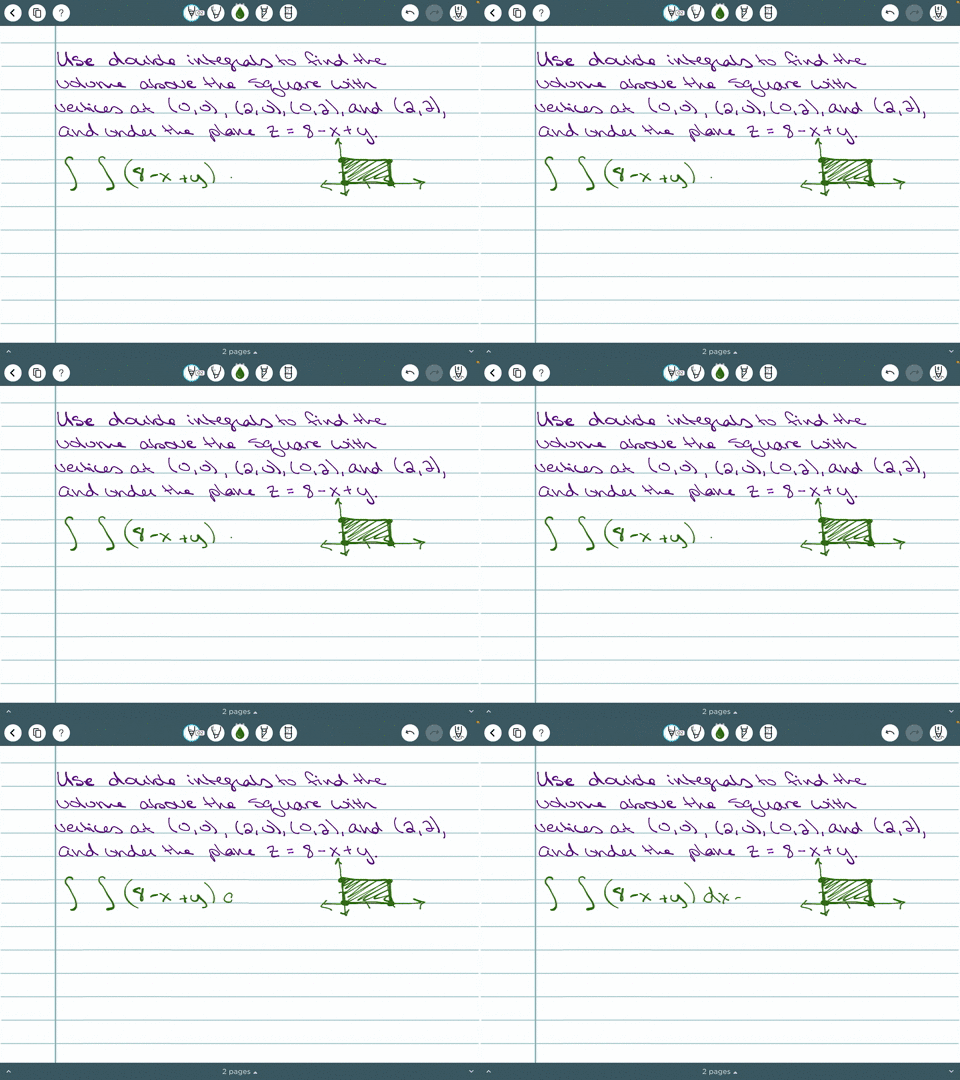
Use double integrals to find the indicated volumes.Above the square with vertices at $(0,0),(2,0),(0,2),$ and $(2,2),$ and under the plane $z=8-x+y$.