EI

Eric Icaza

Numerade Educator
Teaching Assistant

Biography

I started tutoring for the University of Connecticut in 2014 as an undergraduate. I helped undergraduates with classes ranging from algebra to differential equations at the Q Center. After I graduated, I started my actuarial science master's program at The University of Connecticut and became a Teaching Assistant. I helped teach Calculus 1 and then became an instructor for Calculus for Business Majors. After I got my master's degree, I started working for Sun Life Financial for a couple years. I wanted a career change, so I quit and enrolled into The University of Illinois' mathematics master's program. Right now, I work for an online math course called Net Math as a lead Teaching Assistant for Calculus II.

Education

Eric has not yet added their education credentials.

Educator Statistics

Numerade tutor for 5 years
40 Students Helped

Topics Covered

Exploring the World of Derivatives: A Comprehensive Guide
Stand Out with Differentiation Strategies | Boost Your Business
Differential Equations Made Simple: Expert Tips & Resources
Unlock the Power of Sequences: Boost Your Productivity
Discover the Best Series to Binge-Watch | Your Ultimate Guide
Applications of Integration: Exploring Real-World Solutions
Introduction to Sequences and Series
Introduction to Combinatorics and Probability

Eric's Textbook Answer Videos

08:00
Calculus: Early Transcendentals

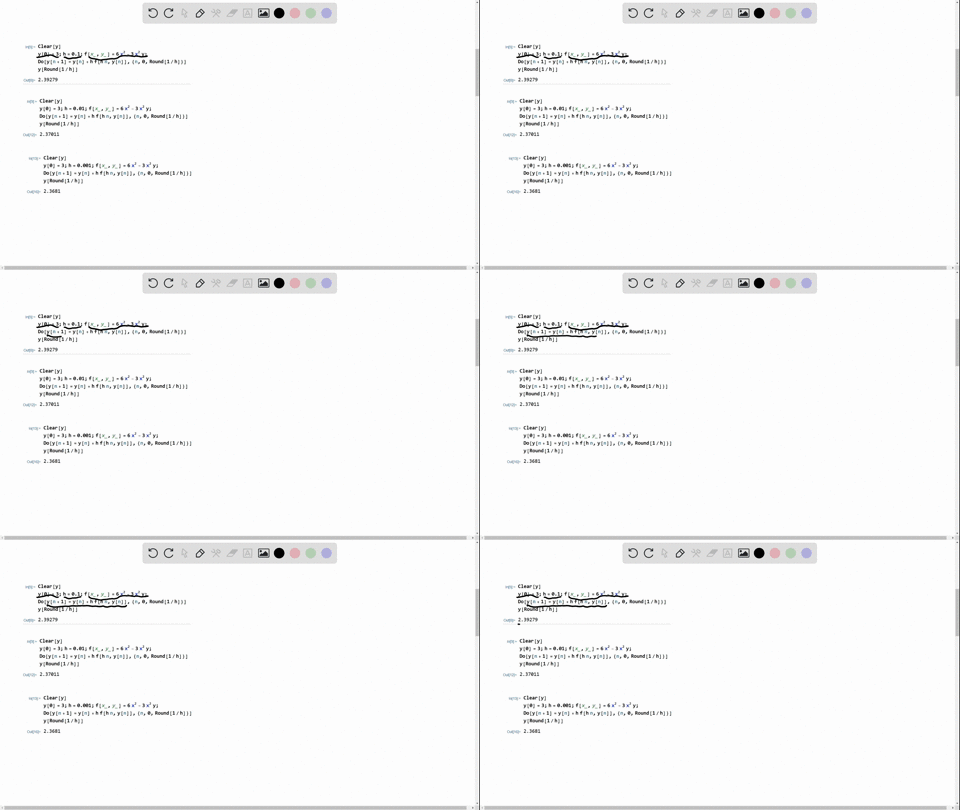
(a) Program a calculator or computer to use Euler's method to compute $ y(1), $ where $ y(x) $ is the solution of the initial-value problem
$ \frac {dy}{dx} + 3x^2y = 6x^2 y(0) = 3 $
(i) $ h = 1 $ (ii) $ h = 0.1 $
(iii) $ h = 0.01 $ (iv) $ h = 0.001 $
(b) Verify that $ y = 2 + e^{-x^3} $ is the exact solution of the differential equation.
(c) Find the errors in using Euler's method to compute $ y(1) $ with the step sizes in part (a). What happens to the error when the step size is divided by 10?

Chapter 9: Differential Equations
Section 2: Direction Fields and Euler's Method
Eric Icaza
01:46
Calculus: Early Transcendentals

(a) Program your computer algebra system, using Euler's method with step 0.01, to calculate $ y(2), $ where $ y $ is the solution of the initial-value problem
$ y' = x^3 - y^3 y(0) = 1 $
(b) Check your work by using the CAS to draw the solution curve.

Chapter 9: Differential Equations
Section 2: Direction Fields and Euler's Method
Eric Icaza
03:21
Calculus: Early Transcendentals

For a fixed value of $ M $ (say $ M = 10), $ the family of logistic functions given by Equation & depends on the initial value $ P_o $ and the proportionality constant $ k. $ Graph several members of this family. How does the graph change when $ P_o $ varies? How does it changes when $ k $ varies?

Chapter 9: Differential Equations
Section 4: Models for Population Growth
Eric Icaza
07:00
Calculus: Early Transcendentals

Let $ c $ be a positive number. A differential equation of the form
$ \frac {dy}{dt} = ky^{1+c} $
where $ k $ is a positive constant, is called a doomsday equation because the exponent in the expression $ ky^{1+c} $ is larger than the exponent 1 for natural growth.
(a) Determine the solution that satisfies the initial condition $ y(0) = y_0. $
(b) Show that there is a finite time $ t = T $ (doomsday) such that lim $ _{t \to T} - y(t) = \infty. $
(c) An especially prolific breed of rabbits has the growth term $ ky^{1.01}. $ If 2 such rabbits breed initially and the warren has 16 rabbits after three months, then when is doomsday?

Chapter 9: Differential Equations
Section 4: Models for Population Growth
Eric Icaza
08:48
Calculus: Early Transcendentals

In a seasonal-growth model, a period function of time is introduced to account for seasonal variations in the rate of growth. Such variations could, for examples, be caused by seasonal changes in the availability of food.
(a) Find the solution of the seasonal-growth model
$ \frac {dP}{dt} = kP \cos(rt - \phi) P(0) = P_0 $
where $ k, r, $ and $ \phi $ are positive constants.
(b) By graphing the solution for several values of $ k, r, $ and $ \phi, $ explain how to the values of $ k, r, $ and $ \phi $ affect the solution. What can you say about lim $ _{t \to \infty} P(t)? $

Chapter 9: Differential Equations
Section 4: Models for Population Growth
Eric Icaza
1 2 3 4 5

Eric's Quick Ask Videos

02:34
Algebra

what is the federal income tax to be paid

07:13
Intro Stats / AP Statistics

Answe this please

07:45
Intro Stats / AP Statistics

Solve the three counting problems below. Then say why it makes sense that they all have the same answer. That is, say how you can interpret them as each other.
How many ways are there to distribute 8 cookies to 3 kids?
How many solutions in non-negative integers are there to x+y+z= 8?
How many different packs of 8 crayons can you make using crayons that come in red, blue and yellow? Provide illustrations for all parts using stars and bars and provide an argument.

06:10
Algebra

Find integers s and t such that 1=7 (dot) s+11 (dot) t. Show that s and t are not unique.

02:53
Probability

Determine the value of K.
Find the probability that the airtime vending
i. Makes a loss
ii. Realises profit of at least $2 000

04:59
Linear Algebra

Could you help me to solve it?Urgent

1 2