Gregory Devenport

Brigham Young University

Biography

I graduated with a Bachelor's degree in applied physics with an aerospace engineering emphasis. I'm a commercial pilot and I love anything to do with flying or physics!

Education

BS Applied Physics
Brigham Young University

Educator Statistics

Numerade tutor for 4 years
1841 Students Helped

Topics Covered

Mastering Motion: Achieving Efficiency Along a Straight Line
Mastering Newton's Laws: Tips for Applying Them Effectively
Motion
Discover the Power of Gravitation: Exploring the Science Behind It
Understanding Moment Impulse and Collisions for Better Physics
Unlocking the Power of Magnetic Fields and Forces
Introduction and Vectors
Understanding Gauss's Law: A Comprehensive Guide
Unlocking the Power of Potential Energy: Discover the Benefits
Save Energy and Money with Effective Conservation Techniques
Find Your Dream Job: Discover the Best Work Opportunities
Unlock the Power of Kinetic Energy: Boost Your Efficiency Today
Unlock the Secrets of Fluid Mechanics with Our Expert Guide
Discovering the Fundamentals: Newton's Laws of Motion Explained
Understanding Electric Charge and Field: A Comprehensive Guide
Unlocking the Power of Electric Potential: Exploring its Benefits
Capacitance and Dielectrics: Understanding the Basics

Gregory's Textbook Answer Videos

0:00
University Physics Volume 1

A camera weighing $10 \mathrm{N}$ falls from a small drone hovering $20 \mathrm{m}$ overhead and enters free fall. What is the gravitational potential energy change of the camera from the drone to the ground if you take a reference point of (a) the ground being zero gravitational potential energy? (b) The drone being zero gravitational potential energy? What is the gravitational potential energy of the camera (c) before it falls from the drone and (d) after the camera lands on the ground if the reference point of zero gravitational potential energy is taken to be a second person looking out of a building $30 \mathrm{m}$ from the ground?

Chapter 8: Potential Energy and Conservation of Energy
Gregory Devenport
0:00
University Physics

Charge is distributed throughout a spherical shell of inner radius $r_{1}$ and outer radius $r_{2}$ with a volume density given by $\rho=\rho_{0} r_{1} / r, \quad$ where $\rho_{0}$ is a constant. Determine the electric field due to this charge as a function of $r,$ the distance from the center of the shell.

Chapter 6: Gauss's Law
Gregory Devenport
0:00
Fundamentals of Fluid Mechanics

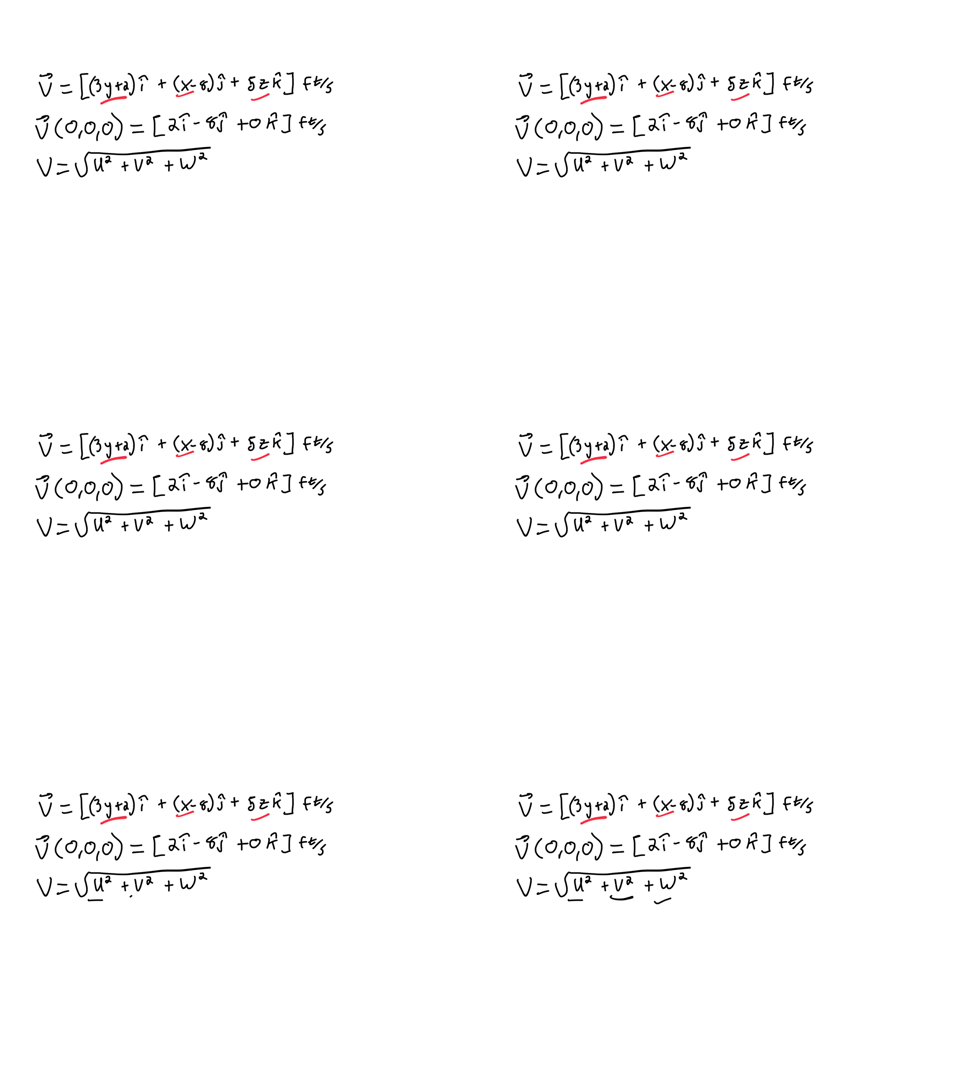
$\mathrm{fcot}^{2}$ The velocity field of a flow is given by
\[
\mathbf{V}=(3 y+2) \hat{\mathbf{i}}+(x-8) \hat{\mathbf{j}}+5 z \hat{\mathbf{k}} \mathrm{ft} / \mathrm{s}, \text { where } x, y, \text { and } z \text { are in }
\]
feet. Determine the fluid speed at the origin $(x=y=z=0)$ and on the $y$ axis $(x=z=0)$

Chapter 4: Fluid Kinematics
Gregory Devenport
0:00
Fundamentals of Fluid Mechanics

The velocity field of a flow is given by $\mathbf{V}=2 x^{2}+\hat{\mathbf{i}}+$ $\left[4 y(t-1)+2 x^{2} t\right] \hat{j} \mathrm{m} / \mathrm{s},$ where $x$ and $y$ are in meters and $t$ is in seconds. For fluid particles on the $x$ axis, determine the speed and direction of flow.

Chapter 4: Fluid Kinematics
Gregory Devenport
0:00
Fundamentals of Fluid Mechanics

The velocity field of a flow is given by $\mathbf{V}=$ $(5 z-3) i+(x+4) \hat{\mathbf{j}}+4 y \hat{\mathbf{k}} \mathrm{ft} / \mathrm{s},$ where $x, y,$ and $z$ are in feet. Determine the fluid speed at the origin $(x=y=z=0)$ and on the $x$ axis $(y=z=0)$

Chapter 4: Fluid Kinematics
Gregory Devenport
1 2 3 4 5 ... 39

Gregory's Quick Ask Videos

05:08
Physics 101 Mechanics

Graphically determine the resultant of the following three vector displacements: (1) 34m, 25 north of east; (2) 48m, 33 east of north; and (3) 22m, 56 west of south

Gregory Devenport
06:16
Physics 101 Mechanics

Tony decides it is time to upgrade to a ring light for his viral videos, so he pushes his ancient lamp (weight = 150N) off the desk and into the garbage can. The coefficients of static and dynamic friction between the lamp and the desk are 0.54 and 0.42, respectively.

(a) What is the magnitude of the force Tony must exceed to move the lamp?
(b) Once it is moving, what is the magnitude of the force needed to keep the lamp in motion?

Gregory Devenport
04:26
Physics 101 Mechanics

Draw a free body diagram of an air freshener hanging from a
car's rear view mirror as the car comes to a stop.
At what angle from vertical does the air freshener hang as the
driver is coming to a stop?
The magnitude of the car's acceleration is 0.80 m/s^2.

Gregory Devenport
07:38
Physics 101 Mechanics

International undercover spy James Bond has been cornered by enemy agents when Barbara, his spying partner, saves him. She swings down holding onto a rope, grabs James, and the two swing away together to safety. The rope is 27 m long, and Barbara starts her swing with the rope horizontal. Barbara has a mass of 55 kg, and James's mass is 87 kg. How high, relative to their lowest point, will the pair rise after the rescue? (Assume the rope is vertical when Barbara grabs James.)

Gregory Devenport
03:46
Physics 101 Mechanics

You are walking along a small country road one foggy morning and
come to an intersection. While you are crossing, you hear an
ambulance siren. As a paramedic, you know that the siren sounds at
a frequency of 8.27 kHz. But, as an amateur musician with perfect
pitch, you can tell that the frequency you are hearing is actually
7.57 kHz. At what speed is the ambulance traveling? (Answer in
MPH)

Gregory Devenport
03:48
Physics 101 Mechanics

A coaxial cable has an inner wire carrying current I = 10 A into the page and an outer sheath carrying current I = 10 A out of the page.
Calculate the magnetic field B at a distance r = 1 cm using Ampere's law: B = (µ0 * I) / (2π * r). This point is inside the coaxial cable.
Calculate the magnetic field B at a distance r = 10 cm using Ampere's law: B = (µ0 * I) / (2π * r). The point is outside the coaxial cable.

Gregory Devenport
1 2 3 4 5 ... 237