Jeff Vermeire

Virginia Commonwealth University
Tutor

Biography

I'm 35, I find teaching fulfilling but hate the bureaucracy of working at a school

Education

BS Physics
Virginia Commonwealth University

Educator Statistics

Numerade tutor for 4 years
850 Students Helped

Topics Covered

Mastering Motion: Achieving Efficiency Along a Straight Line
Mastering Newton's Laws: Tips for Applying Them Effectively
Mastering Partial Derivatives: Essential Techniques and Tips
Vector Functions: Understanding the Basics
Mastering Matrices: An Introduction to the Fundamentals
Unlock the Power of Vectors: Discover Their Limitless Possibilities
Mastering Integration Techniques for Optimal Results
Introduction to Sequences and Series
Exploring the Fascinating World of Mechanical Waves
Discover the Science of Sound and Hearing: Your Guide to Better Listening
Understanding Temperature and Heat: A Comprehensive Guide
Unlocking the Secrets of Thermal Properties: Understanding Matter
Understanding the First Law of Thermodynamics: Key Concepts
Understanding the Second Law of Thermodynamics: Key Principles
Exploring Probability Topics: From Basics to Advanced Strategies
The Central Limit Theorem: Understanding Statistical Sampling
Linear Regression & Correlation: Analyzing Data Relationships
Hypothesis Testing with Two Samples: A Comprehensive Guide
Master Probability and Counting Rules for Better Outcomes
Visualizing Data: Frequency Distributions & Graphs
Stand Out with Differentiation Strategies | Boost Your Business
Applications of Integration: Exploring Real-World Solutions

jeff's Textbook Answer Videos

03:41
University Physics with Modern Physics

CP A Thermodynamic Process in a Solid. A cube of copper 2.00 $\mathrm{cm}$ on a side is suspended by a string. (The physical properties of copper are given in Tables $14.1,17.2,$ and $17.3 .$ ) The cube is heated with a bumer from $20.0^{\circ} \mathrm{C}$ to $90.0^{\circ} \mathrm{C}$ . The air surrounding the cube is at atmospheric pressure $\left(1.01 \times 10^{5} \mathrm{Pa}\right)$ . Find (a) the increase in volume of the cube; (b) the mechanical work done by the cube to expand against the pressure of the surrounding air; (c) the amount of heat added to the cube; (d) the change in internal energy of the cube. (e) Based on your results, explain whether there is any substantial difference between the specific heats $c_{p}$ (at constant pressure) and $c_{V}($ at constant volume) for copper under these conditions.

Chapter 19: The First Law of Thermodynamics
Jeff Vermeire
01:25
Physics for Scientists and Engineers with Modern Physics

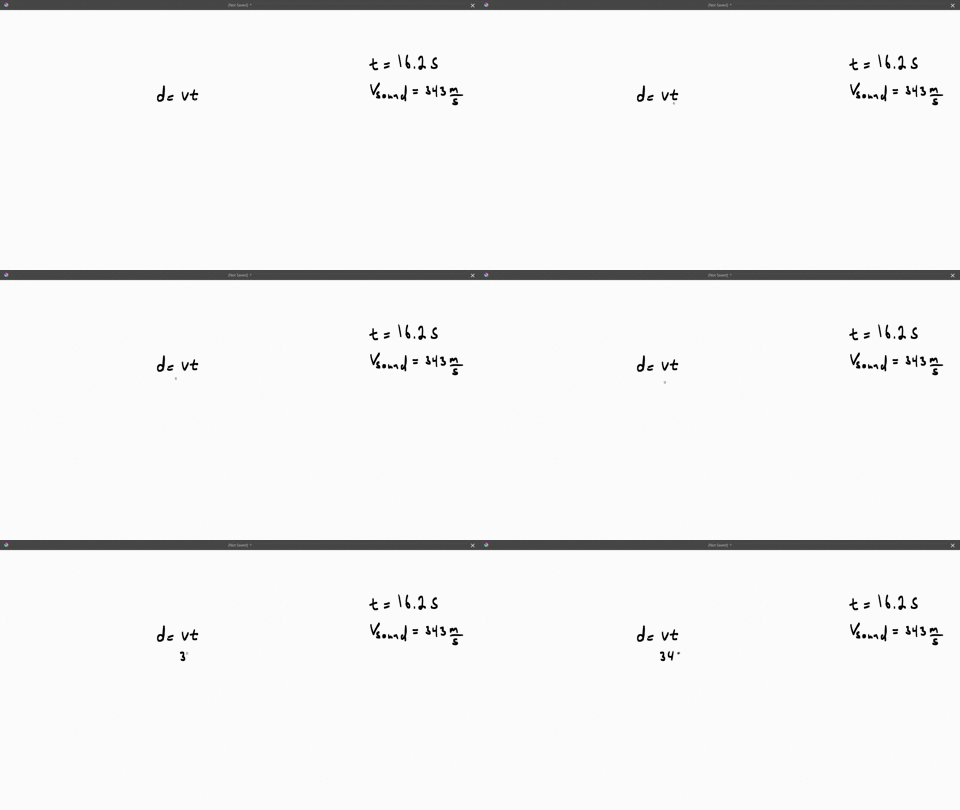
Suppose that you hear a clap of thunder 16.2 s after seeing the associated lightning stroke. The speed of sound waves in air is 343 $\mathrm{m} / \mathrm{s}$ , and the speed of light is $8.00 \times 10^{8} \mathrm{m} / \mathrm{s}$ . How fare you from the lightning stroke?

Chapter 17: Sound Waves
Jeff Vermeire
04:38
Physics for Scientists and Engineers with Modern Physics

An ultrasonic tape measure uses frequencies above 20 MHz to determine dimensions of structures such as buildings. It does this by emitting a pulse of ultrasound into air and then measuring the time for an echo to return from a reflecting surface whose distance away is to be measured. The distance is displayed as a digital read-out. For a tape measure that emits a pulse of ultrasound with a frequency of 22.0 MHz, (a) What is the distance to an object from which the echo pulse returns after 24.0 ms when the
air temperature is 26°C? (b) What should be the duration of the emitted pulse if it is to include 10 cycles of the ultra sonic wave? (c) What is the spatial length of such a pulse?

Chapter 17: Sound Waves
Jeff Vermeire
02:53
Physics for Scientists and Engineers with Modern Physics

Ultrasound is used in medicine both for diagnostic imaging and for therapy. For diagnosis, short pulses of ultrasound are passed through the patient’s body. An echo reflected from a structure of interest is recorded, and from the time delay for the return of the echo the distance to the structure can be determined. A single transducer emits and detects the ultrasound. An image of the structure is obtained by reducing the data with a computer. With sound of low intensity, this technique is noninvasive and harmless. It is used to examine fetuses, tumors, aneurysms, gallstones, and many other structures. A Doppler ultrasound unit is used to study blood flow and functioning of the heart. To
reveal detail, the wavelength of the reflected ultrasound must be small compared to the size of the object reflecting the wave. For this reason, frequencies in the range 1.00 to 20.0 MHz are used. What is the range of wavelengths corresponding to this range of frequencies? The speed of ultra- sound in human tissue is about 1 500 m/s (nearly the same as the speed of sound in water).

Chapter 17: Sound Waves
Jeff Vermeire
01:59
Physics for Scientists and Engineers with Modern Physics

As a certain sound wave travels through the air, it produces pressure variations (above and below atmospheric pres- sure) given by $\Delta P=1.27 \sin (\pi x-340 \pi t)$ in SI units. Find (a) the amplitude of the pressure variations, (b) the frequency, (c) the wavelength in air, and (d) the speed of the sound wave.

Chapter 17: Sound Waves
Jeff Vermeire
1 2 3 4 5 ... 39

jeff's Quick Ask Videos

04:24
Physics 101 Mechanics

A person shoots an arrow at an angle with an initial speed of
86.0 m/s in order to hit a target 300 m away from the archer. The
target is on the same level as the starting position of the
arrow.
a) The archer at first shoots the arrow with an angle of 11.7
degrees in order to hit the target. How long will it take for the
arrow to reach the target?
b) If instead the archer is on a vehicle moving away from the
target at 10.0 m/s (meaning -10.0 m/s in the x direction), and the
archer maintains the same amount of initial velocity and angle on
the bow, what will be the distance that the arrow travels
instead?

Jeff Vermeire
02:39
Intro Stats / AP Statistics

On average, guests in hotel elevators weigh an average of 156 pounds with an SD of 35 pounds. An engineer is designing an elevator for a large hotel, with a capacity to carry 36 people and a total load limit of 6,000 pounds. What is the expected value for the total load in pounds when the elevator is full? What is the SE for the total load in pounds of a full elevator? What is the chance that a full elevator will exceed the load limit? (Answer in %; omit the % sign.)

Jeff Vermeire
03:24
Physics 101 Mechanics

5) 2 Children of masses 10kg and 15kg are playing
on
a seesaw of length L. The 10 kg
child is sitting on
one end. In order to balance the
seesaw, at what
distance from the pivot point
should the 15 kg
child sit?
(1) L/2
(2) L/3
(3) L/4
(4) L/5

Jeff Vermeire
00:51
Physics 101 Mechanics

Please explain how a free energy magnetic mobile phone charger works. Explain using concepts of electricity from magnetism, magnets, and magnetic fields.

Jeff Vermeire
00:52
Intro Stats / AP Statistics

What is the critical value from Pearson's Correlation
Coefficient table for a set of data with sample size of 30. That
is, n = 30. Use a level of significance of 0.05.

Jeff Vermeire
03:54
Precalculus


Sketch a triangle that has acute angle θ.
csc(θ) =
15
5
Find the other five trigonometric ratios of θ.
sin(θ)
=
cos(θ)
=
tan(θ)
=
sec(θ)
=
cot(θ)
=

Jeff Vermeire
1 2 3 4 5 ... 96