Mr. McVay teaches core and advanced high school biology course during the day, and freshman biology at the college level in the evenings. He loves to impart his passion for biology to his students, and wants everyone to gain a greater appreciation for the fascinating biological phenomena that happen all around and inside of us! His research background is in marine biology, focusing on coral reef ecology.
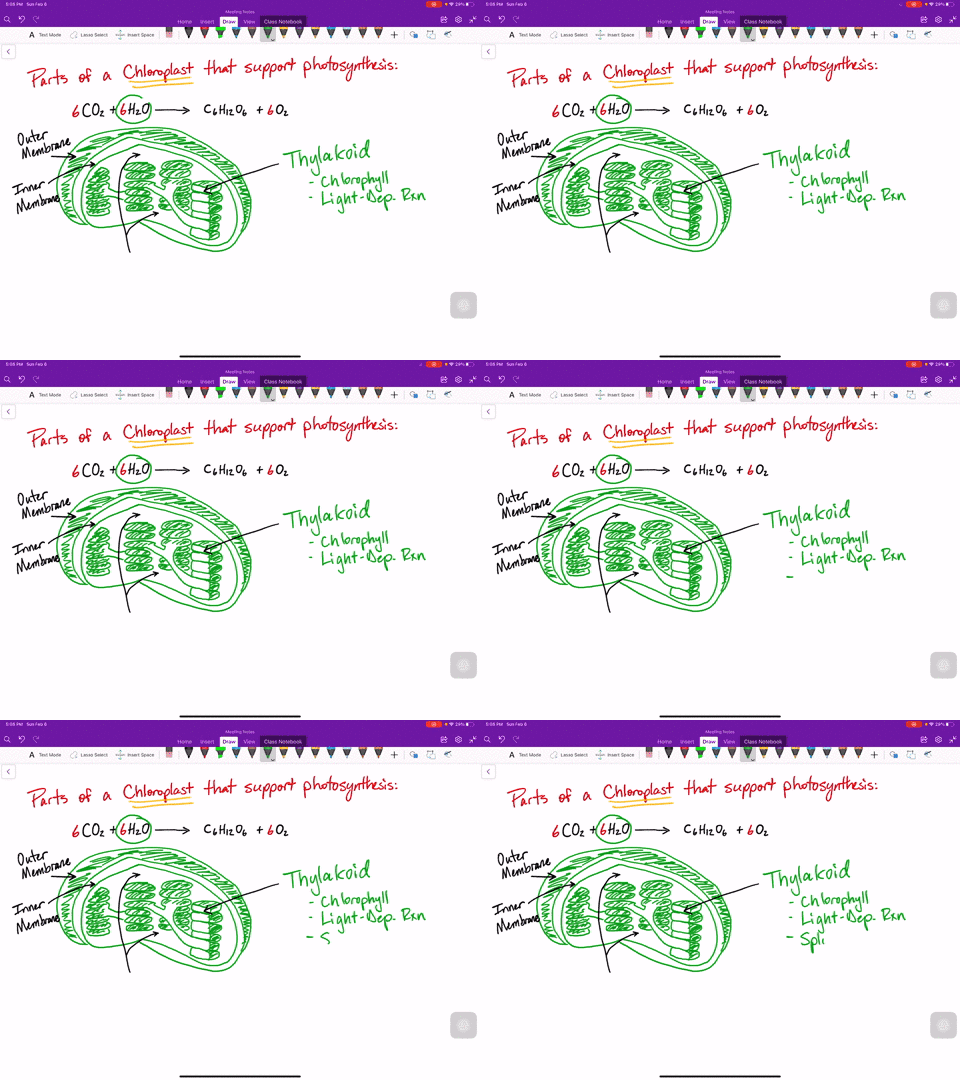
Draw a simplified diagram of a chloroplast and label it. Explain how the individual parts of the chloroplast support photosynthesis.
Explain how photosystems I and II together carry out the light reactions, resulting in energy generation.
Trace the flow of energy in chloroplasts from sunlight to ATP, including an explanation of chemiosmosis.
How does the process of carbon fixation in $\mathrm{C}_{3}$ plants differ from that in $\mathrm{C}_{4}$ plants?
List the characteristics that, taken together, distinguish animals from other kinds of organisms.
Please draw the Punnett squares for all three of the followingsolutions.1. The expected proportions of genotypes and phenotypesfor the offspring of a cross between a woman who is homozygousrecessive and a man who is heterozygous for the Starbucks traitwould be as follows:Cross: Rr x rrF1: Rr, Rr, rr, rra. Genotypes: 50% Rr, 50% rrb. Phenotypes: 50% fan, 50% avoider2. The expected proportions of genotypes and phenotypesfor the offspring of a cross between a woman who is heterozygousand a man who is also heterozygous for the social mediatrait:Cross: Aa x AaF1: AA, Aa, Aa, aaa. Genotypes: 25% AA, 50% Aa, 25% aab. Phenotypes: 75% social media addict, 25% non addict3. The expected proportions of genotypes and phenotypesfor the offspring of a cross between a woman who is homozygousdominant and a man who is homozygous recessive for the channelsurfing syndrome trait would be as follows:Cross: CC x ccF1: Cca. Genotypes: 100% Ccb. Phenotypes: 100% channel surfer
Imagine a very large volcanic eruption occurs, and a 20 km-widelava flow moves into a valley and separates it into two halves. Howmight this affect resident species with regard to allopatricspeciation?1) The lava flow area will cause a geographic barrier thatpromotes speciation among the majority of species populating thearea.2) The lava flow will not cause much allopatric speciation topopulations in the area because species that are present will beable to move across and around the lava flow.3) The effects of the lava flow on speciation will depend on towhat extent the various individuals present at the time can adaptto the new lava in the environment.4) The effect of the lava flow on allopatric speciation willdepend on the identity and traits of the various species present,including their abundance and respective mobility within thevalley.
Define the three types of interactions between organisms (competition, predation, & symbiosis) and give a coral reef example of each.Competition-Predation-Symbiosis-
How does exponential growth differ from logistic growth?Exponential growth is expressed as doubling time, whereas logistic growth is expressed as a percentage change. Exponential growth occurs when the population is at its biotic potential, whereas logistic growth is limited by the carrying capacity of the environment. Exponential growth occurs when the population is very large, whereas logistic growth occurs when the population is at its minimum viable number. Exponential growth results in a J-shaped curve, whereas logistic growth results in an S-shaped curve. R-selected species have exponential growth rates whereas K-selected species always experience logistic growth.
Assuming that the object are on Earth, where acceleration due to gravity is 10N/kg, calculate the gravitational potential energy that they had.