I study galaxies whose mass warps images of more distant galaxies into shapes of bananas!
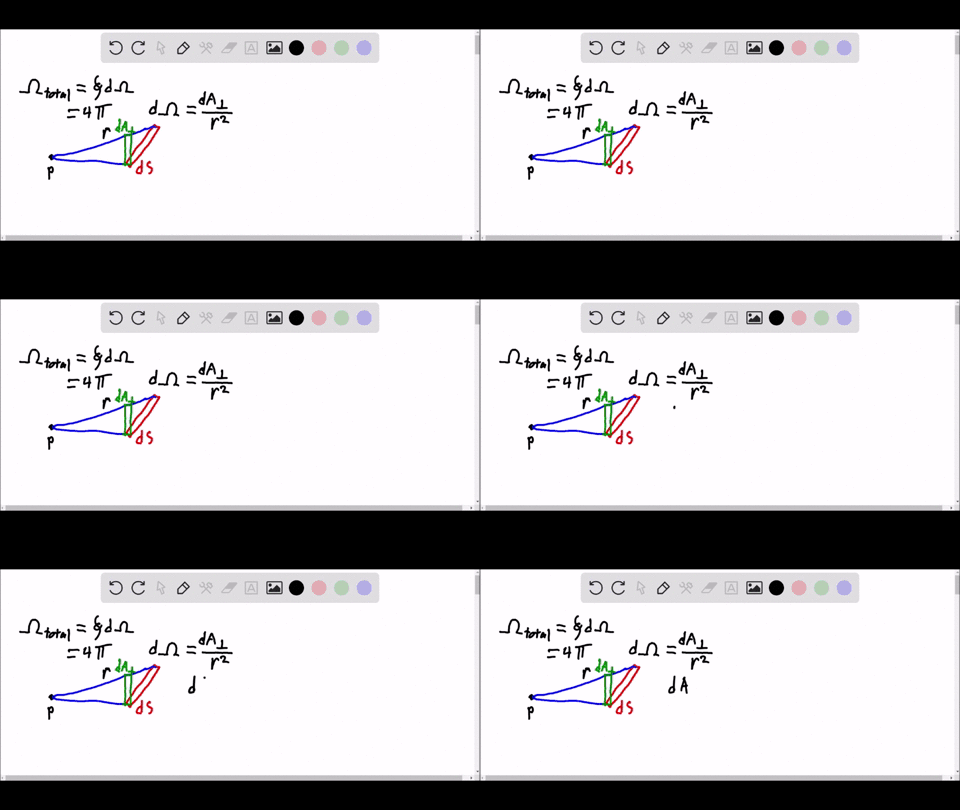
For some point $P$ in space, show that for any arbitrary closed surface surrounding $P$, the integral over a solid angle about $P$ gives$$\Omega_{\mathrm{tot}}=\oint d \Omega=4 \pi$$
The light rays coming from an object do not, in general, travel parallel to the optical axis of a lens or mirror system. Consider an arrow to be the object, located a distance $p$ from the center of a simple converging lens of focal length $f,$ such that $p>f$. Assume that the arrow is perpendicular to the optical axis of the system with the tail of the arrow located on the axis. To locate the image, draw two light rays coming from the tip of the arrow:(i) One ray should follow a path parallel to the optical axis until it strikes the lens. It then bends toward the focal point of the side of the lens opposite the object.(ii) A second ray should pass directly through the center of the lens undeflected. (This assumes that the lens is sufficiently thin.)The intersection of the two rays is the location of the tip of the image arrow. All other rays coming from the tip of the object that pass through the lens will also pass through the image tip. The tail of the image is located on the optical axis, a distance $q$ from the center of the lens. The image should also be oriented perpendicular to the optical axis.(a) Using similar triangles, prove the relation$$\frac{1}{p}+\frac{1}{q}=\frac{1}{f}$$(b) Show that if the distance of the object is much larger than the focal length of the lens $(p \gg f),$ then the image is effectively located on the focal plane. This is essentially always the situation for astronomical observations.The analysis of a diverging lens or a mirror (either converging or diverging) is similar and leads to the same relation between object distance, image distance, and focal length.
Show that if two lenses of focal lengths $f_{1}$ and $f_{2}$ can be considered to have zero physical separation, then the effective focal length of the combination of lenses is$$\frac{1}{f_{\mathrm{eff}}}=\frac{1}{f_{1}}+\frac{1}{f_{2}}$$Note: Assuming that the actual physical separation of the lenses is $x$, this approximation is strictly valid only when $f_{1} \gg x$ and $f_{2} \gg x$
(a) Using the result of Problem $3,$ show that a compound lens system can be constructed from two lenses of different indices of refraction, $n_{1 \lambda}$ and $n_{2 \lambda}$, having the property that the resultant focal lengths of the compound lens at two specific wavelengths $\lambda_{1}$ and $\lambda_{2}$, respectively, can be made equal, or$$f_{\mathrm{eff}, \lambda_{1}}=f_{\mathrm{eff}, \lambda_{2}}$$(b) Argue qualitatively that this condition does not guarantee that the focal length will be constant for all wavelengths.
Prove that the angular magnification of a telescope having an objective focal length of $f_{\mathrm{obj}}$ and an eyepiece focal length of $f_{\text {eye is given by Eq. }}(9)$ when the objective and the eyepiece are separated by the sum of their focal lengths, $f_{\mathrm{obj}}+f_{\mathrm{eye}}$$$m=\frac{f_{\mathrm{obj}}}{f_{\mathrm{eye}}}$$