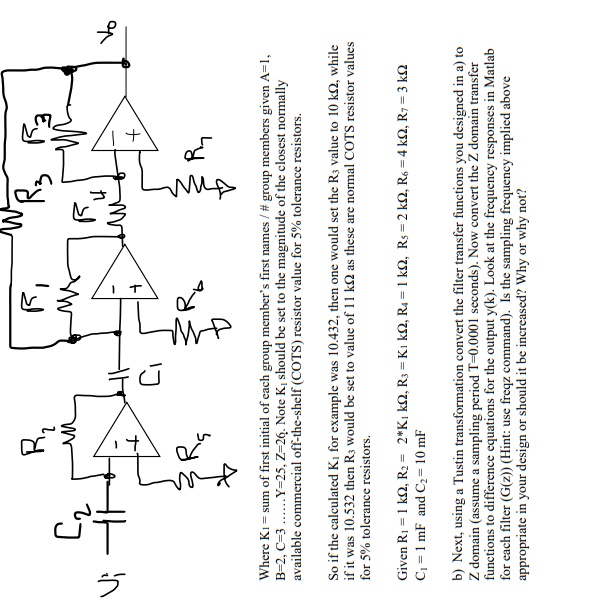
Where K? = sum of first initial of each group member's first names / # group members given A=1,
B=2, C=3 ......Y=25, Z=26. Note K? should be set to the magnitude of the closest normally
available commercial off-the-shelf (COTS) resistor value for 5% tolerance resistors.
So if the calculated K? for example was 10.432, then one would set the R? value to 10 k?, while
if it was 10.532 then R? would be set to value of 11 k? as these are normal COTS resistor values
for 5% tolerance resistors.
Given R? = 1 k?, R? = 2*K? k?, R? = K? k?, R? = 1 k?, R? = 2 k?, R? = 4 k?, R? = 3 k?
C?=1mF and C? = 10 mF
b) Next, using a Tustin transformation convert the filter transfer functions you designed in a) to
Z domain (assume a sampling period T=0.0001 seconds). Now convert the Z domain transfer
functions to difference equations for the output y(k). Look at the frequency responses in Matlab
for each filter (G(z)) (Hint: use freqz command). Is the sampling frequency implied above
appropriate in your design or should it be increased? Why or why not?