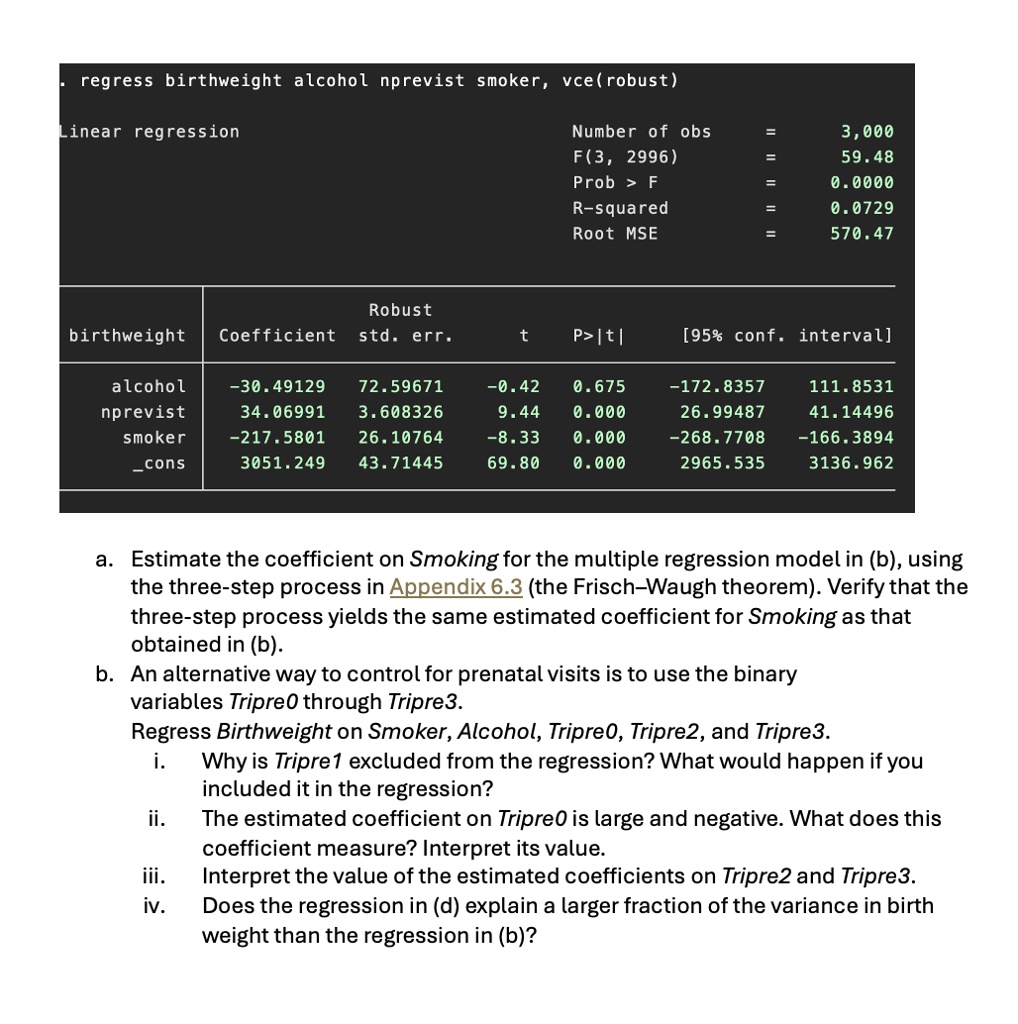
regress birthweight alcohol nprevist smoker, vce (robust)
Linear regression
Number of obs = 3,000
F(3, 2996) = 59.48
Prob > F = 0.0000
R-squared = 0.0729
Root MSE = 570.47
birthweight Robust
Coefficient std. err. t P> | t | [95% conf. interval]
alcohol -30.49129 72.59671 -0.42 0.675 -172.8357 111.8531
nprevist 34.06991 3.608326 9.44 0.000 26.99487 41.14496
smoker -217.5801 26.10764 -8.33 0.000 -268.7708 -166.3894
_cons 3051.249 43.71445 69.80 0.000 2965.535 3136.962
a. Estimate the coefficient on Smoking for the multiple regression model in (b), using
the three-step process in Appendix 6.3 (the Frisch-Waugh theorem). Verify that the
three-step process yields the same estimated coefficient for Smoking as that
obtained in (b).
b. An alternative way to control for prenatal visits is to use the binary
variables Tripre0 through Tripre3.
Regress Birthweight on Smoker, Alcohol, Tripre0, Tripre2, and Tripre3.
i. Why is Tripre1 excluded from the regression? What would happen if you
included it in the regression?
ii. The estimated coefficient on Tripre0 is large and negative. What does this
coefficient measure? Interpret its value.
iii. Interpret the value of the estimated coefficients on Tripre2 and Tripre3.
iv. Does the regression in (d) explain a larger fraction of the variance in birth
weight than the regression in (b)?