Questions asked
-5. Balance the following half reaction in \( \mathrm{BASIC} \) solution: \( \mathrm{ClO}_{2}^{-1} \rightarrow \mathrm{Cl}_{2} \) (basic soln.) 6. Balance the reaction: SHOW ALL WORK!!!!!! \( \mathrm{Br}_{2}+\mathrm{V} \rightarrow \mathrm{Br}^{-1}+\mathrm{V}^{+3} \) 7. For #6, identify the OXIDIZING AGENT Br and the REDUCING AGENT 8. Balance the reaction in ACIDIC solution: \( \mathrm{Cr}^{+3}+\mathrm{Pb}^{+4} \rightarrow \mathrm{Cr}_{2} \mathrm{O}_{7}^{-2}+\mathrm{Pb} \) (acidic soln.)
Ronald Prasad
Numerade educator
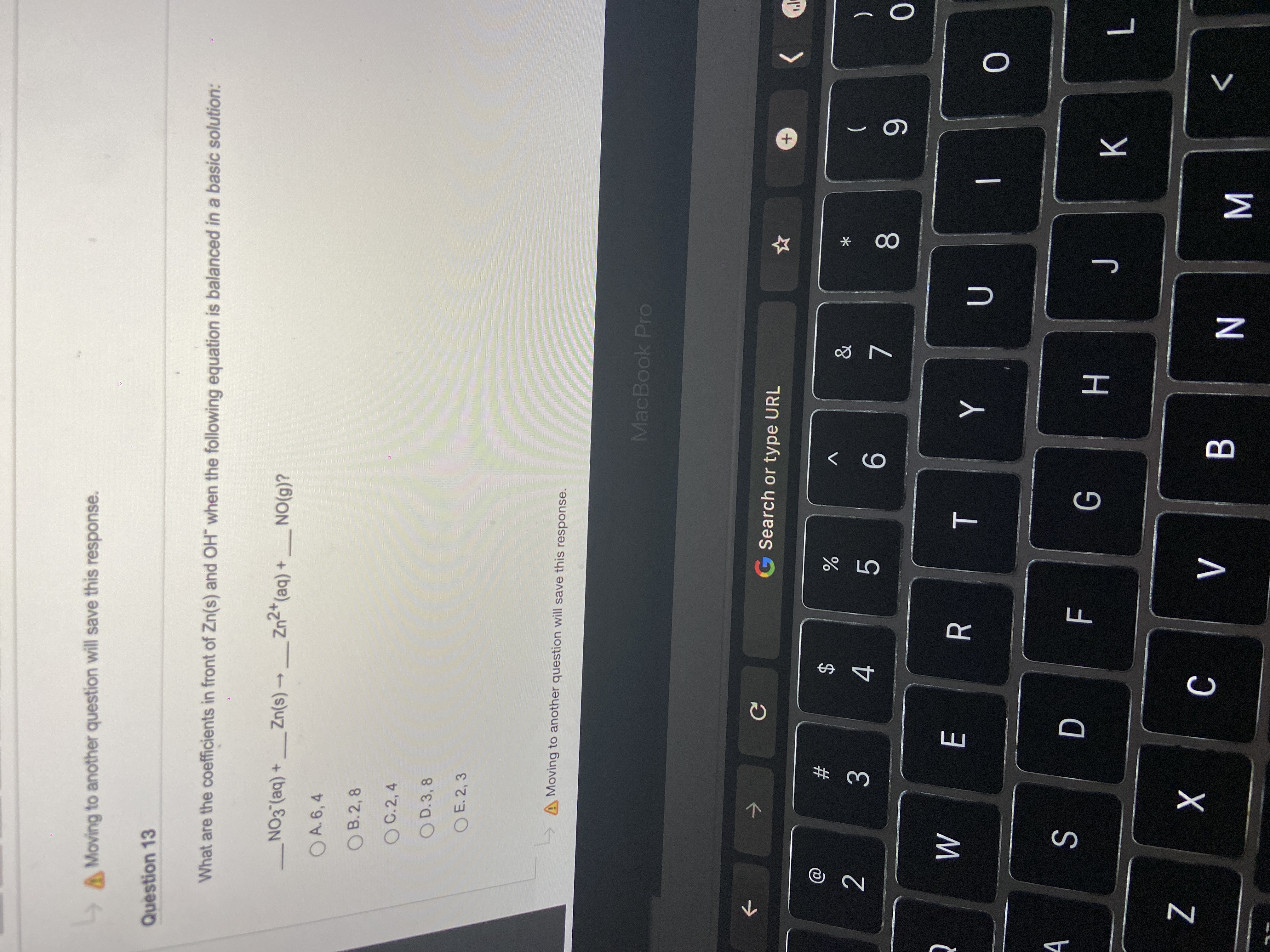
Question 13 What are the coefficients in front of Zn(s) and OH? when the following equation is balanced in a basic solution: ___ NO??(aq) + ___ Zn(s) ? ___ Zn²?(aq) + ___ NO(g)? A. 6, 4 B. 2, 8 C. 2, 4 D. 3, 8 E. 2, 3
What are the coefficients in front of NO3?(aq) and H?(aq) when the following redox equation is balanced in an acidic solution: __ NO3?(aq) + __ Cu(s) ? __ NO(g) + __ Cu²?(aq) A. 2, 6 B. 2, 8 C. 3, 4 D. 2, 3 E. 3, 6
What are the coefficients in front of OCl-(aq) and H2O(l) when the following equation is balanced in an acidic solution: OCl-(aq) + I-(aq) -> Cl-(aq) + I2(aq) A. 1, 1 B. 2, 3 C. 2, 1 D. 1, 8 E. 1, 2
Vishal Sharma
Question 16 In the balanced redox reaction shown below, how many moles of electrons are transferred? PbO + CO ? Pb + CO2 A. 5 B. 1 C. 3 D. 2 E. 4
Rita Devi
Based on the balanced chemical equation shown below, determine the concentration (M) of Fe2+(aq) if 40.00 mL of the Fe2+(aq) solution is required to completely react with 37.63 mL of a 0.125 M bromate, BrO3-(aq), solution. The chemical equation for the reaction is 6 Fe2+(aq) + BrO3-(aq) + 6 H+(aq) -> 6 Fe3+(aq) + Br-(aq) + 3 H2O(l)
A precipitate will form when aqueous Na2SO4 is added to an aqueous solution of ________. A. Cu(NO3)2 B. KI C. Ca(ClO4)2 D. KNO3 E. NaNO3
Sachin Pandey
A 20.0 mL sample of 0.1015 M nitric acid is introduced into a flask, and water is added until the volume of the solution reaches 0.737 L. What is the concentration of nitric acid in the final solution?
If 1.50 mL of a stock solution of 12.0 M HCl is diluted to 25.0 mL, what is the new concentration? A. 200. M B. 3.10 M C. 0.450 M D. 0.720 M E. 0.500 M
Mahendra Rathore
Nitrogen reacts with hydrogen to form ammonia as shown in the reaction below: N2(g) + 3H2(g) equation 2 NH3(g) When 15 g of nitrogen reacts with excess hydrogen, 16.82 g of ammonia was produced. What is the % yield? A. 54% B. 87% C. 92% D. 46% E. 20%