3. The Eyring rate model for solid flow can be used to describe polymer yielding at different
strain rates, $\dot{\epsilon}$, as
$$\dot{\epsilon} = \dot{\epsilon}_0 \exp \left[ \frac{-\Delta H + \sigma_s V^*}{RT} \right]$$
where $\dot{\epsilon}_0$= pre-exponential constant, $\Delta H$ = activation enthalpy, $\sigma_s$ = shear stress, $V^*$ =
activation volume, R= gas constant = 8.31 J/(mol-K), and T = absolute temperature.
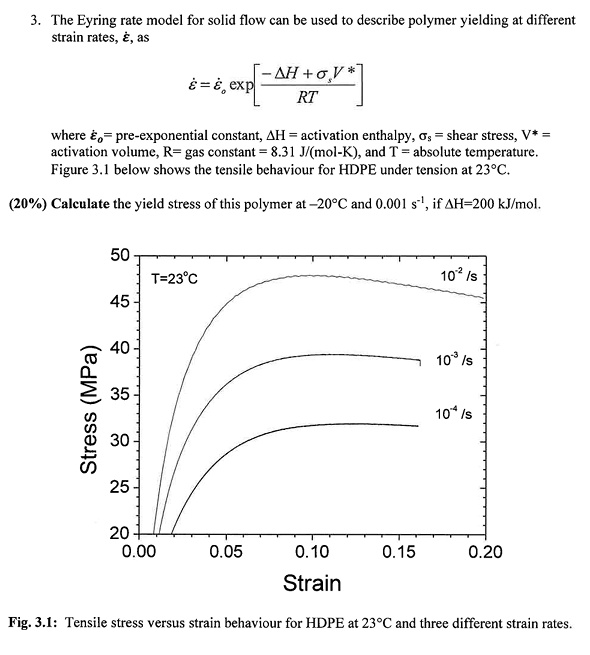
Figure 3.1 below shows the tensile behaviour for HDPE under tension at 23°C.
(20%) Calculate the yield stress of this polymer at -20°C and 0.001 s$^{-1}$, if $\Delta H$=200 kJ/mol.
Stress (MPa)
50
T=23°C
10$^{-2}$ /s
45
40
10$^{-3}$ /s
35
10$^{-4}$ /s
30
25
20
0.00
0.05
0.10
0.15
0.20
Strain
Fig. 3.1: Tensile stress versus strain behaviour for HDPE at 23°C and three different strain rates.