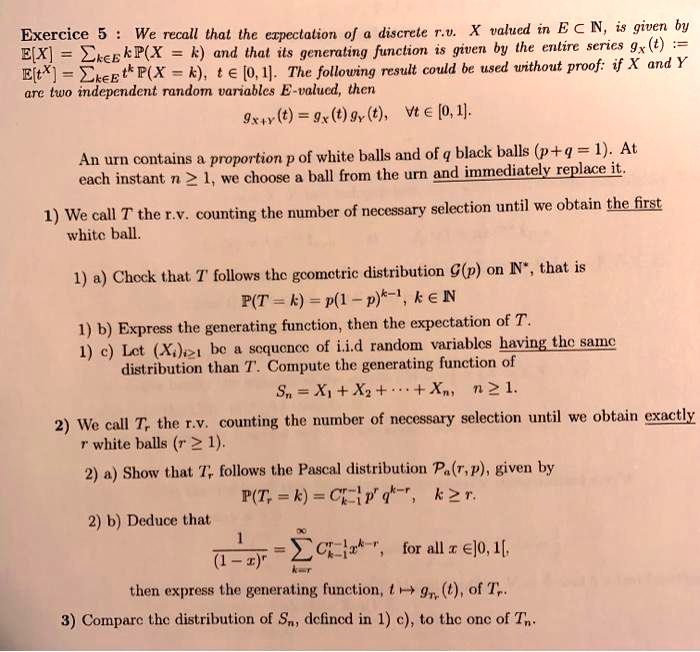
E[] = keEtPX = k, te [0,1]. The following result could be used without proof: if X and Y are two independent random variables E-valued, then 9x + yt = gxtgytVt [0,1]. An urn contains a proportion p of white balls and q black balls, where p + q = 1. At each instant n > 1, we choose a ball from the urn and immediately replace it. We call T the r.v. counting the number of necessary selections until we obtain the first white ball.
1a. Check that T follows the geometric distribution Gp on N, that is PT = k = p(1-p)^(k-1) for k ∈ N.
1b. Express the generating function, then the expectation of T.
1c. Let X be a sequence of i.i.d random variables having the same distribution as T. Compute the generating function of S = X + X + ... + X (n times).
2. We call T' the r.v. counting the number of necessary selections until we obtain exactly r white balls.
2a. Show that T' follows the Pascal distribution Pr,p), given by PT' = k = C(p+q-1, r-1) * p^r * q^(k-r).
2b. Deduce the generating function of T.
3. Compare the distribution of S defined in 1c to the one of T.