Ace - AI Tutor
Ask Our Educators
Textbooks
My Library
Flashcards
Scribe - AI Notes
Notes & Exams
Download App
david martin

david m.

Divider

Questions asked

BEST MATCH

An electron moves at a velocity of 7.34 x 10^6 m/s in a direction perpendicular to a magnetic field of strength 3.74 T. How much force will the electron experience? Question 8 options: 1.76E-12 N 5.71E-12 N 7.02E-12 N 4.39E-12 N

View Answer
divider
BEST MATCH

using literary devices, In Olsen's "I Stand Here Ironing," identify three memories that are sad for the mother as she thinks over daughter Emily's childhood. Why would the mother only focus on those unhappy memories? In Olsen's "I Stand Here Ironing," identify three memories that are sad for the mother as she thinks over daughter Emily's childhood. Why would the mother only focus on those unhappy memories?

View Answer
divider
BEST MATCH

Which of the following is NOT a key service victim advocates provide to victims? Therapeutic counseling Information and education Direct advocacy Safety assessment

View Answer
divider
BEST MATCH

Question 14 Suppose we are investigating max./min. behavior of a function f. We intend using the first derivative test, and have gleaned the following information in preparation for applying the test. Interval Test value Sign behavior of f of f of f x .2 f-10=0.5 + 2,0 f-1=-3 - 0,2 f1=2 + 2,00 f5>0 + Apply the first derivative using the information in the table to select the appropriate conclusion for each critical point. x=-2 A. not a critical point B. neither a local min. nor a local max x=0 C. absolute minimum x=2 D. local minimum E. local maximum F. absolute maximum

View Answer
divider
BEST MATCH

Which of the following exists when price inflation is both high and accelerating? Responses underinflation underinflation debt deflation debt deflation hyperinflation hyperinflation price stability price stability

View Answer
divider
BEST MATCH

Suppose you are a physician or genetic counselor. Your patient has a family history of Huntington's disease. You collect a sample of the patient's cheek cells and send the sample off for genetic testing using PCR primers that will amplify base pairs 60 to 240 of the sequence shown. Note: Your patient may have fewer or more CAG repeats in this region, but the sequence is otherwise the same. If the PCR products made using your patient's DNA as a template are 186 and 276 base pairs long, what would you tell your patient about the likelihood of developing Huntington's disease? Multiple Choice The patient has two mutant alleles and will develop the disease at an early age. The patient has one wild-type and one mutant allele with fewer than 100 repeats. This person will develop the disease at a late age. The patient has one wild-type and one mutant allele with over 100 repeats. This person will develop the disease at an early age. The patient has two wild-type alleles and will not develop the disease. The patient has one wild-type and one mutant allele. This person is a carrier but will not develop the disease. Suppose you are a physician or genetic counselor. Your patient has a family history of Huntington's disease. You collect a sample of the patient's cheek cells and send the sample off for genetic testing using PCR primers that will amplify base pairs 60 to 240 of the sequence shown. Note that your patient may have fewer or more CAG repeats in this region, but the sequence is otherwise the same. If the PCR using your patient's DNA as a template produces two DNA fragments that are 177 and 192 base pairs long, what would you tell your patient about the likelihood of developing Huntington's disease? Multiple Choice The patient has one wild-type and one mutant allele. This person is a carrier but will not develop the disease. The patient has one wild-type and one mutant allele with fewer than 100 repeats. This person will develop the disease at a late age. The patient has two mutant alleles and will develop the disease at an early age. The patient has two wild-type alleles and will not develop the disease. The patient has one wild-type and one mutant allele with over 100 repeats. This person will develop the disease at an early age.

View Answer
divider
BEST MATCH

??9 The expected rate of change in the nominal dollar/euro exchange rate is best described as ??????? the expected rate of change in the real dollar/euro exchange rate plus the U.S.-Europe real interest rate difference. the expected rate of change in the real dollar/euro exchange rate minus the U.S.-Europe real interest rate difference. the expected rate of change in the real dollar/euro exchange rate plus the European expected inflation. the expected rate of change in the real dollar/euro exchange rate minus the U.S.-Europe expected inflation difference. the expected rate of change in the real dollar/euro exchange rate plus the U.S.-Europe expected inflation difference.

View Answer
divider
BEST MATCH

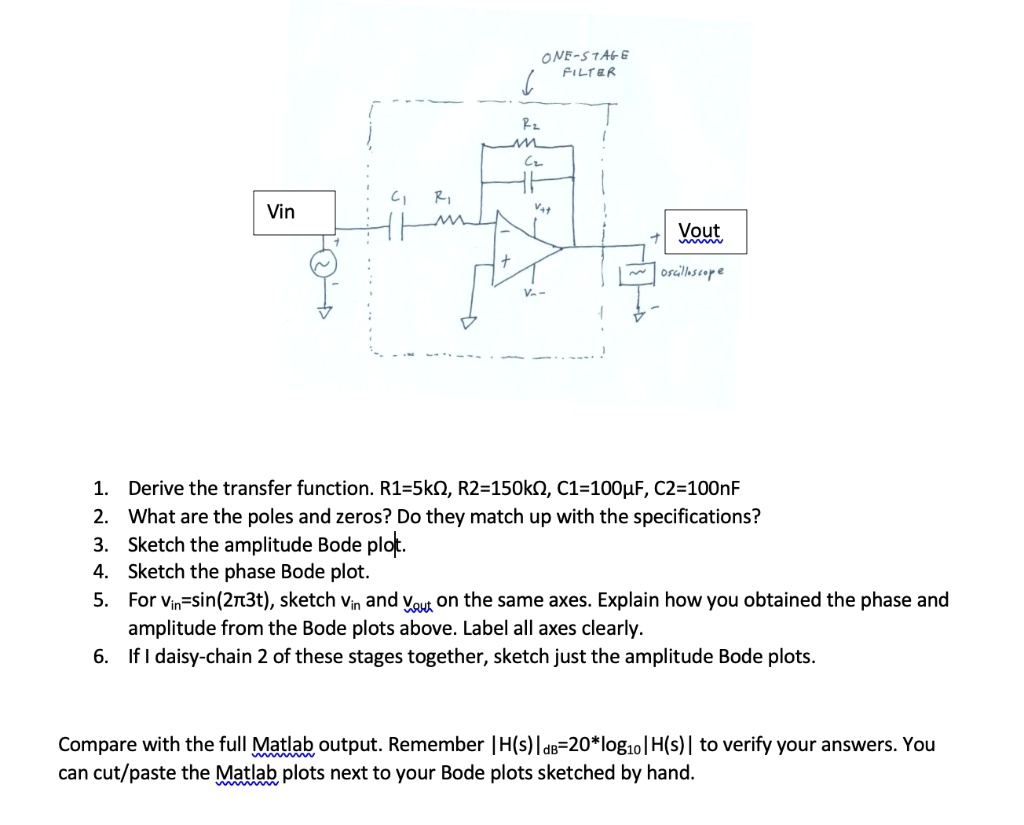
ONE-STAGE FILTER ? R2 M Cz C1 R1 Vin Vat Vout + Oscilloscope V-- 1. Derive the transfer function. R1=5k?, R2=150k?, C1=100µF, C2=100nF 2. What are the poles and zeros? Do they match up with the specifications? 3. Sketch the amplitude Bode plot. 4. Sketch the phase Bode plot. 5. For $V_{in}$=sin(2?3t), sketch $v_{in}$ and $v_{out}$ on the same axes. Explain how you obtained the phase and amplitude from the Bode plots above. Label all axes clearly. 6. If I daisy-chain 2 of these stages together, sketch just the amplitude Bode plots. Compare with the full Matlab output. Remember $|H(s)|_{dB} = 20 \times \log_{10} |H(s)|$ to verify your answers. You can cut/paste the Matlab plots next to your Bode plots sketched by hand.
View Answer
divider
BEST MATCH

Chapter 4, Practice Problem 4/09 A pair of 85-N forces is applied to the handles of the small eyelet squeezer. The block at A slides with negligible friction in a slot machined in the lower part of the tool. Neglect the small force of the light return spring AE and determine the compressive force $P$ applied to the eyelet. Answer: $P = ext{____} N$

View Answer
divider
BEST MATCH

The decimal reduction time D for a spore suspension was measured at 104°C and at 113°C, and the D values were 23 minutes and 3.5 minutes, respectively. What is the thermal resistance constant z for the spores? z = (T2 - T1) / (log(DT1) - log(DT2))

View Answer
divider