Ace - AI Tutor
Ask Our Educators
Textbooks
My Library
Flashcards
Scribe - AI Notes
Notes & Exams
Download App
Vic Jhon

Vic J.

Divider

Viewed Questions

The instantaneous sinusoidal emf from an ac generator with an mos emf of $4.0 \mathrm{V}$ oscillates between what values?

The instantaneous sinusoidal emf from an ac generator with an mos emf of $4.0 \mathrm{V}$ oscillates between what values?

Physics

The density of mercury at exactly $0{ }^{\circ} \mathrm{C}$ is $13600 \mathrm{~kg} / \mathrm{m}^{3}$, and its volume expansion coefficient is $1.82 \times 10^{-4}{ }^{\circ} \mathrm{C}^{-1}$. Calculate the density of mercury at $50.0{ }^{\circ} \mathrm{C}$.
Let $$\begin{array}{c} \rho_{0}=\text { Density of mercury at } 0^{\circ} \mathrm{C} \\ \rho_{1}=\text { Density of mercury at } 50^{\circ} \mathrm{C} \\ V_{0}=\text { Volume of } m \mathrm{~kg} \text { of mercury at } 0{ }^{\circ} \mathrm{C} \\ V_{1}=\text { Volume of } m \mathrm{~kg} \text { of mercury at } 50^{\circ} \mathrm{C} \end{array} $$ Since the mass does not change, $m=\rho_{0} V_{0}=\rho_{1} V_{1}$, from which itfollows that But $$ \begin{array}{c} \rho_{1}=\rho_{0} \frac{V_{0}}{V_{1}}=\rho_{0} \frac{V_{0}}{V_{0}+\Delta V}=\rho_{0} \frac{1}{1+\left(\Delta V / V_{0}\right)} \\
\frac{\Delta V}{V_{0}}=\beta \Delta T=\left(1.82 \times 10^{-4 \circ} \mathrm{C}^{-1}\right)\left(50.0^{\circ} \mathrm{C}\right)=0.00910
\end{array}
$$
Substitution into the first equation yields
$$
\rho_{1}=\left(13600 \mathrm{~kg} / \mathrm{m}^{3}\right) \frac{1}{1+0.00910}=13.5 \times 10^{3} \mathrm{~kg} / \mathrm{m}^{3}
$$

The density of mercury at exactly $0{ }^{\circ} \mathrm{C}$ is $13600 \mathrm{~kg} / \mathrm{m}^{3}$, and its volume expansion coefficient is $1.82 \times 10^{-4}{ }^{\circ} \mathrm{C}^{-1}$. Calculate the density of mercury at $50.0{ }^{\circ} \mathrm{C}$. Let $$\begin{array}{c} \rho_{0}=\text { Density of mercury at } 0^{\circ} \mathrm{C} \\ \rho_{1}=\text { Density of mercury at } 50^{\circ} \mathrm{C} \\ V_{0}=\text { Volume of } m \mathrm{~kg} \text { of mercury at } 0{ }^{\circ} \mathrm{C} \\ V_{1}=\text { Volume of } m \mathrm{~kg} \text { of mercury at } 50^{\circ} \mathrm{C} \end{array} $$ Since the mass does not change, $m=\rho_{0} V_{0}=\rho_{1} V_{1}$, from which itfollows that But $$ \begin{array}{c} \rho_{1}=\rho_{0} \frac{V_{0}}{V_{1}}=\rho_{0} \frac{V_{0}}{V_{0}+\Delta V}=\rho_{0} \frac{1}{1+\left(\Delta V / V_{0}\right)} \\ \frac{\Delta V}{V_{0}}=\beta \Delta T=\left(1.82 \times 10^{-4 \circ} \mathrm{C}^{-1}\right)\left(50.0^{\circ} \mathrm{C}\right)=0.00910 \end{array} $$ Substitution into the first equation yields $$ \rho_{1}=\left(13600 \mathrm{~kg} / \mathrm{m}^{3}\right) \frac{1}{1+0.00910}=13.5 \times 10^{3} \mathrm{~kg} / \mathrm{m}^{3} $$

Schaum’s Outline of College Physics

Find the pressure due to the fluid at a depth of $76 \mathrm{~cm}$ in still $(a)$ water $\left(\rho_{w}=1.00 \mathrm{~g} / \mathrm{cm}^{3}\right)$ and $(b)$ mercury $\left(\rho=13.6 \mathrm{~g} / \mathrm{cm}^{3}\right)$.
(a) $P=\rho_{w} g h=\left(1000 \mathrm{~kg} / \mathrm{m}^{3}\right)\left(9.81 \mathrm{~m} / \mathrm{s}^{2}\right)(0.76 \mathrm{~m})=7450 \mathrm{~N} / \mathrm{m}^{2}=$
$7.5 \mathrm{kPa}$
(b) $P=\rho g h=(13600 \mathrm{~kg})\left(9.81 \mathrm{~m} / \mathrm{s}^{2}\right)(0.76 \mathrm{~m})=1.01 \times 10^{5} \mathrm{~N} / \mathrm{m}^{2} \approx$
$1.0$ atm

Find the pressure due to the fluid at a depth of $76 \mathrm{~cm}$ in still $(a)$ water $\left(\rho_{w}=1.00 \mathrm{~g} / \mathrm{cm}^{3}\right)$ and $(b)$ mercury $\left(\rho=13.6 \mathrm{~g} / \mathrm{cm}^{3}\right)$. (a) $P=\rho_{w} g h=\left(1000 \mathrm{~kg} / \mathrm{m}^{3}\right)\left(9.81 \mathrm{~m} / \mathrm{s}^{2}\right)(0.76 \mathrm{~m})=7450 \mathrm{~N} / \mathrm{m}^{2}=$ $7.5 \mathrm{kPa}$ (b) $P=\rho g h=(13600 \mathrm{~kg})\left(9.81 \mathrm{~m} / \mathrm{s}^{2}\right)(0.76 \mathrm{~m})=1.01 \times 10^{5} \mathrm{~N} / \mathrm{m}^{2} \approx$ $1.0$ atm

Schaum’s Outline of College Physics

An object weighing 600 newtons is pulled up a frictionless incline at a constant speed. If the incline makes an angle of $30^{\circ}$ with the horizontal, the force on the object parallel to the incline is
(A) $200 \mathrm{~N}$
(B) $300 \mathrm{~N}$
(C) $520 \mathrm{~N}$
(D) $600 \mathrm{~N}$

An object weighing 600 newtons is pulled up a frictionless incline at a constant speed. If the incline makes an angle of $30^{\circ}$ with the horizontal, the force on the object parallel to the incline is (A) $200 \mathrm{~N}$ (B) $300 \mathrm{~N}$ (C) $520 \mathrm{~N}$ (D) $600 \mathrm{~N}$

Let's Review Regents: Physics—Physical Setting

Questions asked

ANSWERED

Khoobchandra Agrawal verified

Numerade educator

Find the total field force at (0, 0, 5) m due to Q1 = 0.35 ?C at (0, 4, 0) m and Q2 = -0.55 ?C at (3, 0, 0) m

View Answer
divider
ANSWER IN PROGRESS

3. Find the total field fore ot \( (0,0,5) \mathrm{m} \) due to \( Q_{1}=0.35 \mu \mathrm{C} \) at \( (0,4,0) \mathrm{m} \) and \( Q_{2}=-0.55 \mu C \) at \( (3,0,0) \mathrm{m} \)

View Answer
divider
INSTANT ANSWER

Problem #5: When a pressure of 300 psi us applied to a mercury sample, it contracts by \( 0.008 \) percent. Find the bulk modulus of mercury.

View Answer
divider
ANSWERED

Supratim Pal verified

Numerade educator

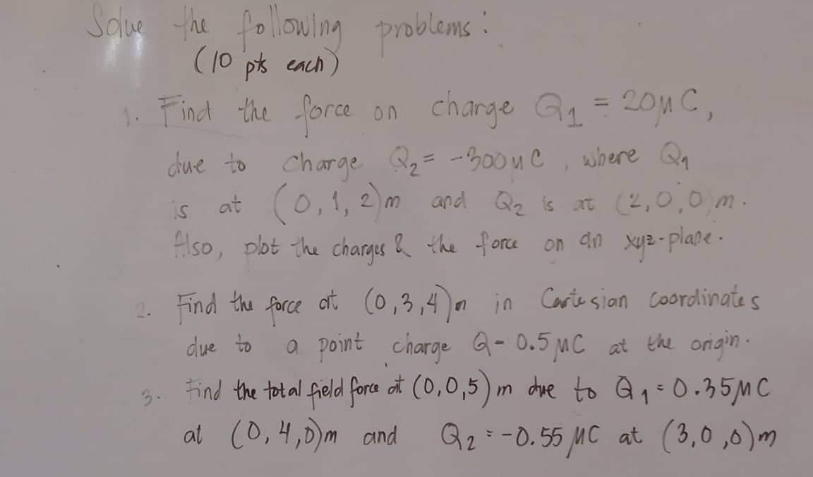
Solve the following problems: (10 pts each) 1. Find the force on charge Q1 = 20?C, due to charge Q2 = -300?C , where Q1 is at (0, 1, 2)m and Q2 is at (2, 0, 0)m. Also, plot the charges & the force on an xyz-plane. 2. Find the force at (0, 3, 4)m in Cartesian coordinates due to a point charge Q = 0.5?C at the origin. 3. Find the total field force at (0, 0, 5)m due to Q1 = 0.35?C at (0, 4, 0)m and Q2 = -0.55?C at (3, 0, 0)m
View Answer
divider
ANSWERED

Melissa Walsh verified

Numerade educator

An impulse d 300 N-s is applied to a 50 kg mass. If the mass had a speed at 100m/s before the impulse, its speed after the impulse could be?

View Answer
divider
ANSWERED

Keondre Parker verified

Numerade educator

A concrete pavement on a street would cost $10,000 and would last for 5 years with negligible repairs. At the end of each 5 years, $1000 would be spent to remove the old surface before $10,000 is spent again to lay a new surface. Find the capitalized cost of the pavement at 5% Interest rate. Use sinking fund method in computing annual deprecation.

View Answer
divider
ANSWERED

Rahul Mahato verified

Numerade educator

A man was offered a bond certificate with a face value $100,000 which is bearing interest of 6% per year payable semi-anually and due in 6 years. If he wants to earn 8% semi-annually, how much must he pay the certificate?

View Answer
divider
ANSWERED

Brooke Bussoletti verified

Numerade educator

To develop an oil well containing 2,000,000 barrels of required an Initial Investment of $30,000,000. In a certain year, 0,000 barrels of oil were produced from this well. Determine the depletion charge during the year.

View Answer
divider
INSTANT ANSWER

A company purchased a machine for $30,000, used for 5 years and then sold it for $10,000. If capital is worth 8%, determine the annual cost. Use sinking fund method for depreciation analysis

View Answer
divider
INSTANT ANSWER

A concrete pavement on a street would cost $10,000 and would last for 5 years with negligible repairs. At the end of each 5 years, $1000 would be spent to remove the old surface before $10,000 is spent again to lay a new surface. Find the capitalized cost of the pavement at 5% Interest rate. Use sinking fund method in computing annual deprecation.

View Answer
divider