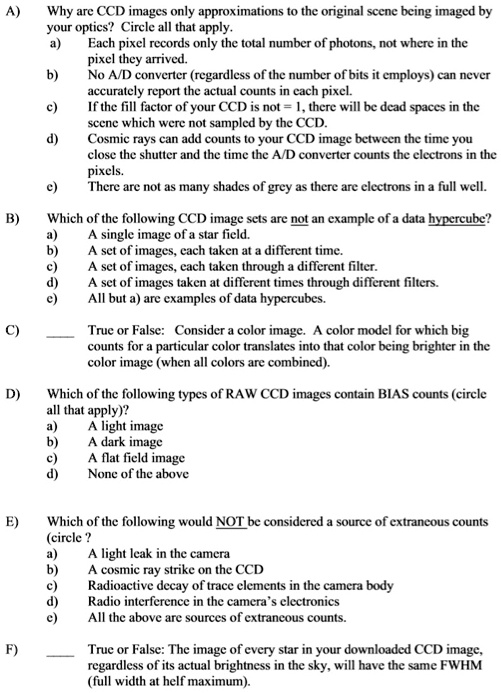
A) Why are CCD images only approximations to the original scene being imaged by
your optics? Circle all that apply.
a) Each pixel records only the total number of photons, not where in the
pixel they arrived.
b) No A/D converter (regardless of the number of bits it employs) can never
accurately report the actual counts in each pixel.
c) If the fill factor of your CCD is not = 1, there will be dead spaces in the
scene which were not sampled by the CCD.
d) Cosmic rays can add counts to your CCD image between the time you
close the shutter and the time the A/D converter counts the electrons in the
pixels.
e) There are not as many shades of grey as there are electrons in a full well.
B) Which of the following CCD image sets are not an example of a data hypercube?
a) A single image of a star field.
b) A set of images, each taken at a different time.
c) A set of images, each taken through a different filter.
d) A set of images taken at different times through different filters.
e) All but a) are examples of data hypercubes.
C) True or False: Consider a color image. A color model for which big
counts for a particular color translates into that color being brighter in the
color image (when all colors are combined).
D) Which of the following types of RAW CCD images contain BIAS counts (circle
all that apply)?
a) A light image
b) A dark image
c) A flat field image
d) None of the above
E) Which of the following would NOT be considered a source of extraneous counts
(circle?
a) A light leak in the camera
b) A cosmic ray strike on the CCD
c) Radioactive decay of trace elements in the camera body
d) Radio interference in the camera's electronics
e) All the above are sources of extraneous counts.
F) True or False: The image of every star in your downloaded CCD image,
regardless of its actual brightness in the sky, will have the same FWHM
(full width at helf maximum).