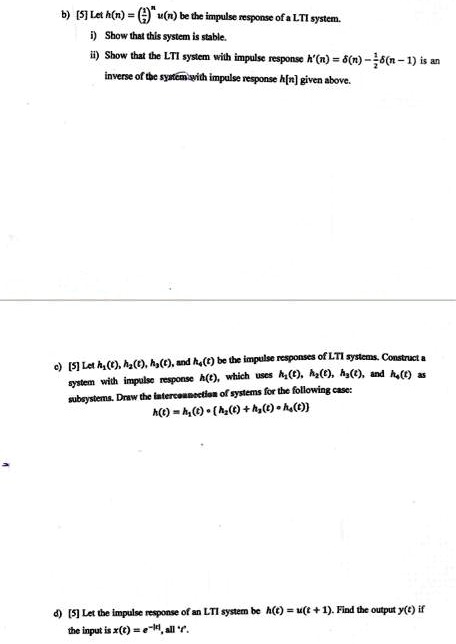
b) [5] Let $h(n) = (\frac{1}{2})^n u(n)$ be the impulse response of a LTI system.
i) Show that this system is stable.
ii) Show that the LTI system with impulse response $h'(n) = \delta(n) - \frac{1}{2}\delta(n-1)$ is an
inverse of the system with impulse response $h[n]$ given above.
c) [5] Let $h_1(t)$, $h_2(t)$, $h_3(t)$, and $h_4(t)$ be the impulse responses of LTI systems. Construct a
system with impulse response $h(t)$, which uses $h_1(t)$, $h_2(t)$, $h_3(t)$, and $h_4(t)$ as
subsystems. Draw the interconnection of systems for the following case:
$h(t) = h_1(t) \cdot (h_2(t) + h_3(t) \cdot h_4(t))$
d) [5] Let the impulse response of an LTI system be $h(t) = u(t+1)$. Find the output $y(t)$ if
the input is $x(t) = e^{-t}$, all $t$.