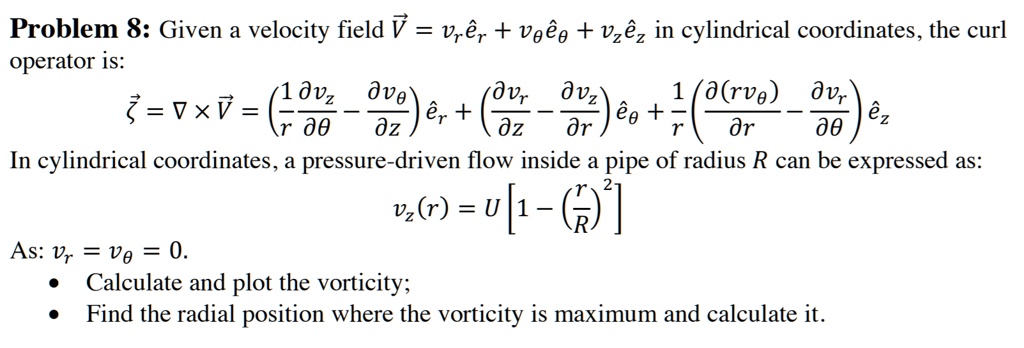
Problem 8: Given a velocity field \(\vec{V} = v_r \hat{e}_r + v_\theta \hat{e}_\theta + v_z \hat{e}_z\) in cylindrical coordinates, the curl
operator is:
\(\vec{\zeta} = \nabla \times \vec{V} = \left(\frac{1}{r}\frac{\partial v_z}{\partial \theta} - \frac{\partial v_\theta}{\partial z}\right)\hat{e}_r + \left(\frac{\partial v_r}{\partial z} - \frac{\partial v_z}{\partial r}\right)\hat{e}_\theta + \frac{1}{r}\left(\frac{\partial (r v_\theta)}{\partial r} - \frac{\partial v_r}{\partial \theta}\right)\hat{e}_z
\)
In cylindrical coordinates, a pressure-driven flow inside a pipe of radius R can be expressed as:
\(v_z(r) = U\left[1 - \left(\frac{r}{R}\right)^2\right]
\)
As: \(v_r = v_\theta = 0\).
• Calculate and plot the vorticity;
• Find the radial position where the vorticity is maximum and calculate it.