Ace - AI Tutor
Ask Our Educators
Textbooks
My Library
Flashcards
Scribe - AI Notes
Notes & Exams
Download App
IBRAHIM ALHAWARI

IBRAHIM A.

Divider

Viewed Questions

Butane $\left(C_{4} H_{10}\right)$ is burned in 200 percent theoretical air. For complete combustion, how many $\mathrm{kmol}$ of water must be sprayed into the combustion chamber per $\mathrm{kmol}$ of fuel if the products of combustion are to have a dew-point temperature of $60^{\circ} \mathrm{C}$ when the product pressure is $100 \mathrm{kPa} ?$

Butane $\left(C_{4} H_{10}\right)$ is burned in 200 percent theoretical air. For complete combustion, how many $\mathrm{kmol}$ of water must be sprayed into the combustion chamber per $\mathrm{kmol}$ of fuel if the products of combustion are to have a dew-point temperature of $60^{\circ} \mathrm{C}$ when the product pressure is $100 \mathrm{kPa} ?$

Thermodynamics: An Engineering Approach

A certain natural gas has the following volumetric analysis: 65 percent $\mathrm{CH}_{4}, 8$ percent $\mathrm{H}_{2}, 18$ percent $\mathrm{N}_{2}, 3$ percent $\mathrm{O}_{2},$ and 6 percent $\mathrm{CO}_{2} .$ This gas is now burned completely with the stoichiometric amount of dry air. What is the air-fuel ratio for this combustion process?

Thermodynamics: An Engineering Approach

In a combustion chamber, ethane $\left(\mathrm{C}_{2} \mathrm{H}_{6}\right)$ is burned at a rate of $8 \mathrm{~kg} / \mathrm{h}$ with air that enters the combustion chamber at a rate of $176 \mathrm{~kg} / \mathrm{h}$. Determine the percentage of excess air used during this process.

Thermodynamics: An Engineering Approach

A gas turbine for an automobile is designed with a regenerator. Air enters the compressor of this engine at $100 \mathrm{kPa}$ and $30^{\circ} \mathrm{C}$. The compressor pressure ratio is 8 ; the maximum cycle temperature is $800^{\circ} \mathrm{C}$; and the cold airstream leaves the regenerator $10^{\circ} \mathrm{C}$ cooler than the hot airstream at the inlet of the regenerator. Assuming both the compressor and the turbine to be isentropic, determine the rates of heat addition and rejection for this cycle when it produces $115 \mathrm{~kW}$. Use constant specific heats at room temperature.

A gas turbine for an automobile is designed with a regenerator. Air enters the compressor of this engine at $100 \mathrm{kPa}$ and $30^{\circ} \mathrm{C}$. The compressor pressure ratio is 8 ; the maximum cycle temperature is $800^{\circ} \mathrm{C}$; and the cold airstream leaves the regenerator $10^{\circ} \mathrm{C}$ cooler than the hot airstream at the inlet of the regenerator. Assuming both the compressor and the turbine to be isentropic, determine the rates of heat addition and rejection for this cycle when it produces $115 \mathrm{~kW}$. Use constant specific heats at room temperature.

Thermodynamics: An Engineering Approach

Questions asked

INSTANT ANSWER

PROBLEM 3.154 \( 3.154 \) In the bevel-gear system shown \( \alpha=18.43^{\circ} \). Knowing that the allowable shearing stress is \( 55 \mathrm{MPa} \) in each shaft, determine the largest torque \( \mathbf{T}_{A} \) which may be applied at \( A \). SOLUTION Shaft \( A \) : \[ \begin{aligned} \tau & =55 \mathrm{MPa} \quad c=\frac{1}{2} d=6 \mathrm{~mm} \\ T_{A} & =\frac{J \tau}{c}=\frac{\pi}{2} c^{3} \tau=\frac{\pi}{2}(0.006)^{3}\left(55 \times 10^{6}\right)=18.66 \mathrm{~N} \cdot \mathrm{m} \end{aligned} \] Shaft \( B: \quad \tau=55 \mathrm{MPa} \quad c=\frac{1}{2} d=8 \mathrm{~mm} \) \[ T_{B}=\frac{J \tau}{c}=\frac{\pi}{2} c^{3} \tau=\frac{\pi}{2}(0.008)^{3}\left(55 \times 10^{6}\right)=44.23 \mathrm{~N} \cdot \mathrm{m} \] From Statics: \( T_{A}=\frac{r_{A}}{r_{B}} T_{B}=(\tan \alpha) T_{B}=\left(\tan 18.43^{\circ}\right)(44.23) \) \[ =14.74 \mathrm{~N} \cdot \mathrm{m} \] Allowable value of \( T_{A} \) is the smaller \[ T_{A}=14.74 \mathrm{~N} \cdot \mathrm{m} \]

View Answer
divider
INSTANT ANSWER

PROBLEM 3.130 Shafts \( A \) and \( B \) are made of the same material and have the same crosssectional area, but \( A \) has a circular cross section and \( B \) has a square cross section. Determine the ratio of the maximum torques \( T_{A} \) and \( T_{B} \) when the two shafts are subjected to the same maximum shearing stress \( \left(\tau_{A}=\tau_{B}\right) \). Assume both deformations to be elastic. SOLUTION Let \( c= \) radius of circular section \( A \) and \( b= \) side of square section \( B \). For equal areas \( \pi c^{2}=b^{2} \) \[ c=\frac{b}{\sqrt{\pi}} \] Circle: \[ \tau_{A}=\frac{T_{A} c}{J}=\frac{2 T_{A}}{\pi c^{3}} \quad \therefore \quad T_{A}=\frac{\pi}{2} c^{3} \tau_{A} \] Square: From Table 3.1, Ratio: \[ \begin{aligned} c_{1} & =0.208 \\ \tau_{B} & =\frac{T_{A}}{c_{1} a b^{2}}=\frac{T_{B}}{c_{1} b^{3}} \quad \therefore \quad T_{B}=c_{1} b^{3} \tau_{B} \\ \frac{T_{A}}{T_{B}} & =\frac{\frac{\pi}{2} c^{3} \tau_{B}}{c_{1} b^{3} \tau_{B}}=\frac{\frac{\pi}{2} \cdot \frac{b^{3}}{\pi^{3 / 2}} \tau_{B}}{c_{1} b^{3} \tau_{B}}=\frac{1}{2 c_{1} \sqrt{\pi}} \frac{\tau_{A}}{\tau_{B}} \end{aligned} \] For the same stresses, \[ \tau_{B}=\tau_{A} \quad \therefore \frac{T_{A}}{T_{B}}=\frac{1}{(2)(0.208) \sqrt{\pi}} \quad \frac{T_{A}}{T_{B}}=1.356 \]

View Answer
divider
INSTANT ANSWER

PROBLEM \( 3.123 \) \( (a) \) Using \( \tau_{\text {all }}=70 \mathrm{MPa} \) and \( G=27 \mathrm{GPa} \), determine for each of the aluminum bars shown the largest torque \( \mathbf{T} \) that can be applied and the corresponding angle of twist at end \( B \). (b) SOLUTION \[ \tau_{\text {all }}=70 \times 10^{6} \mathrm{~Pa} \quad G=27 \times 10^{9} \mathrm{~Pa} \quad L=0.900 \mathrm{~m} \] (a) \( a=45 \mathrm{~mm} \quad b=15 \mathrm{~mm} \quad \frac{a}{b}=3.0 \quad \) From Table 3.1, \( c_{1}=0.267, \quad c_{2}=0.263 \) \[ \begin{aligned} \tau_{\max } & =\frac{T}{c_{1} a b^{2}} \quad T=c_{1} a b^{2} \tau_{\max } \\ T & =(0.267)(0.045)(0.015)^{2}\left(70 \times 10^{6}\right)=189.236 \mathrm{~N} \cdot \mathrm{m} \quad T=189.2 \mathrm{~N} \cdot \mathrm{m} \\ \varphi & =\frac{T L}{c_{2} a b^{3} G}=\frac{(189.236)(0.900)}{(0.263)(0.045)(0.015)^{3}\left(27 \times 10^{9}\right)}=157.921 \times 10^{-3} \mathrm{rad} \quad \varphi=9.05^{\circ} \end{aligned} \] (b) \( \quad a=25 \mathrm{~mm} \quad b=25 \mathrm{~mm}, \quad \frac{a}{b}=1.0 \quad \) From Table 3.1, \( c_{1}=0.208, \quad c_{2}=0.1406 \) \[ \begin{aligned} \tau_{\max }=\frac{T}{a b^{2}} \quad T & =c_{1} a b^{2} \tau_{\max } \\ & =(0.208)(0.025)(0.025)^{2}\left(70 \times 10^{6}\right) \\ & =227.5 \mathrm{~N} \cdot \mathrm{m} \quad T=228 \mathrm{~N} \cdot \mathrm{m} \\ \varphi=\frac{T L}{c_{2} a b^{3} G}= & \frac{(227.5)(0.900)}{(0.1406)(0.025)(0.025)^{3}\left(27 \times 10^{9}\right)}=138.075 \times 10^{-3} \mathrm{rad} \quad \varphi=7.91^{\circ} \end{aligned} \]

View Answer
divider
AWAITING AN EDUCATOR

PROBLEM \( 3.120 \) A torque \( \mathbf{T} \) applied to a solid rod made of an elastoplastic material is increased until the rod is fully plastic and them removed. (a) Show that the distribution of residual shearing stresses is as represented in the figure. (b) Determine the magnitude of the torque due to the stresses acting on the portion of the rod located within a circle of radius \( c_{0} \). SOLUTION Loading Unloading Residual \( (a) \) After loading: \[ \rho_{Y}=0, \quad T_{\text {load }}=\frac{4}{3} T_{Y}=\frac{4}{3} \frac{\pi}{2} c^{3} \tau_{Y}=\frac{2 \pi}{3} c^{3} \tau_{Y} \] Unloading: Residual: \[ \begin{array}{l} \tau^{\prime}=\frac{T c}{J}=\frac{2 T}{\pi c^{3}}=\frac{2\left(T_{\text {load }}\right)}{\pi c^{3}}=\frac{4}{3} \tau_{Y} \quad \text { at } \rho=c \\ \tau^{\prime}=\frac{4}{3} \tau_{Y} \frac{\rho}{c} \\ \tau_{\mathrm{res}}=\tau_{Y}-\frac{4}{3} \tau_{Y} \frac{\rho}{c}=\tau_{Y}\left(1-\frac{4 \rho}{3 c}\right) \\ 0=1-\frac{4 c_{0}}{3 c} \quad \therefore \quad c_{0}=\frac{3}{4} c \\ c_{0}=0.150 c \\ \end{array} \] To find \( c_{0} \) set, \( \quad \tau_{\text {res }}=0 \) and \( \rho=c_{0} \) \( (b) \) \[ \begin{array}{l} T_{0}=2 \pi \int_{0}^{c_{0}} \rho^{2} \tau d \rho=2 \pi \int_{0}^{(3 / 4) c} \rho^{2} \tau_{Y}\left(1-\frac{4}{3} \frac{\rho}{c}\right) d \rho \\ =\left.2 \pi \tau_{Y}\left(\frac{\rho^{3}}{3}-\frac{4}{3} \frac{\rho^{4}}{4 c}\right)\right|_{0} ^{(34) c}=2 \pi \tau_{Y} c^{3}\left\{\frac{1}{3}\left(\frac{3}{4}\right)^{3}-\left(\frac{4}{3}\right) \frac{1}{4}\left(\frac{3}{4}\right)^{4}\right\} \\ =2 \pi \tau_{Y} c^{3}\left\{\frac{9}{64}-\frac{27}{256}\right\}=\frac{9 \pi}{128} \tau_{Y} c^{3}=0.2209 \tau_{Y} c^{3} \\ T_{0}=0.221 \tau_{Y} c^{3} \\ \end{array} \]

View Answer
divider
AWAITING AN EDUCATOR

PROBLEM \( 3.112 \) A 50-mm-diameter cylinder is made of a brass for which the stress-strain diagram is as shown. Knowing that the angle of twist is \( 5^{\circ} \) in a \( 725-\mathrm{mm} \) length, determine by approximate means the magnitude \( T \) of torque applied to the shaft SOLUTION \( (a) \) \[ \begin{aligned} \varphi & =5^{\circ}=87.266 \times 10^{-3} \mathrm{rad} \\ c & =\frac{1}{2} d=0.025 \mathrm{~m} \quad L=0.725 \mathrm{~m} \\ \gamma_{\max } & =\frac{c \varphi}{L}=\frac{(0.025)\left(87.266 \times 10^{-3}\right)}{0.725}=0.00301 \end{aligned} \] Let \( \quad z=\frac{\gamma}{\gamma_{\max }}=\frac{\rho}{c} \) \( T=2 \pi \int_{0}^{c} \rho^{2} \tau d \rho=2 \pi c_{2}^{3} \int_{0}^{1} z^{2} \tau d z=2 \pi c_{2}^{3} I \quad \) where the integral \( I \) is given by \( I=\int_{1 / 3}^{1} z^{2} \tau d z \) Evaluate \( I \) using a method of numerical integration. If Simpson's rule is used, the integration formula is \[ I=\frac{\Delta z}{3} \sum w z^{2} \tau \] where \( w \) is a weighting factor. Using \( \Delta z=0.25 \), we get the values given in the table below. \[ \begin{array}{l} I=\frac{(0.25)\left(283.75 \times 10^{6}\right)}{3}=23.65 \times 10^{6} \mathrm{~Pa} \\ T=2 \pi c^{3} I=2 \pi(0.025)^{3}\left(23.65 \times 10^{6}\right)=2.32 \times 10^{3} \mathrm{~N} \cdot \mathrm{m} \quad T=2.32 \mathrm{kN} \cdot \mathrm{m} \end{array} \]

View Answer
divider
INSTANT ANSWER

PROBLEM \( 3.93 \) A 30-mm diameter solid rod is made of an elastoplastic material with \( \tau_{Y}=3.5 \mathrm{MPa} \). Knowing that the elastic core of the rod is \( 25 \mathrm{~mm} \) in diameter, determine the magnitude of the applied torque \( \mathbf{T} \). SOLUTION \[ \begin{aligned} \tau_{Y} & =3.5 \cdot 10^{6} \mathrm{~Pa}, \quad c=\frac{1}{2}(30 \mathrm{~mm})=15 \mathrm{~mm}=0.015 \mathrm{~m} \\ \rho_{Y} & =\frac{1}{2}(25 \mathrm{~mm})=12.5 \mathrm{~mm}=0.0125 \mathrm{~m} \\ T_{Y} & =\frac{J}{c} \tau_{Y}=\frac{\pi}{2} c^{3} \tau_{Y}=\frac{\pi}{2}(0.015)^{3}\left(3.5 \cdot 10^{6}\right)=18.555 \mathrm{~N} \cdot \mathrm{m} \\ T & =\frac{4}{3} T_{Y}\left(1-\frac{\rho_{Y}^{3}}{c^{3}}\right)=\frac{4}{3}(18.555)\left[1-\frac{(0.0125)^{3}}{(0.015)^{3}}\right] \\ & =21.2 \mathrm{~N} \cdot \mathrm{m} \quad T=21.2 \mathrm{~N} \cdot \mathrm{m} \end{aligned} \]

View Answer
divider
INSTANT ANSWER

PROBLEM \( 3.85 \) \( 150 \mathrm{~mm} \) The stepped shaft shown rotates at \( 450 \mathrm{rpm} \). Knowing that \( r=5 \mathrm{~mm} \), determine the maximum power that can be transmitted without exceeding an allowable shearing stress of \( 50 \mathrm{MPa} \). SOLUTION \[ \begin{aligned} d & =125 \mathrm{~mm} \quad D=150 \mathrm{~mm} \quad r=5 \mathrm{~mm} \\ \frac{D}{d} & =\frac{150}{125}=1.20 \quad \frac{r}{d}=\frac{5}{125}=0.04 \end{aligned} \] From Fig. \( 3.32 \) \[ K=1.55 \] For smaller side \[ \begin{aligned} c & =\frac{1}{2} d=62.5 \mathrm{~mm} \quad \tau=\frac{K T c}{J}=\frac{2 K T}{\pi c^{3}} \\ T & =\frac{\pi c^{3} \tau}{2 K}=\frac{\pi(0.0625)^{3}\left(50 \cdot 10^{6}\right)}{(2)(1.55)}=12.4 \mathrm{kN} \cdot \mathrm{m} \\ f & =450 \mathrm{rpm}=7.5 \mathrm{~Hz} \end{aligned} \] Power \[ P=2 \pi f T=2 \pi(7.5)\left(12.4 \cdot 10^{3}\right)=584 \mathrm{~kW} \] \[ P=584 \mathrm{~kW} \]

View Answer
divider
INSTANT ANSWER

PROBLEM \( 3.78 \) The shaft-disk-belt arrangement shown is used to transmit \( 2 \mathrm{~kW} \) from point \( A \) to point \( D \). (a) Using an allowable shearing stress of \( 66 \mathrm{MPa} \), determine the required speed of shaft \( A B \). (b) Solve Part \( a \), assuming that the diameters of shafts \( A B \) and \( C D \) are, respectively, \( 18 \mathrm{~mm} \) and \( 15 \mathrm{~mm} \). SOLUTION \[ \begin{aligned} \tau & =66 \mathrm{MPa}, \quad P=2 \mathrm{~kW} / \mathrm{s} \\ \tau & =\frac{T c}{J}=\frac{2 T}{\pi c^{3}} \quad T=\frac{\pi}{2} c^{3} \tau \end{aligned} \] Allowable torques \( 16 \mathrm{~mm} \) diameter shaft \( \quad c=8 \mathrm{~mm}, \quad T_{\text {all }}=\frac{\pi}{2}(0.008)^{3}\left(66 \cdot 10^{6}\right)=53 \mathrm{~N} \cdot \mathrm{m} \) \( 18 \mathrm{~mm} \) diameter shaft \( \quad c=9 \mathrm{~mm}, \quad T_{\text {all }}=\frac{\pi}{2}(0.009)^{3}\left(66 \cdot 10^{6}\right)=75.6 \mathrm{~N} \cdot \mathrm{m} \) Statics: (a) Allowable torques \( \quad T_{B, \text { all }}=53 \mathrm{~N} \cdot \mathrm{m}, T_{C, \text { all }}=75.6 \mathrm{~N} \cdot \mathrm{m} \) Assume Then \[ \begin{aligned} T_{C}=75.6 \mathrm{~N} \cdot \mathrm{m} & \\ T_{B}=(0.2727)(75.6) & =20.6 \mathrm{~N} \cdot \mathrm{m} \\ & <53 \mathrm{~N} \cdot \mathrm{m} \quad \text { (okay) } \\ P & =2 \pi F T \quad f_{A B}=\frac{P}{2 \pi T_{B}}=\frac{2000}{2 \pi(20.6)} \quad f_{A B}=15.45 \mathrm{~Hz} \end{aligned} \] (b) Allowable torques Assume Then \[ \begin{array}{l} T_{B, \text { all }}=75.6 \mathrm{~N} \cdot \mathrm{m}, \quad T_{C, \text { all }}=53 \mathrm{~N} \cdot \mathrm{m} \\ T_{C}=53 \mathrm{~N} \cdot \mathrm{m} \\ T_{B}=(0.2727)(53)=14.5 \mathrm{~N} \cdot \mathrm{m} \\ <75.6 \mathrm{~N} \cdot \mathrm{m} \\ P=2 \pi F T \quad f_{A B}=\frac{P}{2 \pi T_{B}}=\frac{2000}{2 \pi(14.5)} \\ f_{A B}=21.95 \mathrm{~Hz} \\ \end{array} \]
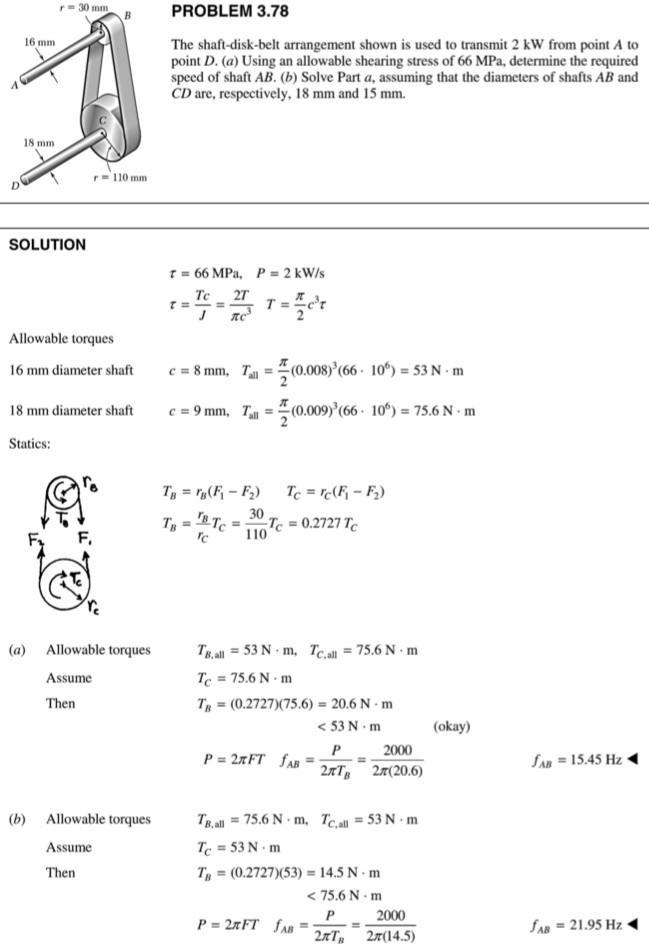
View Answer
divider
INSTANT ANSWER

SOLUTION (a) Shaft \( A B \) : \[ \begin{aligned} P & =12 \mathrm{~kW} \\ f & =\frac{1260}{60}=21 \mathrm{~Hz} \\ T_{A B} & =\frac{P}{2 \pi f}=\frac{12 \cdot 10^{3}}{2 \pi(21)}=91 \mathrm{Nm} \\ c & =\frac{1}{2} d=12.5 \mathrm{~mm} \\ \tau & =\frac{T c}{J}=\frac{2 T}{\pi c^{3}} \\ & =\frac{(2)(91)}{\pi(0.0125)^{3}}=29.66 \mathrm{MPa} \quad \tau_{A B}=29.66 \mathrm{MPa} \end{aligned} \] (b) Shaft \( C D \) : \[ \begin{aligned} T_{C D} & =\frac{r_{C}}{r_{B}} T_{A B}=\frac{5}{3}(91)=151.7 \mathrm{Nm} \\ \tau & =\frac{2 T}{\pi c^{3}}=\frac{(2)(151.7)}{\pi(0.0125)^{3}}=49.44 \mathrm{MPa} \quad \tau_{C D}=49.44 \mathrm{MPa} \end{aligned} \]

View Answer
divider
INSTANT ANSWER

PROBLEM 3.67 Using an allowable shearing stress of \( 50 \mathrm{MPa} \), design a solid steel shaft to transmit \( 15 \mathrm{~kW} \) at a frequency of (a) \( 30 \mathrm{~Hz},(b) 60 \mathrm{~Hz} \). SOLUTION \[ \tau_{\text {all }}=50 \mathrm{MPa}=50 \times 10^{6} \mathrm{~Pa} \quad P=15 \mathrm{~kW}=15 \times 10^{3} \mathrm{~W} \] \( (a) \) \[ \begin{aligned} f & =30 \mathrm{~Hz}: \\ T & =\frac{P}{2 \pi f}=\frac{15 \times 10^{3}}{2 \pi(30)}=79.577 \mathrm{~N} \cdot \mathrm{m} \\ \tau & =\frac{T c}{J}=\frac{2 T}{\pi c^{3}} \\ c & =\sqrt[3]{\frac{2 T}{\pi \tau}}=\sqrt[3]{\frac{(2)(79.577)}{\pi\left(50 \times 10^{6}\right)}}=10.0438 \times 10^{-3} \mathrm{~m}=10.0438 \mathrm{~mm} \end{aligned} \] \( (b) \) \[ d=2 c=20.1 \mathrm{~mm} \] \[ \begin{aligned} f & =60 \mathrm{~Hz} \\ T & =\frac{P}{2 \pi f}=\frac{15 \times 10^{3}}{2 \pi(60)}=39.789 \mathrm{~N} \cdot \mathrm{m} \\ c & =\sqrt[3]{\frac{(2)(39.789)}{\pi\left(50 \times 10^{6}\right)}}=7.9718 \times 10^{-3} \mathrm{~m}=7.9718 \mathrm{~mm} \end{aligned} \] \[ d=2 c=15.94 \mathrm{~mm} \]

View Answer
divider