Questions asked
Solve the following inequality algebraically. |x-3|>=11 Solve the following inequality algebraically. $$|x - 3| \geq 11$$
Given the following information: Process: A B C D E F Arrival Time: 0 2 4 6 8 10 CPU Burst: 6 3 2 7 5 9 Priority: 1 2 4 3 3 2 (smallest integer ≡ highest priority) Draw a Gantt chart that illustrate the execution of the given processes using SRTF and "Priority with RR" (quantum = 2, ignoring context switching overhead). Compute the average waiting time and average turnaround time for each scheduling algorithm
The main aim of a realist review is to describe which interventions work.
Find the $y$-intercept of the following line. $y = -8x + 1$ Give your answer as an ordered pair $(a, b)$.
Which of these is not a valid use of the Chroot Jail?
Consider 6 points in two-dimensions space shown in the table: P1 P2 P3 P4 P5 P6 X 1 5 3 5 3 4 Y 2 1 3 4 6 6 Apply K-means algorithm with two clusters C1(3,3) and C2(5,4) using Manhattan distance for only one iteration.
An abrupt Si PN$^+$ junction has $N_A = 5 \times 10^{15} \text{cm}^{-3}$, $N_D = 1 \times 10^{18} \text{cm}^{-3}$, and has a cross sectional area of the junction is $1 \times 10^{-4} \text{cm}^2$. What is the electron current at the edge of the transition region in the P material of the diode with a forward bias of 0.8V?
EXERCISES 4.8 In Problems 1-20 solve the given system of differential equations by systematic elimination. 1. \frac{dx}{dt} = 2x - y \frac{dy}{dt} = x 2. \frac{dx}{dt} = 4x + 7y \frac{dy}{dt} = x - 2y 3. \frac{dx}{dt} = -y + t \frac{dy}{dt} = x - t 4. \frac{dx}{dt} - 4y = 1 \frac{dy}{dt} + x = 2 Answers to selected odd-numbered problems begin on page ANS-6. 5. $(D^2 + 5)x - 2y = 0$ $-2x + (D^2 + 2)y = 0$ 6. $(D + 1)x + (D - 1)y = 2$ $3x + (D + 2)y = -1$ 7. \frac{d^2x}{dt^2} = 4y + e^t \frac{d^2y}{dt^2} = 4x - e^t 8. \frac{d^2x}{dt^2} + \frac{dy}{dt} = -5x \frac{dx}{dt} + \frac{dy}{dt} = -x + 4y 9. $Dx + D^2y = e^t$ $(D + 1)x + (D - 1)y = 4e^t$
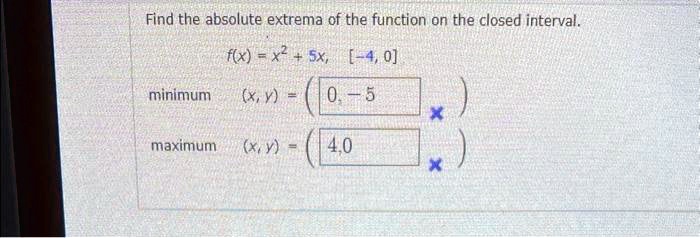
Find the absolute extrema of the function on the closed interval. f(x) = x^2 + 5x, [-4, 0] minimum (x, y) = (0, -5) maximum (x, y) = (4, 0)
For the system shown in Fig. 2, the mass $m$ collects with spring $k_2$ through a linkage rod (with moment of inertia $J$ about the pivot.) $k_2$ $n$ $b$ $a$ $x$ $k_1$ $m$ Figure 2 (a) Determine the degree of freedom (DOF) for the system and justify your answer. (b) Derive the equations of motion for the system. (c) Determine the natural frequency for the system.