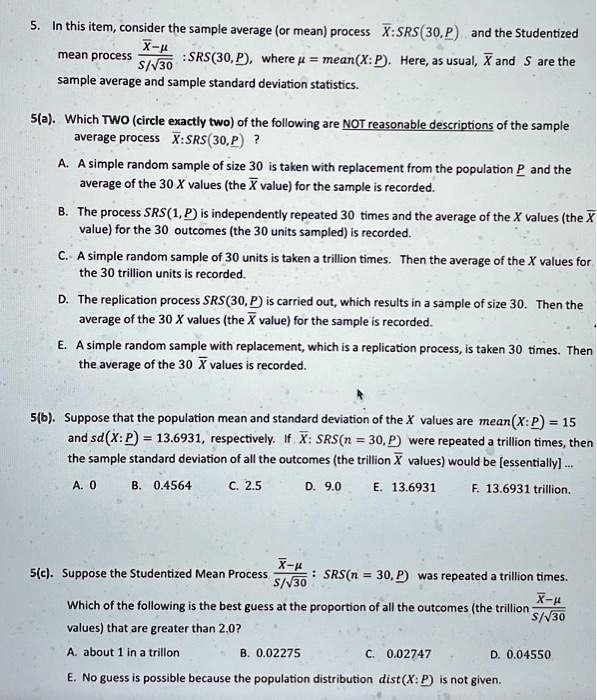
5. In this item, consider the sample average or mean process X: SRS(30, P) and the Studentized n-X mean process S/V30 SRS(30, P) where meanX = P. Here, as usual, X and S are the sample average and sample standard deviation statistics.
5(a) Which TWO (circle exactly two of the following are NOT reasonable descriptions of the sample average process X: SRS(30, P)?
A. A simple random sample of size 30 is taken with replacement from the population P and the average of the 30 X values (the X value) for the sample is recorded.
B. The process SRS1, P is independently repeated 30 times and the average of the X values (the X value for the 30 outcomes the 30 units sampled is recorded.
C. A simple random sample of 30 units is taken a trillion times. Then the average of the X values for the 30 trillion units is recorded.
D. The replication process SRS(30, P) is carried out, which results in a sample of size 30. Then the average of the 30 X values (the X value for the sample is recorded.
E. A simple random sample with replacement, which is a replication process, is taken 30 times. Then the average of the 30 X values is recorded.
5(b) Suppose that the population mean and standard deviation of the X values are meanX = P) = 15 and sdX(P) = 13.6931, respectively. If X: SRS(n = 30, P) were repeated a trillion times, then the sample standard deviation of all the outcomes (the trillion X values) would be [essentially]...
A. 0
B. 0.4564
C. 2.5
D. 9.0
E. 13.6931
F. 13.6931 trillion.
X- SRS(n=30, P) was repeated a trillion times. X-values) that are greater than 2.0?
A. about 1 in a trillion
B. 0.02275
C. 0.02747
D. 0.04550
E. No guess is possible because the population distribution distX: P is not given.