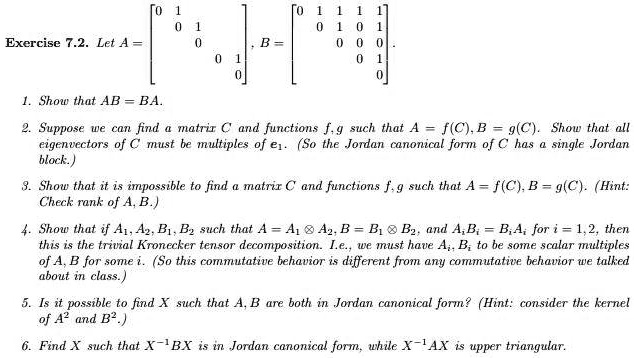
Exercise 7.2. Let A=\begin{bmatrix} 0 & 1\\ 0 & 1\\ 0 & 0 \end{bmatrix}, B = \begin{bmatrix} 0 & 1 & 1 & 1 & 1\\ 0 & 1 & 0 & 1\\ 0 & 0 & 0 & 0\\ 0 & 0 & 1 & 0 \end{bmatrix}
1. Show that AB = BA.
2. Suppose we can find a matrix C and functions f, g such that A = f(C), B = g(C). Show that all eigenvectors of C must be multiples of e1. (So the Jordan canonical form of C has a single Jordan block.)
3. Show that it is impossible to find a matrix C and functions f, g such that A = f(C), B = g(C). (Hint: Check rank of A, B.)
4. Show that if A1, A2, B1, B2 such that A = A1 \otimes A2, B = B1 \otimes B2, and A?B? = B?A? for i = 1, 2, then this is the trivial Kronecker tensor decomposition. I.e., we must have A?, B? to be some scalar multiples of A, B for some i. (So this commutative behavior is different from any commutative behavior we talked about in class.)
5. Is it possible to find X such that A, B are both in Jordan canonical form? (Hint: consider the kernel of A² and B².)
6. Find X such that X?¹BX is in Jordan canonical form, while X?¹AX is upper triangular.