16.
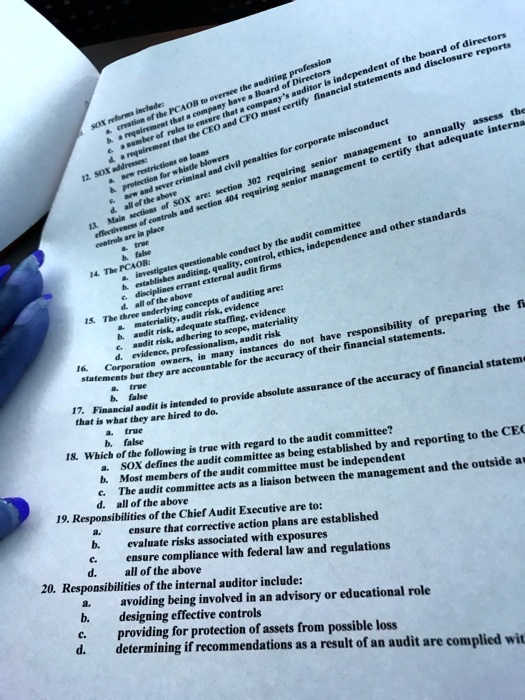
creation of the PCAOB to oversee the auditing profession
SOX reforms include:
b. a requirement that a company have a Board of Directors
c. a number of rules to ensure that a company's auditor is independent of the board of directors
d. a requirement that the CEO and CFO must certify financial statements and disclosure reports
a.
12. SOX addresses:
b. protection for whistle blowers
c. new and sever criminal and civil penalties for corporate misconduct
d. all of the above
13. Main sections of SOX are: section 302 requiring senior management to annually assess the
effectiveness of controls and section 404 requiring senior management to certify that adequate interna
controls are in place
a. true
b. false
14. The PCAOB:
a. investigates questionable conduct by the audit committee
b. establishes auditing, quality, control, ethics, independence and other standards
c. disciplines errant external audit firms
d. all of the above
15. The three underlying concepts of auditing are:
a. materiality, audit risk, evidence
b. audit risk, adequate staffing, evidence
c. audit risk, adhering to scope, materiality
d. evidence, professionalism, audit risk
Corporation owners, in many instances do not have responsibility of preparing the fi
statements but they are accountable for the accuracy of their financial statements.
a. true
b. false
17. Financial audit is intended to provide absolute assurance of the accuracy of financial stateme
that is what they are hired to do.
a. true
b. false
18. Which of the following is true with regard to the audit committee?
a. SOX defines the audit committee as being established by and reporting to the CEC
b. Most members of the audit committee must be independent
c. The audit committee acts as a liaison between the management and the outside an
d. all of the above
19. Responsibilities of the Chief Audit Executive are to:
b. ensure that corrective action plans are established
c. evaluate risks associated with exposures
d. ensure compliance with federal law and regulations
20. Responsibilities of the internal auditor include:
a. avoiding being involved in an advisory or educational role
b. designing effective controls
c. providing for protection of assets from possible loss
d. determining if recommendations as a result of an audit are complied wit