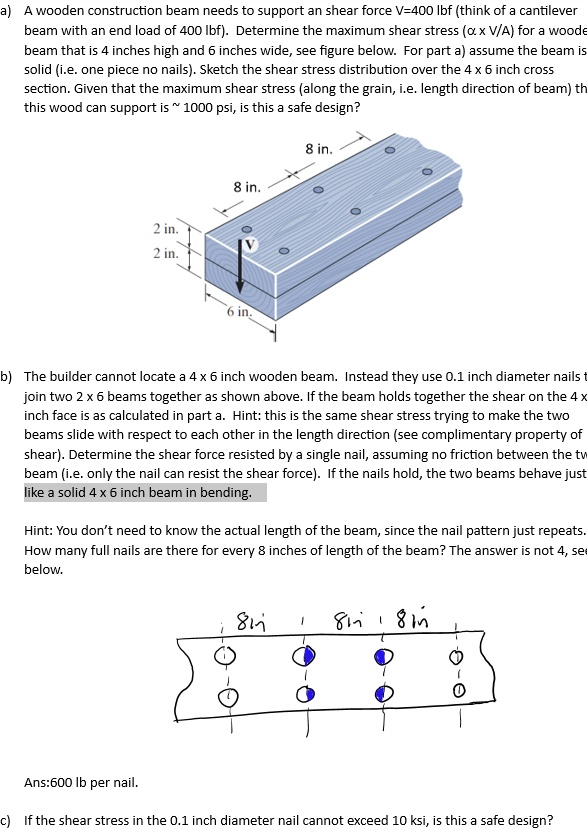
a) A wooden construction beam needs to support an shear force V=400 lbf (think of a cantilever
beam with an end load of 400 lbf). Determine the maximum shear stress (o. x V/A) for a woode
beam that is 4 inches high and 6 inches wide, see figure below. For part a) assume the beam is
solid (i.e. one piece no nails). Sketch the shear stress distribution over the 4 x 6 inch cross
section. Given that the maximum shear stress (along the grain, i.e. length direction of beam) th
this wood can support is ~ 1000 psi, is this a safe design?
8 in.
8 in.
2 in.
0
0
2 in.
V
6 in.
0
b) The builder cannot locate a 4 x 6 inch wooden beam. Instead they use 0.1 inch diameter nails t
join two 2 x 6 beams together as shown above. If the beam holds together the shear on the 4 x
inch face is as calculated in part a. Hint: this is the same shear stress trying to make the two
beams slide with respect to each other in the length direction (see complimentary property of
shear). Determine the shear force resisted by a single nail, assuming no friction between the tw
beam (i.e. only the nail can resist the shear force). If the nails hold, the two beams behave just
like a solid 4 x 6 inch beam in bending.
Hint: You don't need to know the actual length of the beam, since the nail pattern just repeats.
How many full nails are there for every 8 inches of length of the beam? The answer is not 4, se
below.
8ή
1
881
0
Ans:600 lb per nail.
c) If the shear stress in the 0.1 inch diameter nail cannot exceed 10 ksi, is this a safe design?