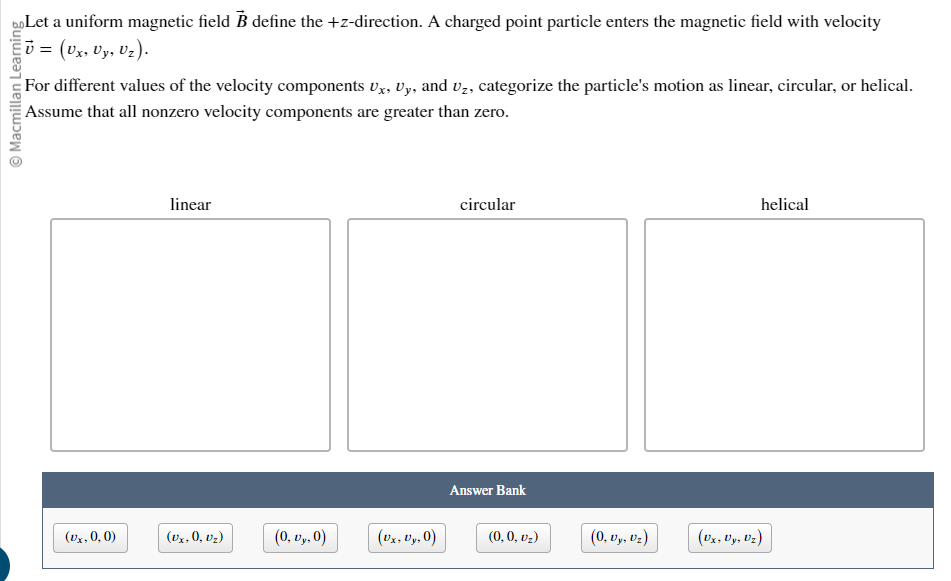
Let a uniform magnetic field \( \vec{B} \) define the \( +z \)-direction. A charged point particle enters the magnetic field with velocity \( \vec{v}=\left(v_{x}, v_{y}, v_{z}\right) \).
For different values of the velocity components \( v_{x}, v_{y} \), and \( v_{z} \), categorize the particle's motion as linear, circular, or helical. Assume that all nonzero velocity components are greater than zero.
linear
\( \square \)
circular
helical
Answer Bank
\( \left(v_{x}, 0,0\right) \)
\( \left(v_{x}, 0, v_{z}\right) \)
\( \left(0, v_{y}, 0\right) \)
\( \left(v_{x}, v_{y}, 0\right) \)
\( \left(0,0, v_{z}\right) \)
\( \left(0, v_{y}, v_{z}\right) \)
\( \left(v_{x}, v_{y}, v_{z}\right) \)