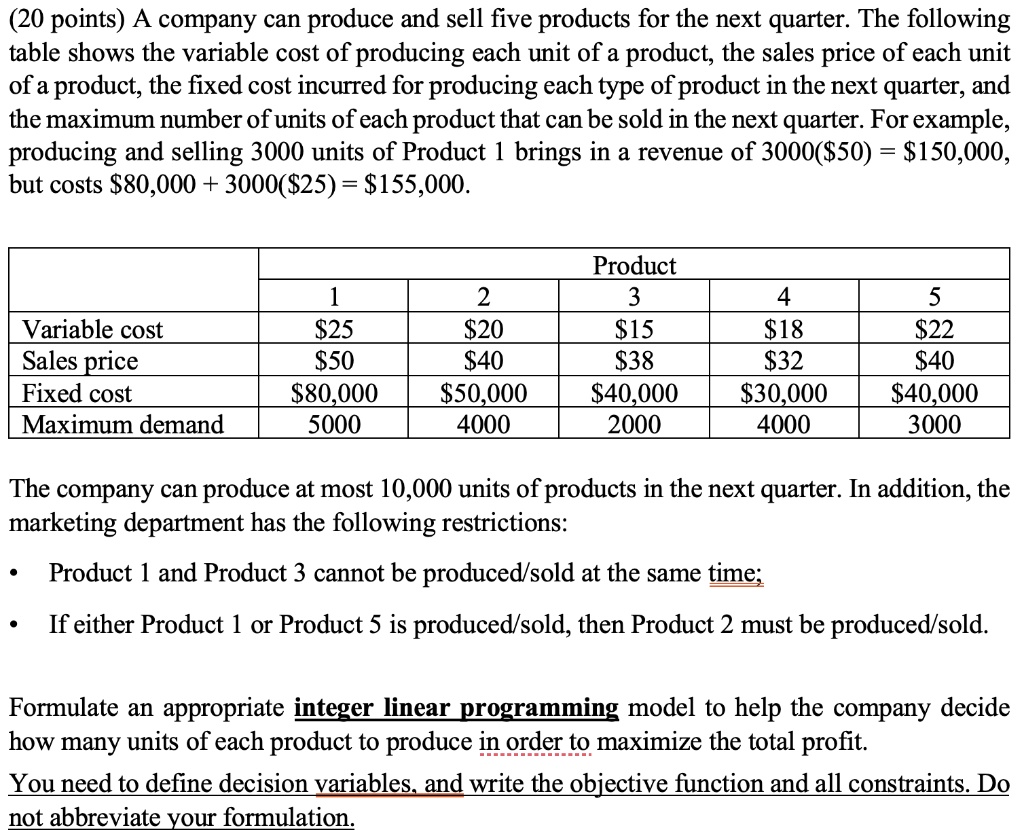
(20 points) A company can produce and sell five products for the next quarter. The following table shows the variable cost of producing each unit of a product, the sales price of each unit of a product, the fixed cost incurred for producing each type of product in the next quarter, and the maximum number of units of each product that can be sold in the next quarter. For example, producing and selling 3000 units of Product 1 brings in a revenue of $150,000, but costs $80,000 + 3000($25) = $155,000.
Product 1: Variable cost = $25, Sales price = $50, Fixed cost = $80,000, Maximum demand = 5000 units
Product 2: Variable cost = $18, Sales price = $32, Fixed cost = $30,000, Maximum demand = 4000 units
Product 3: Variable cost = $22, Sales price = $40, Fixed cost = $40,000, Maximum demand = 3000 units
Product 4: Variable cost = $15, Sales price = $38, Fixed cost = $50,000, Maximum demand = 2000 units
Product 5: Variable cost = $20, Sales price = $40, Fixed cost = $50,000, Maximum demand = 4000 units
The company can produce at most 10,000 units of products in the next quarter. In addition, the marketing department has the following restrictions: Product 1 and Product 3 cannot be produced/sold at the same time. If either Product 1 or Product 5 is produced/sold, then Product 2 must be produced/sold.
Formulate an appropriate integer linear programming model to help the company decide how many units of each product to produce in order to maximize the total profit. You need to define decision variables and write the objective function and all constraints. Do not abbreviate your formulation.