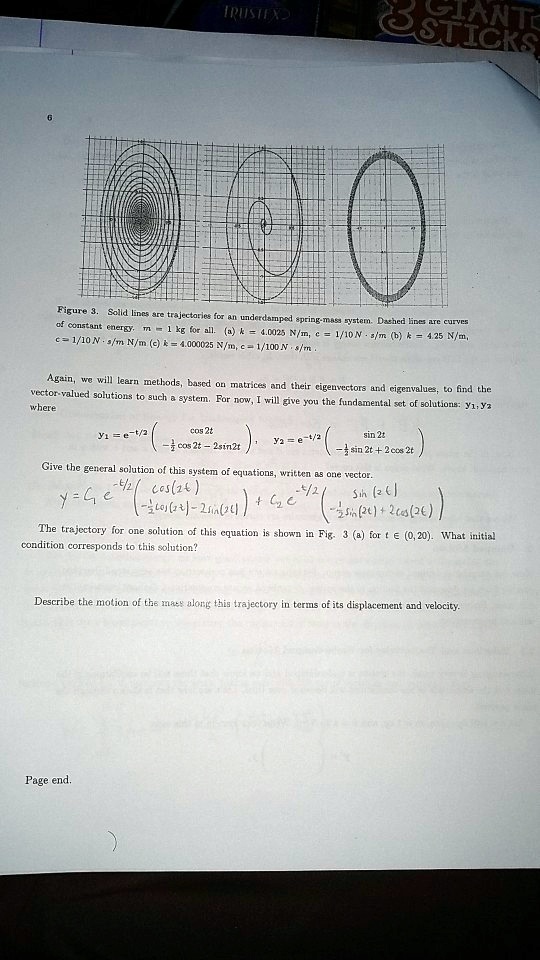
Figure 3. Solid lines are trajectories for an underdamped spring-mass system. Dashed lines are curves of constant energy. $m = 1$ kg for all. (a) $k = 4.0025$ N/m, $c = 1/10$ N s/m (b) $k = 4.25$ N/m, $c = 1/10$ N s/m (c) $k = 4.000025$ N/m, $c = 1/100$ N s/m.
Again, we will learn methods, based on matrices and their eigenvectors and eigenvalues, to find the vector-valued solutions to such a system. For now, I will give you the fundamental set of solutions: $y_1, y_2$ where
$y_1 = e^{-t/2} \begin{pmatrix} \cos 2t\\ -\frac{1}{2}\cos 2t - 2\sin 2t \end{pmatrix}$, $y_2 = e^{-t/2} \begin{pmatrix} \sin 2t\\ -\frac{1}{2}\sin 2t + 2\cos 2t \end{pmatrix}$
Give the general solution of this system of equations, written as one vector.
$y = C_1 e^{-t/2} \begin{pmatrix} \cos (2t)\\ -\frac{1}{2}\cos (2t) - 2\sin (2t) \end{pmatrix} + C_2 e^{-t/2} \begin{pmatrix} \sin (2t)\\ -\frac{1}{2}\sin (2t) + 2\cos (2t) \end{pmatrix}$
The trajectory for one solution of this equation is shown in Fig. 3 (a) for $t \in (0, 20)$. What initial condition corresponds to this solution?
Describe the motion of the mass along this trajectory in terms of its displacement and velocity.
Page end.