Ace - AI Tutor
Ask Our Educators
Textbooks
My Library
Flashcards
Scribe - AI Notes
Notes & Exams
Download App
Sophia Tran

Sophia T.

Divider

Books Assigned

Fundamentals of Differential Equations

Fundamentals of Differential…

R. Kent Nagle 9th Edition
Achievement 1,179 solutions
Linear Algebra with Application

Linear Algebra with Application

Steven J. Leon 9th Edition
Achievement 1,295 solutions
Linear Algebra With Applications

Linear Algebra With Applications

Steven J. Leon 9th Edition
Achievement 1,389 solutions

Viewed Questions

For each pair of vectors in Exercise 1 , find the scalar projection of $\mathbf{v}$ onto $\mathbf{w}$. Also find the vector projection of $\mathbf{v}$ onto $\mathbf{w}$

Linear Algebra With Applications

Orthogonality

The Scalar Product in $\mathbb{R}^{n}$

For each pair of vectors in Exercise 1, find the scalar projection of v onto w. Also find the vector projection of v onto w.

Linear Algebra with Application

Orthogonality

The Scalar Product in Rn

Early Monday morning, the temperature in the lecture hall has fallen to $$40^{\circ} \mathrm{F}$$, the same as the temperature outside. At 7:00 a.m., the janitor turns on the furnace with the thermostat set at $$70^{\circ} \mathrm{F}$$. The time constant for  the building is 1>K = 2 hr and that for the building
along with its heating system is 1>K1 = 1>2 hr. Assuming that the outside temperature remains constant, what will be the temperature inside the lecture hall at 8:00 a.m.? When will the temperature inside the hall reach $$65^{\circ} \mathrm{F}$$?

Early Monday morning, the temperature in the lecture hall has fallen to $$40^{\circ} \mathrm{F}$$, the same as the temperature outside. At 7:00 a.m., the janitor turns on the furnace with the thermostat set at $$70^{\circ} \mathrm{F}$$. The time constant for the building is 1>K = 2 hr and that for the building along with its heating system is 1>K1 = 1>2 hr. Assuming that the outside temperature remains constant, what will be the temperature inside the lecture hall at 8:00 a.m.? When will the temperature inside the hall reach $$65^{\circ} \mathrm{F}$$?

Fundamentals of Differential Equations

Mathematical Models and Numerical…

Heating and Cooling of Buildings

Let $\mathbf{x}_{1}, \mathbf{x}_{2}, \ldots, \mathbf{x}_{k}$ be linearly independent vectors in a vector space $V$ (a) If we add a vector $\mathbf{x}_{k+1}$ to the collection, will we still have a linearly independent collection of vectors? Explain. (b) If we delete a vector, say, $\mathbf{x}_{k},$ from the collec- tion, will we still have a linearly independent collection of vectors? Explain.

Linear Algebra with Application

Vector Spaces

Linear Independence

Questions asked

ANSWERED

Tavis Lam verified

Numerade educator

For the circuit shown, ( R=18 k Omega, C=0.2 mu F, V_{c c}=22 mathrm{~V} ), and the source voltage is given by [ V_{s}(t)=A cdot sin (500 t), ] What is the largest value of ( A ) (the amplitude of the sinusoidal input voltage) for which the op-amp operates in its linear range (i.e., does not saturate). Express your answer in units of Volts.

View Answer
divider
ANSWERED

Tavis Lam verified

Numerade educator

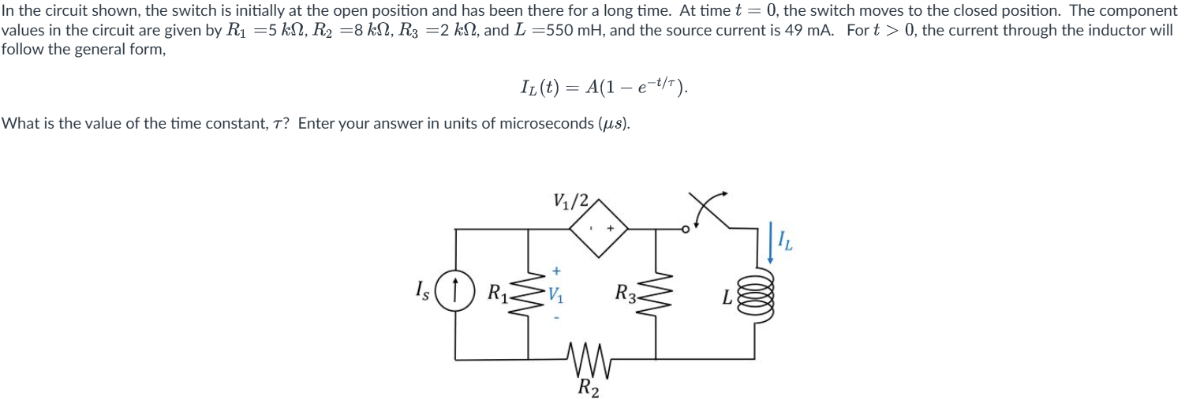
In the circuit shown, the switch is initially at the open position and has been there for a long time. At time ( t=0 ), the switch moves to the closed position. The component values in the circuit are given by ( R_{1}=5 k Omega, R_{2}=8 k Omega, R_{3}=2 k Omega ), and ( L=550 mathrm{mH} ), and the source current is 49 mA . For ( t>0 ), the current through the inductor will follow the general form, [ I_{L}(t)=Aleft(1-e^{-t / au} ight) ] What is the value of the time constant, ( au ) ? Enter your answer in units of microseconds ( (mu s) ).
View Answer
divider
ANSWERED

Sam Stansfield verified

Numerade educator

In the circuit shown, the switch is initially at position 2 and has been there for a long time. At time ( t=0 ), the switch moves to position 1 . The component values in the circuit are given by ( R_{1}=8 k Omega, R_{2}=6 k Omega, R_{3}=9 k Omega ), and ( C=138 mathrm{pF} ). If the capacitor voltage for time ( t>0 ) is expressed in the form [ v_{C}(t)=A e^{-t / au}+B ext { Volts } ] find the value of the time constant ( au ). Enter your answer in units of microseconds ( (mu s) ).

View Answer
divider
ANSWERED

Ivan Kochetkov verified

Numerade educator

In the circuit shown, the switch is initially at position 2 and has been there for a long time. At time t = 0, the switch moves to position 1. The component values in the circuit are given by R1 =1 k?, R2 =3 k?, R3 =4 k?, and C =125 pF and the source voltage is Vs =11 Volts. What is the final value of the capacitor voltage, VC (?). Enter your answer in units of Volts.

View Answer
divider
ANSWERED

Ivan Kochetkov verified

Numerade educator

In the circuit shown, the switch is initially at the open position and has been there for a long time. At time ( t=0 ), the switch moves to the closed position. The component values in the circuit are given by ( R_{1}=6 mathrm{k} Omega, R_{2}=7 mathrm{k} Omega, R_{3}=1 mathrm{k} Omega ), and ( L=205 mathrm{mH} ), and the source current is ( I_{s}=256 mathrm{~mA} ). What is the final value of the inductor current, ( I_{L}(infty) ). Enter your answer in units of milliamps (mA).

View Answer
divider
ANSWERED

Tavis Lam verified

Numerade educator

In the circuit shown, the switch is initially at the closed position and has been there for a long time. At time ( t=0 ), the switch moves to the open position. The component values in the circuit are given by ( R_{1}=10 mathrm{k} Omega, R_{2}=8 mathrm{k} Omega, R_{3}=8 mathrm{k} Omega ), and ( L=54 mathrm{mH} ), and the source current is ( I_{s}=96 mathrm{~mA} ). If the inductor voltage is defined with + on the top and - on the bottom of the inductor, what is the value of the inductor voltage at the time instant immediately after the switch moves, ( V_{L}left(0^{+} ight) ). Enter your answer in units of Volts.

View Answer
divider
ANSWERED

Tavis Lam verified

Numerade educator

In the circuit shown, the switch is initially at position 1 and has been there for a long time. At time ( t=0 ), the switch moves to position 2 . The component values in the circuit are given by ( R_{1}=10 k Omega, R_{2}=5 k Omega, R_{3}=8 k Omega ), and ( C=104 mathrm{pF} ) and the source voltage is ( V_{s}=4 mathrm{Volts} ). What is the value of the capacitor voltage at the time instant immediately after the switch moves, ( V_{C}left(0^{+} ight) ). Enter your answer in units of volts ( (mathrm{V}) ).

View Answer
divider
ANSWERED

Brian Beasley verified

Numerade educator

Consider the following first order ODE, [ 3 frac{d v}{d t}+6 v(t)=-4, quad v(0)=2 ] If the general solution to this differential equation is written as ( v(t)=A e^{-t / au}+B ), find the value of ( au ). Enter your answer in units of seconds.

View Answer
divider
ANSWERED

Tavis Lam verified

Numerade educator

Consider the following first order ODE, [ 4 frac{d v}{d t}+8 v(t)=10 e^{-5 t}, quad v(0)=-5 ] If the general solution to this differential equation is written as ( v(t)=A e^{-t / au}+B e^{-5 t} ), find the value of ( A ).

View Answer
divider
ANSWERED

Tavis Lam verified

Numerade educator

In the circuit shown, ( I_{s}=41 mathrm{~mA}, R_{1}=2.1 k Omega, R_{2}=1.8 k Omega, L=62 mathrm{mH} ), and ( C=63 mathrm{nF} ). How much energy is stored in the capacitor in steady state (as ( t ightarrow infty ) )? Express your answer in units of microJoules ( (mu J) ).

View Answer
divider