Ace - AI Tutor
Ask Our Educators
Textbooks
My Library
Flashcards
Scribe - AI Notes
Notes & Exams
Download App
thomas abella

thomas a.

Divider

Questions asked

BEST MATCH

Select the factors that inhibit the pyruvate dehydrogenase complex. increase in $Ca^{2+}$ concentration high concentration of NADH pyruvate inhibition of the regulatory kinase insulin (in the liver and adipose tissue) phosphorylation of $E_1$ (pyruvate dehydrogenase)

View Answer
divider
BEST MATCH

For the circuit for Part 4.1 of the lab, find the voltage gain for each value of feedback resistor Figure 3: Inverting opamp circuit. $R_f$ $R_1$ +12V -12V Figure 3: Inverting opamp circuit.

View Answer
divider
BEST MATCH

Why is atmospheric pressure highest at sea level? Group of answer choices The temperature is generally higher at sea level, increasing pressure. The Earth's rotation causes air to accumulate at lower altitudes. There is a higher density of air molecules due to the weight of the atmosphere above. Friction between the Earth's surface and the atmosphere compresses the air at sea level.

View Answer
divider
BEST MATCH

Show me the steThe following compound is water soluble. What ions are produced when the compound is in aqueous solution? Enter each ion preceded by the number produced upon dissolution. Cation: Anion:ps to solve

View Answer
divider
BEST MATCH

what is the feature of a ground circuit creates a safe path for current

View Answer
divider
BEST MATCH

Find the minimum of following functions using (a) Simplex (b) Powell's method Function 1) $f(x_1,x_2) = x_1^2 + 4x_2^2 - 4x_1$ Function 2) $f(x_1,x_2) = x_1^2 + x_2^2 - 2x_1 + 4x_2 - 2$ Function 3) $f(x_1,x_2) = x_1^3 + x_2^4 - 4x_1x_2^2$

View Answer
divider
BEST MATCH

Review Test - Ch. 9 13. Given a log phase bacterial culture with 1 x 10$^6$ cells per ml and a generation time of 30 minutes, how long does it take the culture to reach a density of 6.4 x 10$^7$ cells per ml? A. 1 hour B. 2 hours C. 3 hours D. 4 hours E. 6 hours 14. Which of the following is NOT a possible reason for entry into the stationary phase of growth? A. Nutrient limitation B. Limited oxygen availability C. Toxic waste accumulation D. Critical population density reached E. All of the above are possible reasons 15. ______ found in the death phase are associated with certain chronic infections and do not respond to antibiotic treatment. A. Bacteria B. Daughter cells C. Pathogens D. Persisters E. Vegetative cells 16. ______ means bacteria cannot grow under lab conditions but may grow under appropriate conditions. A. Death phase B. Genetically programmed cell death C. Starvation response D. Viable but nonculturable E. None of the above 17. A culture in a closed vessel to which no additional medium is added and from which no waste products are removed is called a(n) ______ culture. A. Batch B. Continuous C. Enrichment D. Fed-batch E. Semi-continuous 18. Which of the following is NOT true of chemostats? A. An open system B. An essential nutrient is in limiting quantities C. Has a photocell that measures the turbidity D. Maintains cells in log phase E. All of the above are true 3

View Answer
divider
BEST MATCH

A 25 - year - old male was admitted to the ER with a blood glucose of 600 mg / dL . His breathing is deep and rapid and his breath smells of acetone . What is the probable diagnosis ? Why is his breathing deep and rapid ? What would you predict his blood pH to be

View Answer
divider
BEST MATCH

4. Predict which of the following organisms would have the shortest phospholipids in their plasma membranes: A. Desert snake B. Humans C. Antarctic fish D. Bacteria living in an active volcano 5. Transport through a symport transporter requires which of the following steps? A. lons must be phosphorylated to move against their concentration gradient B. High concentrations of $K^+$ ions must be found outside of the cell C. An ion must travel down its electrochemical gradient D. ATP hydrolysis must phosphorylate the symport transporter E. Equal concentrations of $Na^+$ must be on the inside and outside of the cell 6. The picture below shows a vesicle that contains a transmembrane protein in its membrane. The N-terminus and C-terminus of the protein are indicated. If this vesicle moves from the Golgi to the plasma membrane, where will the N- terminus of the protein be located after vesicle fusion? A. The N-terminus will interact with the extracellular environment B. The N-terminus will remain in the lumen of the vesicle C. The N-terminus will interact with the cytosol of the cell D. The N-terminus will be cleaved off the protein Image modified from vesicle image in public domain. Finally, we're going to practice understanding action potentials. You will always be given a reminder of the relative concentrations of different ions inside versus outside of a cell. Use this information to help yourself remember which directions different ions will move during nerve signaling and to remember which steps require active vs passive transport. Cell Membrane Extracellular Intracellular $Na^+$ $Cl^-$ $K^+$ Ion Concentration Gradients

View Answer
divider
BEST MATCH

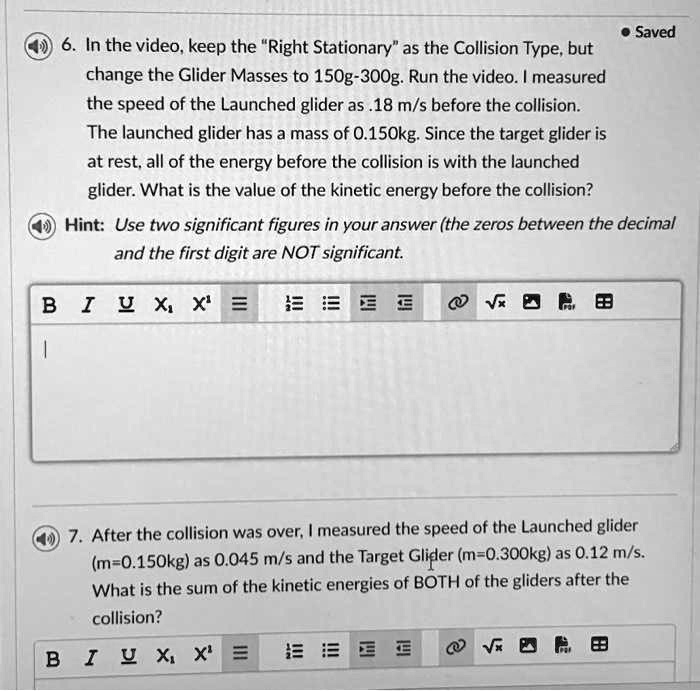
6. In the video, keep the "Right Stationary" as the Collision Type, but change the Glider Masses to 150g-300g. Run the video. I measured the speed of the Launched glider as .18 m/s before the collision. The launched glider has a mass of 0.150kg. Since the target glider is at rest, all of the energy before the collision is with the launched glider. What is the value of the kinetic energy before the collision? Hint: Use two significant figures in your answer (the zeros between the decimal and the first digit are NOT significant. 7. After the collision was over, I measured the speed of the Launched glider (m=0.150kg) as 0.045 m/s and the Target Glider (m=0.300kg) as 0.12 m/s. What is the sum of the kinetic energies of BOTH of the gliders after the collision?
View Answer
divider