Ace - AI Tutor
Ask Our Educators
Textbooks
My Library
Flashcards
Scribe - AI Notes
Notes & Exams
Download App
Tom

Tom

Divider

Viewed Questions

Using Excel, create a table that shows the relationship among the units of mass to describe people's mass in kilogram, slugs, and pound mass in the range of $20 \mathrm{~kg}$ to $120 \mathrm{~kg}$. Use increments of $5 \mathrm{~kg}$.

Engineering Fundamentals

A cantilever beam shown in the accompanying figure is used to support a load acting on a balcony. The deflection of the centerline of the beam is given by the following equation: $$ y=\frac{-w x^{2}}{24 E I}\left(x^{2}-4 L x+6 L^{2}\right) $$ where $$ \begin{aligned} y &=\text { deflection at a given } x \text { location, }(\mathrm{m}) \\ w &=\text { distributed load } \\ E &=\text { modulus of elasticity }\left(\mathrm{N} / \mathrm{m}^{2}\right) \\ I &=\text { second moment of area }\left(\mathrm{m}^{4}\right) \\ x &=\text { distance from the support as shown }(\mathrm{m}) \\ L &=\text { length of the beam }(\mathrm{m}) \end{aligned} $$ What is the appropriate unit for $w$, if the preceding equation is to be homogeneous in units? Show all steps of your work.

Engineering Fundamentals

The cantilevered beam shown in the accompanying figure is used to support a load acting on a balcony. The deflection of the centerline of the beam is given by the following equation: $$ y=\frac{-w x^{2}}{24 E I}\left(x^{2}-4 L x+6 L^{2}\right) $$ where $$ \begin{aligned} &y=\text { deflection at a given } x \text { location }(\mathrm{m}) \\ &w=\text { distributed load }(\mathrm{N} / \mathrm{m}) \\ &E=\text { modulus of elasticity }\left(\mathrm{N} / \mathrm{m}^{2}\right) \\ &I=\text { second moment of area }\left(\mathrm{m}^{4}\right) \\ &x=\text { distance from the support as shown }(x) \end{aligned} $$ Using Excel, plot the deflection of a beam whose length is $5 \mathrm{~m}$ with the modulus of elasticity of $E=$ $200 \mathrm{GPa}$ and $I=99.1 \times 10^{6} \mathrm{~mm}^{4}$. The beam is designed to carry a load of $10,000 \mathrm{~N} / \mathrm{m}$. What is the maximum deflection of the beam?

Engineering Fundamentals

Use Excel to plot the following data. Use two different $y$ axes. Use a scale of zero to $100^{\circ} \mathrm{F}$ for temperature, and zero to $12 \mathrm{mph}$ for wind speed. \begin{tabular}{ccc} Time (PaM.) & Temperature ( F) ) & Wind Speed (mph) \\ \hline 1 & 75 & 4 \\ 2 & 80 & 5 \\ 3 & 82 & 8 \\ 4 & 82 & 5 \\ 5 & 78 & 5 \\ 6 & 75 & 4 \\ 7 & 70 & 3 \\ 8 & 68 & 3 \end{tabular}

Engineering Fundamentals

Questions asked

ANSWERED

Penny Riley verified

Numerade educator

Assuming an average 35% efficiency for power plants and a heating value of approximately 1000 BTU/ft^3 (22,000 BTU/lbm), calculate the amount of natural gas required in ft^3 and lbm for generating electricity for each year: Year 1980 346.2399 billion kWh year 1990 372.7652 billion kWh Year 2000 601.0382 billion kWh year 2005 751.8189 billion kWh year 2010 773.8234 billion kWh year 2020 1102.762 billion kWh Year 2030 992.7706 billion kWh

View Answer
divider
INSTANT ANSWER

\begin{tabular}{|l|l|l|l} Year & Coal & Petroleum & \begin{tabular}{l} Natural \\ Gas \end{tabular} \\ \hline 1980 & 1161.562 & \( \mathbf{2 4 5 . 9 9 4 2} \) & \( \underline{346.2399} \) \\ \hline 1990 & 1594.011 & \( \mathbf{1 2 6 . 6 2 1 1} \) & \( \underline{372.7652} \) \\ \hline 2000 & 1966.265 & 111.221 & \( \underline{601.0382} \) \\ \hline 2005 & 2040.913 & \( \mathbf{1 1 5 . 4 2 6 4} \) & \( \underline{751.8189} \) \\ \hline 2010 & 2217.555 & \( \mathbf{1 0 4 . 8 1 8 2} \) & \( \underline{773.8234} \) \\ \hline 2020 & 2504.786 & \( \mathbf{1 0 6 . 6 7 9 9} \) & 1102.762 \\ \hline 2030 & 3380.674 & \( \mathbf{1 1 4 . 6 7 4 1} \) & \( \underline{992.7706} \) \\ \hline & & & \\ \hline \end{tabular} Data from U.S. Department of Energy. 13.19 Assuming an average 35\% efficiency for power plants and a heating value of approximately \( 1000 \mathrm{Btu} / \mathrm{ft}^{3}(22,000 \mathrm{Btu} / \mathrm{lbm}) \), calculate the amount of natural gas required in \( \mathrm{ft}^{3} \) and \( \mathrm{lbm} \) for generating electricity for each year shown in the table.

View Answer
divider
ANSWERED

Nicholas Mogoi verified

Numerade educator

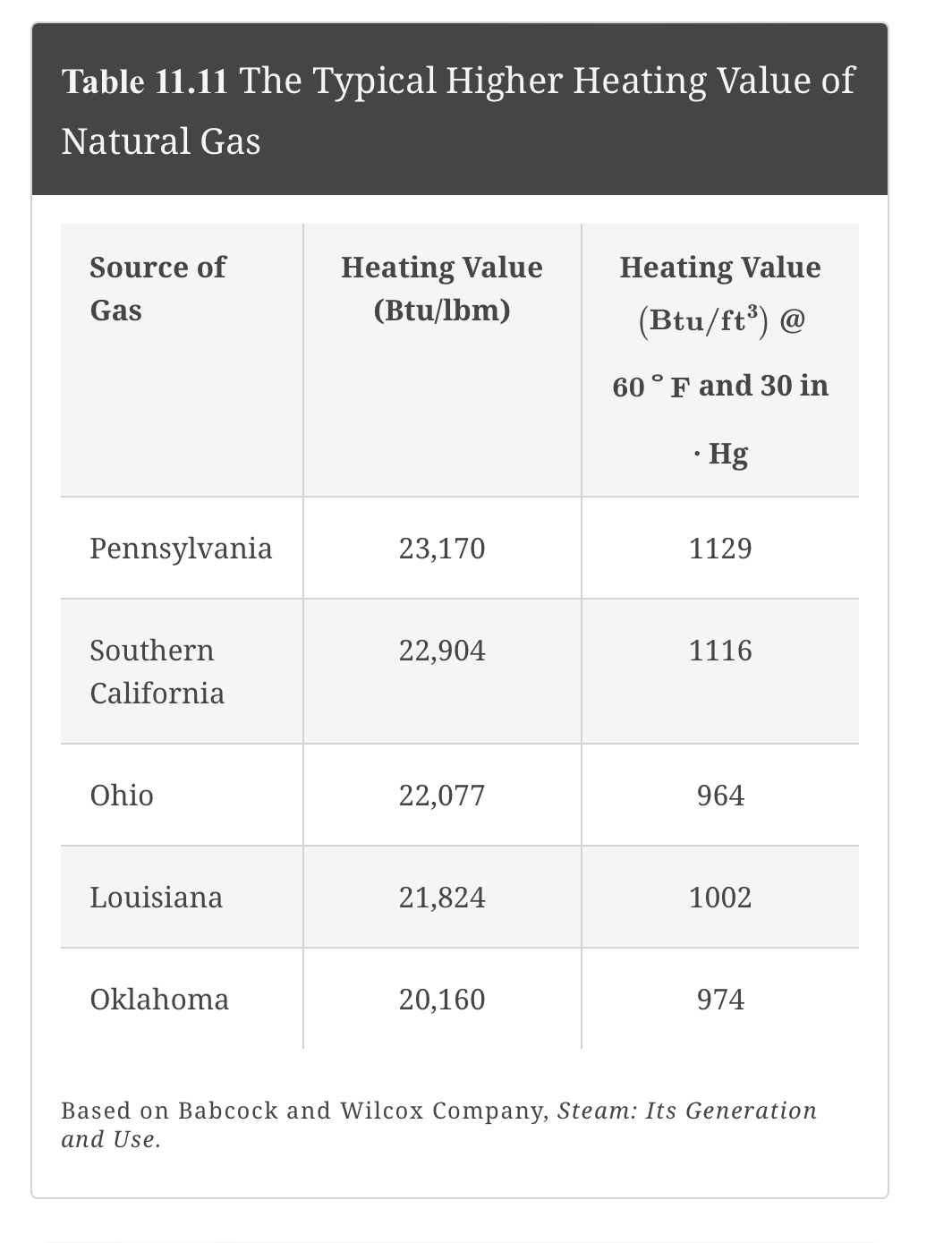
Table 11.11 The Typical Higher Heating Value of Natural Gas Source of Gas | Heating Value (Btu/lbm) | Heating Value (Btu/ft³) @ 60 °F and 30 in · Hg --- | --- | --- Pennsylvania | 23,170 | 1129 Southern California | 22,904 | 1116 Ohio | 22,077 | 964 Louisiana | 21,824 | 1002 Oklahoma | 20,160 | 974 Based on Babcock and Wilcox Company, Steam: Its Generation and Use.
View Answer
divider
ANSWERED

Rachel Gore verified

Numerade educator

Items Resistance 1. Outside film resistance (winter, 15 mph wind) 0.17 2. Siding, wood (1/2 × 8 lapped) 0.81 3. Sheathing (1/2 in. regular) 1.32 4. Insulation batt (5 1/2 in.) 19.0 5. Gypsum wallboard (1/2 in.) 0.45 6. Inside film resistance (winter) 0.68

View Answer
divider
ANSWERED

Nicholas Mogoi verified

Numerade educator

11.12 In order to increase the thermal resistance of a typical exterior frame wall, such as the one shown in Example 11.11, it is customary to use 2 x 6 studs instead of 2 x 4 studs to allow for placement of more insulation within the wall cavity. A typical exterior (2 x 6) frame wall of a house consists of the materials shown in the accompanying figure. Assume an inside room temperature of 68 °F and an outside air temperature of 20 °F with an exposed area of 150 ft². Determine the heat loss through this wall. The figure shows a section of an exterior frame wall. The frame wall consists of an exterior sliding wood attached to sheathing. The exterior sliding wood is coated with an outside film. On the other end of the wall is a gypsum wall board coated with an inside film. The insulation batt is attached between the exterior and interior ends of the wall. The outside and inside films are marked 1 and 6 respectively. The sliding wood is marked 2 and the sheathing is marked 3. The insulation batt is marked 4. The gypsum wallboard is marked 5.

View Answer
divider
ANSWERED

Nishant Kumar verified

Numerade educator

Determine the mass moment of inertia of the earth about its axis of rotation, going through the poles. Assume the shape of the earth to be spherical. Look up information such as the mass of the earth and the radius of the earth at the equatorial plane.

View Answer
divider
ANSWERED

Vishal Gupta verified

Numerade educator

10.34. Determine the sum of the moments created by the forces shown in the accompanying figure about points A, B, C and D. Problem 10.34 The figure shows a bar A B C D which is inclined at an angle of 35 degrees below the horizontal axis. The distance between A and B is 5 centimeters, the distance between B and C is 2 centimeters and the distance between C and D is 3 centimeters. A force of magnitude 50 newtons is applied perpendicular to the bar on point B, a force of magnitude 50 newtons is applied vertically on point C and a force of magnitude 100 newtons is applied vertically on point D.

View Answer
divider
ANSWERED

Timothy James verified

Numerade educator

10.30. The tire wrench shown in the accompanying figure is used to tighten the bolt on a wheel. Given the information on the diagram, determine the moment about point ( O ) for the two loading situations shown: a. pushing perpendicular to the wrench arm b. pushing at a ( 75^{circ} ) angle. Problem 10.30 Details The figure shows a tire wrench of length 2 feet used to tighten a bolt on the wheel. A force of magnitude 50 pounds is applied on the end of the wrench and is directed downwards. The wrench is pushed down at an angle of 75 degrees.

View Answer
divider
ANSWERED

Kirsty Gledhill verified

Numerade educator

10.5. Former basketball player Shaquille O’Neal weighs approximately 335 lb and wears a size 23 shoe. Estimate the pressure he exerts on a floor. What pressure would he exert if his shoe size were 13 ? State all your assumptions, and show how you arrived at a reasonable solution.

View Answer
divider
ANSWERED

Supratim Pal verified

Numerade educator

The density of standard air is a function of temperature and may be approximated using the ideal gas law, according to [ ho=frac{P}{R T} ] where [ egin{array}{l} P= ext { standard atmospheric pressure }(101.3 mathrm{kPa}) \ R= ext { gas constant } ; ext { its value for air is } 286.9 end{array} ] [ ho=operatorname{density}left(mathrm{kg} / mathrm{m}^{3} ight) ] ( T= ) air temperature in Kelvin Create a table that shows the density of air as a function of temperature in the range of ( 0^{circ} mathrm{C}(273.15 mathrm{~K}) ) to ( 50^{circ} mathrm{C}(323.15 mathrm{~K}) ) in increments of ( 5^{circ} mathrm{C} ). Also, create a graph showing the value of density as a function of temperature.

View Answer
divider