Ace - AI Tutor
Ask Our Educators
Textbooks
My Library
Flashcards
Scribe - AI Notes
Notes & Exams
Download App
trinidad gray

trinidad g.

Divider

Questions asked

BEST MATCH

When converting Fahrenheit to Celsius you should Multiple Choice subtract 32 and then divide by 1.8. divide by 1.8 and then subtract 32. multiply by 32 and then add 1.8. add 32 and then multiply by 1.8.

View Answer
divider
BEST MATCH

3. Given $\vec{v} = (3, 5)$ and $\vec{w} = (-2, 1)$, find a) the angle (in degrees) between the two vectors. b) the vector projection of $\vec{v} = (3, 5)$ onto $\vec{w} = (-2, 1)$.

View Answer
divider
BEST MATCH

I determined the molecular formula of a compound to be C6H8O by using the rule of 13 for a molecular ion of m/z=96. This gives me a DBE (or index of hydrogen deficiency =3. My C13 NMR indicates a carbonyl group and peaks in the alkene region. My H NMR shows 4 peaks, 1.9ppm,singlet,3H,2.1ppm, quartet,2H,3.0ppm, triplet 2H, and 6.4ppm,triplet, 1H. Can you help me?

View Answer
divider
BEST MATCH

0.148 M solution of a monoprotic acid has a percent ionization of 1.55%. What is the K for this acid?

View Answer
divider
BEST MATCH

Animals and plants are both very successful kingdoms in evolutionary terms (number of species). Describe four challenges faced by both plants and vertebrate animals had when moving from an aquatic environment to a land environment. Describe the strategies and adaptations plants and vertebrate animals use/must overcome these challenges.

View Answer
divider
BEST MATCH

FIGURE 12.3 Skeletal muscle fiber. 1. 2. 3. 4. 5. 6. 7. 8. 9. 10. 11. 12. 13. 14. (a) Skeletal muscle fiber • myofibril (myo-FY-bril) • sarcolemma (sar-co-LEM-ma) • sarcoplasmic reticulum (sar-co-PLAZ-mic re-TIC-u-lum) • terminal cisterns (cis-TER-nee) • T tubule (b) Thick and thin filaments • sarcomere • thick filament • thin filament (c) Contractile proteins • myosin (MY-oh-sin) heads • myosin tails • tropomyosin (tro-poh-MY-o-sin) • troponin FIGURE 12.3 Skeletal muscle fiber, continued. (b) Thick and thin filaments (c) Contractile proteins Myosin heads Myosin tail 10 11 12 13 14 Z disc M line Before Going to Lab 1. Label the skeletal muscle fiber in Figure 12.3. EXERCISE 12 SKELETAL MUSCLE STRUCTURE 179 Int. Muscle fiber Sarcolemma Z disc Mitochondrion Sarcomere Thick Filament (myosin) Thin Filament (actin) 1 2 3 4 5 6 7 8 9 10 11 12 13 14

View Answer
divider
BEST MATCH

A common mechanism of injury of the throacic region the spine includes ... none of these impacts kyphosis falling lordosis

View Answer
divider
BEST MATCH

2) Use calculus and algebra to find the equation of the tangent line to $y = \frac{2}{1 + e^{-x}}$ at $x = 0$. Put your final answer in slope intercept form. Be sure to show ALL steps.

View Answer
divider
BEST MATCH

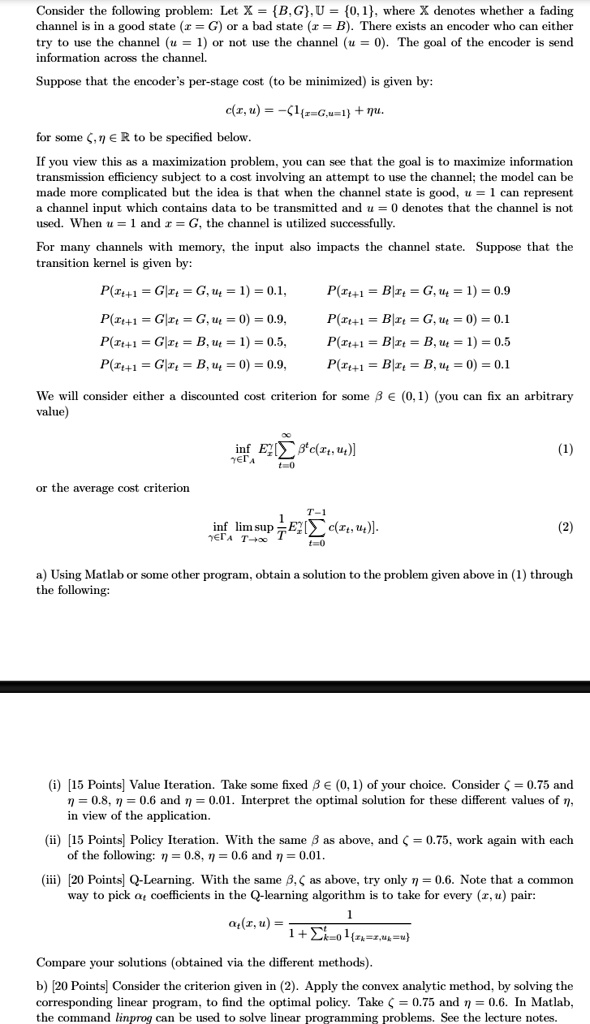
Consider the following problem: Let X = {B, G}, U = {0, 1}, where X denotes whether a fading channel is in a good state (G) or a bad state (B). There exists an encoder who can either try to use the channel (u = 1) or not use the channel (u = 0). The goal of the encoder is to send information across the channel. Suppose that the encoder's per-stage cost (to be minimized) is given by: c(x, u=1) = {r=G, u=1} + u, for some (, n R to be specified below. If you view this as a maximization problem, you can see that the goal is to maximize information transmission efficiency subject to a cost involving an attempt to use the channel. The model can be made more complicated, but the idea is that when the channel state is good, u = 1 can represent a channel input which contains data to be transmitted, and u = 0 denotes that the channel is not used. When u = 1 and = G, the channel is utilized successfully. For many channels with memory, the input also impacts the channel state. Suppose that the transition kernel is given by: P(x+1=G|x=G, u=1) = 0.1, P(x+1=B|x=G, =1) = 0.9, P(x+1=G|x=G, =0) = 0.9, P(x+1=B|x=G, u=0) = 0.1, P(x+1=G|x=B, u=1) = 0.5, P(x+1=G|x=B, u=0) = 0.9, P(x+1=B|x=B, u=1) = 0.5, P(x+1=B|x=B, u=0) = 0.1. We will consider either a discounted cost criterion for some (0,1) (you can fix an arbitrary value): infE[c(x,u)] YETA t=0 (1), or the average cost criterion: T r T t=0. a) Using Matlab or some other program, obtain a solution to the problem given above in (1) through the following: (i) [15 Points] Value Iteration. Take some fixed (0, 1) of your choice. Consider = 0.75 and n = 0.8, n = 0.6, and n = 0.01. Interpret the optimal solution for these different values of n, in view of the application. (ii) [15 Points] Policy Iteration. With the same as above, and = 0.75, work again with each of the following: n = 0.8, n = 0.6, and n = 0.01. (iii) [20 Points] Q-Learning. With the same as above, try only n = 0.6. Note that a common way to pick coefficients in the Q-learning algorithm is to take for every (, u) pair: 1 ax,u = 1 + D = 0.1{x=2,u=u}. Compare your solutions (obtained via the different methods). b) [20 Points] Consider the criterion given in (2). Apply the convex analytic method, by solving the corresponding linear program, to find the optimal policy. Take = 0.75 and n = 0.6. In Matlab, the command linproq can be used to solve linear programming problems. See the lecture notes.
View Answer
divider
BEST MATCH

9. i) Consider the integral $\int_1^6 \frac{1}{x+2x^2}dx$. Write a Python code to approximate this integral using a Riemann sum with midpoint rule. Write a Python code 5 to approximate this integral using Monte Carlo (MC) simulations. You may import numpy as np 9. ii) Consider the function $g(k) = \int_1^6 \frac{1}{x+kx^2}dx$. For a fixed positive k, approximate g(k) with a Riemann sum. Use this approximation to plot the function g on interval [0, 5]. You may import matplotlib.pyplot as plt [3%]

View Answer
divider