Carlos Pinilla

University of Colorado at Boulder

Biography

Carlos has not yet added a biography.

Education

Phd Mathematics
University of Colorado at Boulder

Educator Statistics

Numerade tutor for 7 years
1418 Students Helped

Topics Covered

Mastering Equations and Inequalities: Your Guide to Mathematical Success
Breaking Limits: Unlock Your Potential with Our Expert Solutions
Unlocking the Power of Functions: Boost Your Programming Skills
Stand Out with Differentiation Strategies | Boost Your Business
Exploring the World of Derivatives: A Comprehensive Guide
Differential Equations Made Simple: Expert Tips & Resources
Mastering Integrals: Tips and Tricks for Calculus Success
Integration
Mastering Integration Techniques for Optimal Results
Applications of Integration: Exploring Real-World Solutions
Unlock the Power of Vectors: Discover Their Limitless Possibilities
Mastering Vectors: An Introduction to Vector Basics
Master Vector Calculus with Our Comprehensive Guide
Mastering the Basics of Parametric Equations: A Comprehensive Guide
Polar Coordinates: Understanding the Basics and Applications
Understanding Complex Numbers: A Comprehensive Guide
Vector Functions: Understanding the Basics
Introduction to Sequences and Series
Mastering Multiple Integrals: Techniques and Tips
Discover the Best Series to Binge-Watch | Your Ultimate Guide
Mastering Second Order Differential Equations: Tips and Techniques
Unlock the Power of Sequences: Boost Your Productivity
Power Series
Exploring Probability Topics: From Basics to Advanced Strategies
Taylor Series

Carlos's Textbook Answer Videos

06:43
Calculus: Early Transcendentals

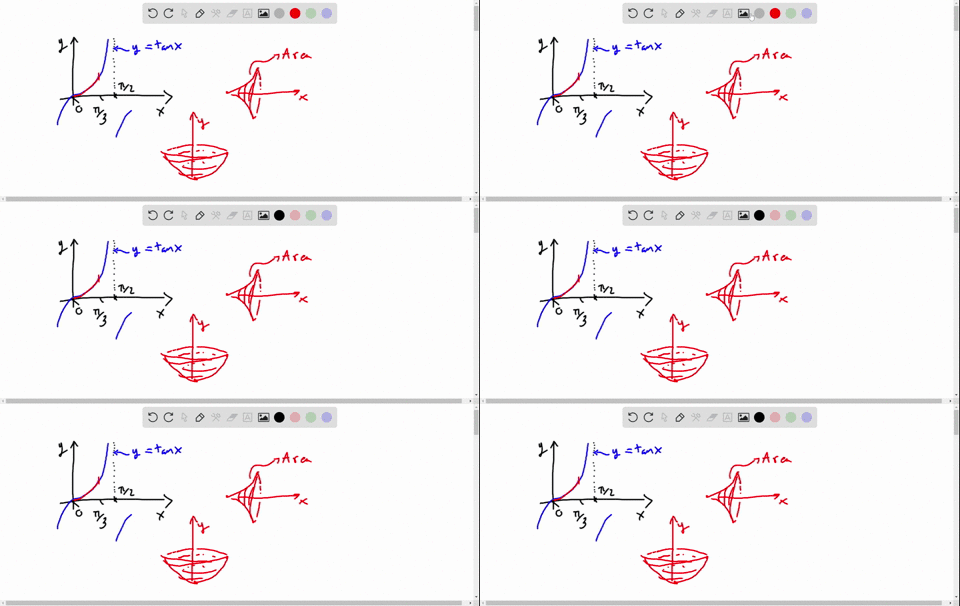
(a) Set up an integral for the area of the surface obtained by rotating the curve about (i) the x-axis and (ii) the y-axis.
(b) Use the numerical integration capability of a calculator to evaluate the surface areas correct to four decimal places.

$ y = \tan x $ , $ 0 \le x \le \frac{\pi}{3} $

Chapter 8: Further Applications of Integration
Section 2: Area of a Surface of Revolution
Carlos Pinilla
06:14
Calculus: Early Transcendentals

(a) Set up an integral for the area of the surface obtained by rotating the curve about (i) the x-axis and (ii) the y-axis.
(b) Use the numerical integration capability of a calculator to evaluate the surface areas correct to four decimal places.

$ y = x^{-2} $ , $ 1 \le x \le 2 $

Chapter 8: Further Applications of Integration
Section 2: Area of a Surface of Revolution
Carlos Pinilla
06:51
Calculus: Early Transcendentals

(a) Set up an integral for the area of the surface obtained by rotating the curve about (i) the x-axis and (ii) the y-axis.
(b) Use the numerical integration capability of a calculator to evaluate the surface areas correct to four decimal places.

$ y = e^{-x^2} $ , $ -1 \le x \le 1 $

Chapter 8: Further Applications of Integration
Section 2: Area of a Surface of Revolution
Carlos Pinilla
07:27
Calculus: Early Transcendentals

(a) Set up an integral for the area of the surface obtained by rotating the curve about (i) the x-axis and (ii) the y-axis.
(b) Use the numerical integration capability of a calculator to evaluate the surface areas correct to four decimal places.

$ x = \ln (2y + 1) $ , $ 0 \le y \le 1 $

Chapter 8: Further Applications of Integration
Section 2: Area of a Surface of Revolution
Carlos Pinilla
07:06
Calculus: Early Transcendentals

(a) Set up an integral for the area of the surface obtained by rotating the curve about (i) the x-axis and (ii) the y-axis.
(b) Use the numerical integration capability of a calculator to evaluate the surface areas correct to four decimal places.

$ x = y + y^3 $ , $ 0 \le y \le 1 $

Chapter 8: Further Applications of Integration
Section 2: Area of a Surface of Revolution
Carlos Pinilla
06:05
Calculus: Early Transcendentals

(a) Set up an integral for the area of the surface obtained by rotating the curve about (i) the x-axis and (ii) the y-axis.
(b) Use the numerical integration capability of a calculator to evaluate the surface areas correct to four decimal places.

$ y = \tan^{-1} x $ , $ 0 \le x \le 2 $

Chapter 8: Further Applications of Integration
Section 2: Area of a Surface of Revolution
Carlos Pinilla
1 2 3 4 5 ... 222