Matthew Winsor

University of Iowa
Professor

Biography

I have been teaching mathematics since 1994. I have taught middle school mathematics, high school mathematics, and college mathematics. Since 2004, I have been teaching university students how to be high school mathematics teachers. My own children have had former students of mine as mathematics teachers. I love teaching mathematics and helping students understand why mathematics works in a manner that is meaningful to them.

Education

Phd Mathematics education
University of Iowa

Educator Statistics

Numerade tutor for 4 years
541 Students Helped

Topics Covered

The Power of Algebraic Language: Unlocking Mathematical Potential
Mastering Equations and Inequalities: Your Guide to Mathematical Success
Understanding Complex Numbers: A Comprehensive Guide
Exploring the World of Derivatives: A Comprehensive Guide
Stand Out with Differentiation Strategies | Boost Your Business
Applications of the Derivative
Unlocking the Power of Geometric Proof: A Comprehensive Guide
Circles: Exploring the Beauty and Significance of Circular Shapes
Unlock the Power of Logic: Boost Your Critical Thinking Skills
Discover the Power of Right Triangles in Geometry
Exploring Relationships Within Triangles
Solving Systems of Equations and Inequalities: A Comprehensive Guide
Unlocking the Power of Functions: Boost Your Programming Skills
Discover the Properties of Congruent Triangles | Exploring Geometry
Calculate Area and Perimeter - Easy Online Tools
Maximize Your Results with Surface Area Optimization
Boost Your Business with High Volume Solutions
Breaking Limits: Unlock Your Potential with Our Expert Solutions
Multivariable Optimization
Mastering Integrals: Tips and Tricks for Calculus Success
Integration
Applications of Integration: Exploring Real-World Solutions
Volume
Exploring Probability Topics: From Basics to Advanced Strategies
Master Geometry Basics for a Strong Foundation
Functions
Mastering Linear Functions: A Comprehensive Guide
Explore the Power of Continuous Functions: Boost Your Mathematical Skills
Unlock Insights with Data-Driven Graphs & Statistics
Mastering Exponential and Logarithmic Functions: Your Ultimate Guide
Mastering Integration Techniques for Optimal Results
Mastering Quadratic Functions: Unlocking Their Power
Mastering Polynomials: Essential Tips and Tricks | [Brand Name]
Rational Functions: Understanding Their Properties and Applications
Discovering Conic Sections: An Introduction
Differential Equations Made Simple: Expert Tips & Resources
Mastering Decimals: Tips and Tricks for Easy Computation
Mastering Exponents and Polynomials: A Comprehensive Guide
Unlocking Insights with Descriptive Statistics: A Comprehensive Guide
Master Trigonometry with Our Comprehensive Guide
Discover the Best Series to Binge-Watch | Your Ultimate Guide
Introduction to Combinatorics & Probability: Understanding the Basics
Mastering Fractions and Mixed Numbers: A Comprehensive Guide

Matthew's Textbook Answer Videos

01:55
Calculus: Early Transcendentals

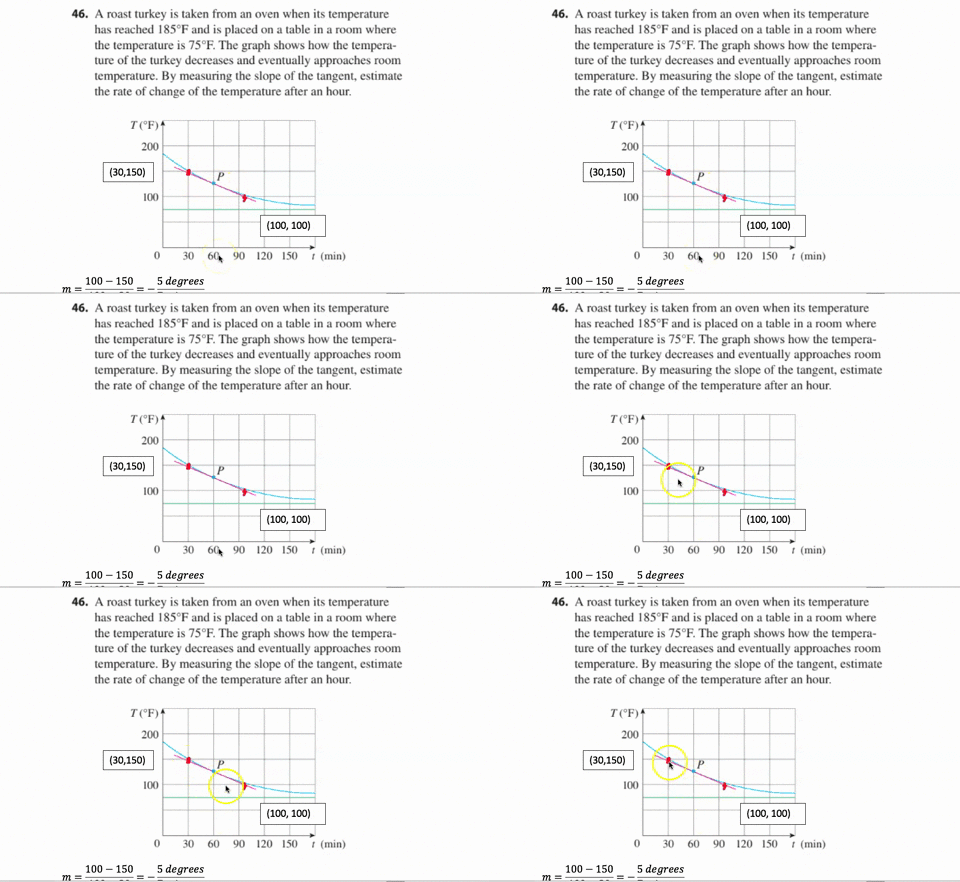
A roast turkey is taken from an oven when its temperature has reached $ 185^{\circ}F $ and is placed on a table in a room where the temperature is $ 75^{\circ}F $. The graph shows how the temperature of the turkey decreases and eventually approaches room temperature. By measuring the slope of the tangent, estimate the rate of change of the temperature after an hour.

Chapter 2: Limits and Derivatives
Section 7: Derivatives and Rates of Change
Matthew Winsor
06:35
Calculus: Early Transcendentals

The graph of the first derivative $ f' $ of a function $ f $ is shown.
(a) On what intervals is $ f $ increasing? Explain.
(b) At what values of $ x $ does $ f $ have a local maximum or minimum? Explain.
(c) On what intervals is $ f $ concave upward or concave downward? Explain.
(d) What are the $ x $-coordinates of the inflection points of $ f $? Why?

Chapter 4: Applications of Differentiation
Section 3: How Derivatives Affect the Shape of a Graph
Matthew Winsor
02:39
Calculus: Early Transcendentals

Sketch the graph by hand using asymptotes and intercepts, but not derivatives. Then use your sketch as a guide to producing graphs (with a graphing device) that display the major features of the curve. Use these graphs to estimate the maximum and minimum values.

$ f(x) = \dfrac{(2x + 3)^2(x - 2)^5}{x^3(x - 5)^2} $

Chapter 4: Applications of Differentiation
Section 6: Graphing with Calculus and Calculators
Matthew Winsor
02:58
Calculus: Early Transcendentals

Use the arc length formula to find the length of the curve $ y = \sqrt{2 - x^2} $, $ 0 \le x \le 1 $. Check your answer by noting that the curve is part of a circle.

Chapter 8: Further Applications of Integration
Section 1: Arc Length
Matthew Winsor
03:43
Calculus: Early Transcendentals

Solve the differential equation.
$ \frac {dy}{dx} = x \sqrt y $

Chapter 9: Differential Equations
Section 3: Separable Equations
Matthew Winsor
03:33
Precalculus with Limits

A relation that assigns to each element $x$ from a set of inputs, or ________, exactly one element $y$ in a set of outputs, or ________, is called a ________.

Chapter 1: Functions and Their Graphs
Section 4: Functions
Matthew Winsor
1 2 3 4 5 ... 13

Matthew's Quick Ask Videos

03:07
Algebra

A company sells x units of a product at a
price of p dollars each unit. If the total
monthly profit depending on x is given by:
P(x) = (60x -
0.01x2) - (2000 + 25x).
Then to maximize the profit:

Matthew Winsor
04:08
Calculus 1 / AB

Let and Then
The graph of the function is having a horizontal
tangent at x =

Matthew Winsor
06:17
Calculus 3

Which of the following statements are TRUE about the Normal Distribution? Check all that apply:
The graph of the Normal Distribution is bell-shaped, with tapering tails that never actually touch the horizontal axis.
About 95% of all data values lie within 1 standard deviation of the mean.
The distribution is symmetric with a single peak.
Data values are spread evenly around the mean.
Data values farther from the mean are less common than data values closer to the mean.
50% of the data values lie at or above the mean.
The mean, median and mode are all equal and occur at the center of the distribution.

Matthew Winsor
05:26
Algebra

A regular icosagon and a regular tetracontagon are inscribed in a circle with a radius of 15 units. Which of the two polygons has bigger area and how much? a. Tetracontagon with A = 695.28 sq. units b. Icosagon with A = 703.96 sq. units c. Icosagon with A = 695.28 sq. units d. Tetracontagon with A = 703.96 sq. units

Matthew Winsor
05:34
Prealgebra

Fibonacci sequence and Golden Ratio
Are you a Golden Person? measure carefully the 3 sets of pairs of your body measurements. Fill in the table below and use a calculator to work out the ratios/divisions.

Matthew Winsor
12:11
Geometry

A. Draw 5 equally-spaced inclined lines normal to the given line
B. Draw 5 equally-spaced inclined lines parallel to the given line
C. Draw a circle that circumscribed the given triangle and locate its center
D. Draw a circular arc with radius 30 mm that passes through the point C and tangent to the line AB.

Matthew Winsor
1 2 3 4 5 ... 60