Ryan Kutayiah

Texas A&M University

Biography

Ryan has not yet added a biography.

Education

Phd Physics
Texas A&M University

Educator Statistics

Numerade tutor for 7 years
97 Students Helped

Topics Covered

Discover the Science of Sound and Hearing: Your Guide to Better Listening
Calculating Electrical Power: Resistance and EMF
Understanding Reflection and Refraction of Light: A Comprehensive Guide
Explore the Fascinating World of Wave Optics - Unleash Its Potential

Ryan's Textbook Answer Videos

04:11
University Physics with Modern Physics

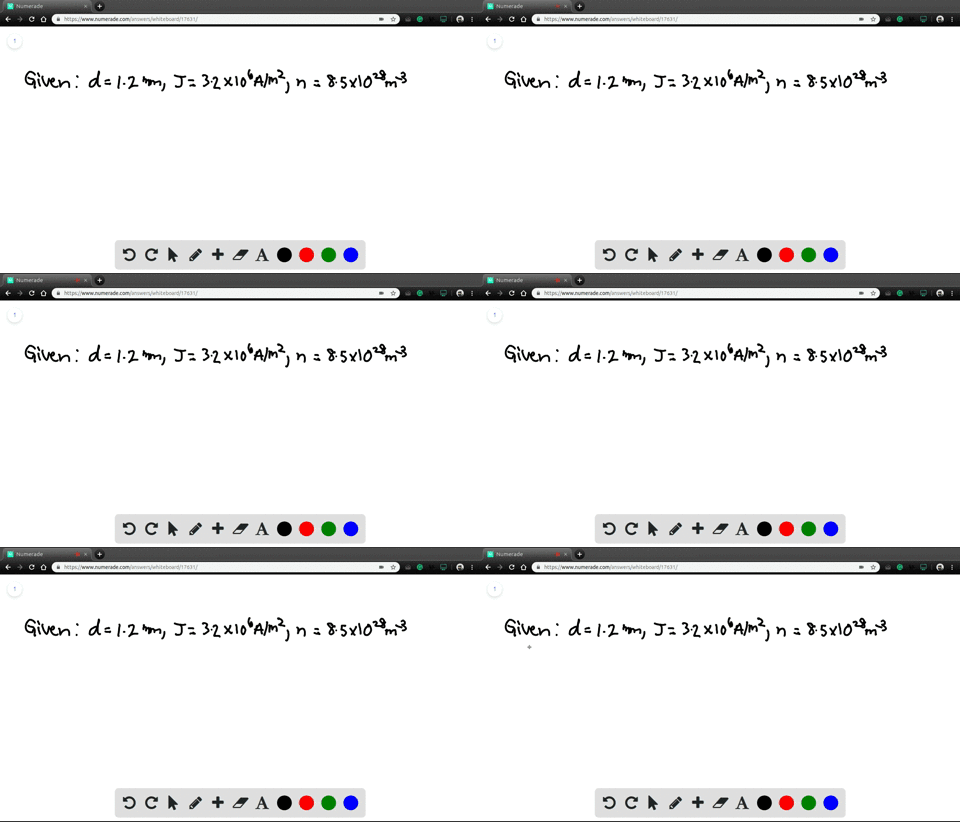
An 18-gauge copper wire (diameter 1.02 mm) carries a current with a current density of $3.20 \times 10{^6} A/m{^2}$. The density of free electrons for copper is $8.5 \times 10^{28}$ electrons per cubic meter. Calculate (a) the current in the wire and (b) the drift velocity of electrons in the wire.

Chapter 25: Current, Resistance, and Electromotive Force
Section 1: Current
Ryan Kutayiah
10:14
University Physics with Modern Physics

You want to produce three 1.00-mm-diameter cylindrical wires, each with a resistance of 1.00 $\Omega$ at room temperature. One wire is gold, one is copper, and one is aluminum. Refer to Table 25.1 for the resistivity values. (a) What will be the length of each wire? (b) Gold has a density of $1.93 \times 10{^4} kg/m{^3}$. What will be the mass of the gold wire? If you consider the current price of gold, is this wire very expensive?

Chapter 25: Current, Resistance, and Electromotive Force
Section 1: Current
Ryan Kutayiah
05:25
University Physics with Modern Physics

Current passes through a solution of sodium chloride. In 1.00 s, $2.68 \times 10^{16}$ Na${^+}$ ions arrive at the negative electrode and $3.92 \times 10^{16}$ Cl${^-}$ ions arrive at the positive electrode. (a) What is the current passing between the electrodes? (b) What is the direction of the current?

Chapter 25: Current, Resistance, and Electromotive Force
Section 1: Current
Ryan Kutayiah
08:52
University Physics with Modern Physics

A copper wire has a square cross section 2.3 mm on a side. The wire is 4.0 m long and carries a current of 3.6 A. The density of free electrons is 8.5 $\times$ 10$^{28}$/m${^3}$. Find the magnitudes of (a) the current density in the wire and (b) the electric field in the wire. (c) How much time is required for an electron to travel the length of the wire?

Chapter 25: Current, Resistance, and Electromotive Force
Section 2: Resistivity
Ryan Kutayiah
02:58
University Physics with Modern Physics

A wire 6.50 m long with diameter of 2.05 mm has a resistance of 0.0290 $\Omega$. What material is the wire most likely made of?

Chapter 25: Current, Resistance, and Electromotive Force
Section 2: Resistivity
Ryan Kutayiah
06:07
University Physics with Modern Physics

A ductile metal wire has resistance $R$. What will be the resistance of this wire in terms of $R$ if it is stretched to three times its original length, assuming that the density and resistivity of the material do not change when the wire is stretched? ($Hint:$ The amount of metal does not change, so stretching out the wire will affect its cross-sectional area.)

Chapter 25: Current, Resistance, and Electromotive Force
Section 3: Resistance
Ryan Kutayiah
1 2 3 4 5 ... 16