I am passionate about teaching. I get a great sense of achievement from seeing my students develop and grow as an individuals. If I can provide a positive impact on their future with my teachings and my guidance ,I feel like I am doing my best. I want to help more and more students. I am pursuing B.TECH in Electronics and communication engineering. I have experience of around 2 years as a tutor. I have worked with Unacademy, Doubtnut, Cheggindia, FILO, Way2class. I am always trying to make the things easier for students.
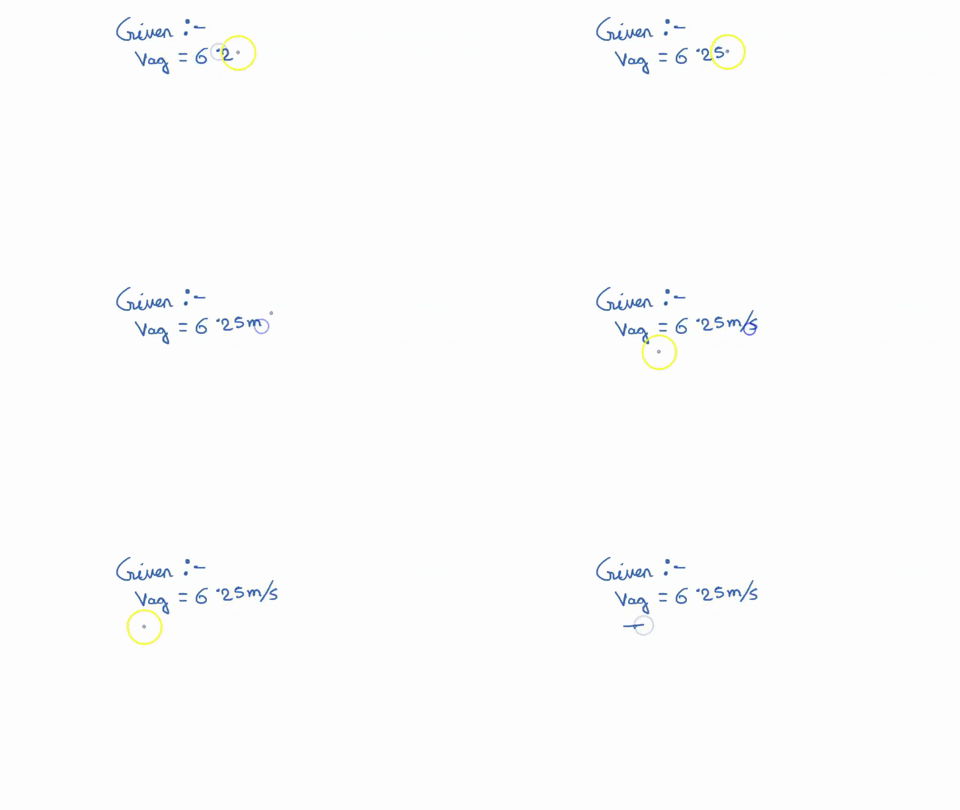
A car travels in the $+x$-direction on a straight and level road. For the first 4.00 s of its motion, the average velocity of the car is $v_{av-x}$ = 6.25 m/s. How far does the car travel in 4.00 s?
An equiconvex lens located in air has radii of $5.20 \mathrm{~cm}$, an index of $1.680$, and a thickness of $3.50 \mathrm{~cm} .$ Calculate (a) the focal length and $(b)$ the power of the lens. Find $(c)$ the distances from the vertices to the focal points and $(d)$ the principal points.
A plano-convex lens $2.80 \mathrm{~cm}$ thick is made of glass of index $1.530 .$ If the second surface has a radius of $3.50 \mathrm{~cm}$, find $(a)$ the focal length of the lens and $(b)$ the power of the lens. Find the distances from the vertices to ( $c$ ) the focal points and $(d)$ the principal points.
A glass lens with radii $r_{1}=+2.50 \mathrm{~cm}$ and $r_{2}=+4.50 \mathrm{~cm}$ has a thickness of $2.90 \mathrm{~cm}$ and an index of 1.630. Calculate $(a)$ the focal length and $(b)$ the power of the lens. Find the distances from the vertices to (c) the focal points and $(d)$ the principal points.
A glass lens with radii $r_{1}=+6.50 \mathrm{~cm}$ and $r_{2}=+3.20 \mathrm{~cm}$ has a thickness of $2.80 \mathrm{~cm}$ and an index of 1.560. Calculate ( $a$ ) the focal length and (b) the power of this lens in air. Find the distances from the vertices to ( $c$ ) the focal points and (d) the principal points.
A thick lens with radii $r_{1}=-4.50 \mathrm{~cm}$ and $r_{2}=-3.60 \mathrm{~cm}$ has a thickness of $3.0 \mathrm{~cm}$ and an index of 1.560. Calculate ( $a$ ) the focal length and (b) the power of the lens. Find also the distances from the vertices to the corresponding (c) focal points and(d) principal points.