Ace - AI Tutor
Ask Our Educators
Textbooks
My Library
Flashcards
Scribe - AI Notes
Notes & Exams
Download App
Analise Guerrero

Analise G.

Divider

Questions asked

ANSWERED

Prakash Hampole verified

Numerade educator

The van der Waals equation of state was designed (by Dutch physicist Johannes van der Waals) to predict the relationship between pressure p, volume V and temperature T for gases better than the Ideal Gas Law does: (p + a(n²/V²))(V - nb) = nRT The van der Waals equation of state. R stands for the gas constant and n for moles of gas. The parameters a and b must be determined for each gas from experimental data. Use the van der Waals equation to answer the questions in the table below. What are the units of a? What are the units of b? For water the numerical value of a is 5.464 and the numerical value of b is 0.0305. Use the van der Waals equation to calculate the pressure of a sample of water at 510.0 °C with a molar volume of 0.183 L/mol. Round your answer to the correct number of significant digits. atm Use the Ideal Gas Law to calculate the pressure of the same sample under the same conditions. Round your answer to the correct number of significant digits. atm

View Answer
divider
ANSWERED

Ivan Kochetkov verified

Numerade educator

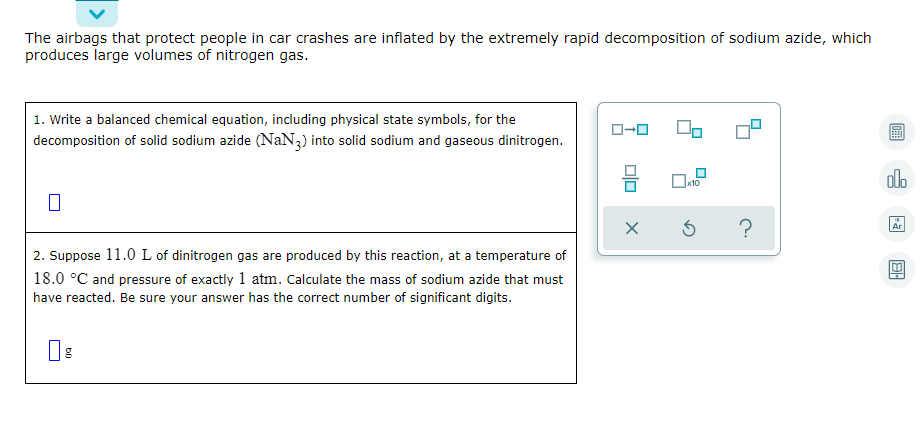
The airbags that protect people in car crashes are inflated by the extremely rapid decomposition of sodium azide, which produces large volumes of nitrogen gas. 1. Write a balanced chemical equation, including physical state symbols, for the decomposition of solid sodium azide (NaN3) into solid sodium and gaseous dinitrogen. 2. Suppose 11.0 L of dinitrogen gas are produced by this reaction, at a temperature of 18.0 °C and pressure of exactly 1 atm. Calculate the mass of sodium azide that must have reacted. Be sure your answer has the correct number of significant digits. g
View Answer
divider
ANSWERED

Alkendra Singh verified

Numerade educator

Suppose 4.08 g of sodium chloride is dissolved in 50. mL of a 0.80 M aqueous solution of silver nitrate. Calculate the final molarity of chloride anion in the solution. You can assume the volume of the solution doesn't change when the sodium chloride is dissolved in it. Be sure your answer has the correct number of significant digits.

View Answer
divider
ANSWERED

Alkendra Singh verified

Numerade educator

An analytical chemist weighs out 0.067 g of an unknown diprotic acid into a 250 mL volumetric flask and dilutes to the mark with distilled water. She then titrates this solution with 0.1100 M NaOH solution. When the titration reaches the equivalence point, the chemist finds she has added 7.3 mL of NaOH solution. Calculate the molar mass of the unknown acid. Be sure your answer has the correct number of significant digits.

View Answer
divider
ANSWERED

Dominique Jan Tan verified

Numerade educator

A chemistry student weighs out 0.154 g of sulfurous acid (H2SO3), a diprotic acid, into a 250. mL volumetric flask and dilutes to the mark with distilled water. He plans to titrate the acid with 0.1600 M NaOH solution. Calculate the volume of NaOH solution the student will need to add to reach the final equivalence point. Be sure your answer has the correct number of significant digits.

View Answer
divider
ANSWERED

Ronald Prasad verified

Numerade educator

Calculate the volume in milliliters of a 3.83 M sodium nitrate solution that contains 125. g of sodium nitrate (NaNO3). Be sure your answer has the correct number of significant digits.

View Answer
divider
ANSWERED

Dominique Jan Tan verified

Numerade educator

One way the U.S. Environmental Protection Agency (EPA) tests for chloride contaminants in water is by titrating a sample of silver nitrate solution. Any chloride anions in solution will combine with the silver cations to produce bright white silver chloride precipitate. Suppose an EPA chemist tests a 250. mL sample of groundwater known to be contaminated with nickel(II) chloride, which would react with silver nitrate solution like this: NiCl2(aq) + 2 AgNO3(aq) ? 2 AgCl(s) + Ni(NO3)2(aq) The chemist adds 80.0 mM silver nitrate solution to the sample until silver chloride stops forming. She then washes, dries, and weighs the precipitate. She finds she has collected 8.7 mg of silver chloride. Calculate the concentration of nickel(II) chloride contaminant in the original groundwater sample. Be sure your answer has the correct number of significant digits.

View Answer
divider
ANSWERED

Dominique Jan Tan verified

Numerade educator

A chemist prepares a solution of iron(II) chloride (FeCl2) by measuring out 38. mg of FeCl2 into a 100. mL volumetric flask and filling to the mark with distilled water. Calculate the molarity of Cl- anions in the chemist's solution. Be sure your answer is rounded to the correct number of significant digits.

View Answer
divider
ANSWERED

Dominique Jan Tan verified

Numerade educator

A chemist adds 365.0 mL of a 4.85 mol/L sodium nitrate (NaNO3) solution to a reaction flask. Calculate the mass in kilograms of sodium nitrate the chemist has added to the flask. Be sure your answer has the correct number of significant digits.

View Answer
divider
ANSWERED

Ronald Prasad verified

Numerade educator

Calculate the volume in milliliters of a 2.20M nickel(II) chloride solution that contains 175. g of nickel(II) chloride (NiCl2). Be sure your answer has the correct number of significant digits.

View Answer
divider