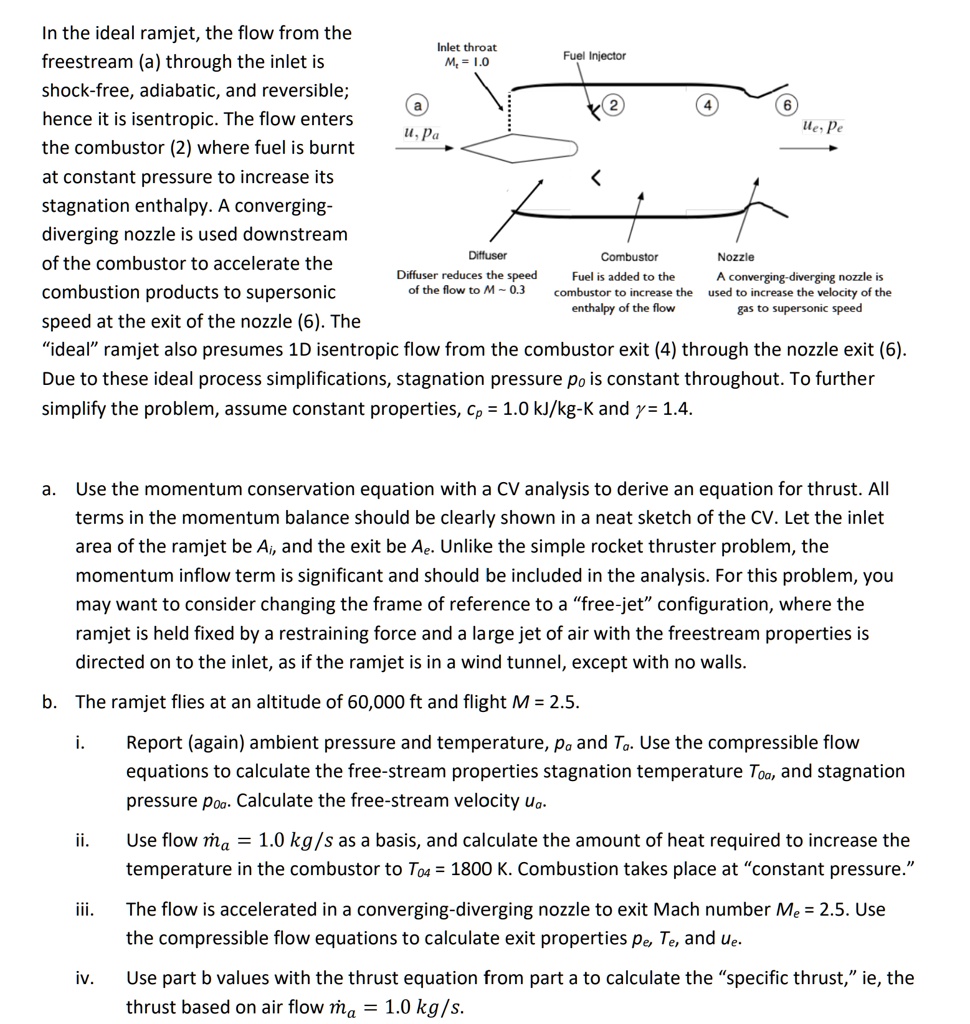
In the ideal ramjet, the flow from the freestream (a) through the inlet is shock-free, adiabatic, and reversible; hence it is isentropic. The flow enters the combustor (2) where fuel is burnt at constant pressure to increase its stagnation enthalpy. A converging-diverging nozzle is used downstream of the combustor to accelerate the combustion products to supersonic speed at the exit of the nozzle (6). The "ideal" ramjet also presumes 1D isentropic flow from the combustor exit (4) through the nozzle exit (6).
Due to these ideal process simplifications, stagnation pressure p0 is constant throughout. To further simplify the problem, assume constant properties, Cp = 1.0 kJ/kg-K and γ = 1.4.
a. Use the momentum conservation equation with a CV analysis to derive an equation for thrust. All terms in the momentum balance should be clearly shown in a neat sketch of the CV. Let the inlet area of the ramjet be Ai, and the exit be Ae. Unlike the simple rocket thruster problem, the momentum inflow term is significant and should be included in the analysis. For this problem, you may want to consider changing the frame of reference to a "free-jet" configuration, where the ramjet is held fixed by a restraining force and a large jet of air with the freestream properties is directed onto the inlet, as if the ramjet is in a wind tunnel, except with no walls.
b. The ramjet flies at an altitude of 60,000 ft and flight M = 2.5.
i. Report (again) ambient pressure and temperature, pa and Ta. Use the compressible flow equations to calculate the free-stream properties stagnation temperature T0a, and stagnation pressure p0a. Calculate the free-stream velocity ua.
ii. Use flow ma = 1.0 kg/s as a basis, and calculate the amount of heat required to increase the temperature in the combustor to T04 = 1800 K. Combustion takes place at "constant pressure."
iii. The flow is accelerated in a converging-diverging nozzle to exit Mach number Me = 2.5. Use the compressible flow equations to calculate exit properties pe, Te, and ue.
iv. Use part b values with the thrust equation from part a to calculate the "specific thrust," i.e., the thrust based on air flow ma = 1.0 kg/s.