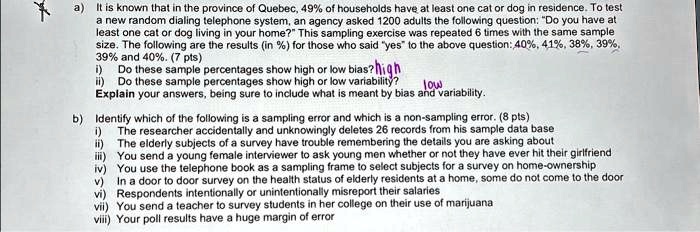
a) It is known that in the province of Quebec, 49% of households have at least one cat or dog in residence. To test
a new random dialing telephone system, an agency asked 1200 adults the following question: "Do you have at
least one cat or dog living in your home?" This sampling exercise was repeated 6 times with the same sample
size. The following are the results (in %) for those who said "yes" to the above question: 40%, 41%, 38%, 39%,
39% and 40%. (7 pts)
i) Do these sample percentages show high or low bias? high
ii) Do these sample percentages show high or low variability? low
Explain your answers, being sure to include what is meant by bias and variability.
b) Identify which of the following is a sampling error and which is a non-sampling error. (8 pts)
i) The researcher accidentally and unknowingly deletes 26 records from his sample data base
ii) The elderly subjects of a survey have trouble remembering the details you are asking about
iii) You send a young female interviewer to ask young men whether or not they have ever hit their girlfriend
iv) You use the telephone book as a sampling frame to select subjects for a survey on home-ownership
v) In a door to door survey on the health status of elderly residents at a home, some do not come to the door
vi) Respondents intentionally or unintentionally misreport their salaries
vii) You send a teacher to survey students in her college on their use of marijuana
viii) Your poll results have a huge margin of error