Marissa Mota

Bridgewater State University
Teacher

Biography

I teach 9th grade science at B.M.C. Durfee High School. I have been a teacher at Durfee for a year and a half. Before that I was a Peer Tutor at the Academic Achievement Center at Bridgewater State University, where I tutored students in biology coarse work. I have gained experience working with all different learners ranging from honors level students to students learning english and students on IEPs and 504 plans.

Education

BS Biology and Secondary Education
Bridgewater State University
MA MAT-Biology
Bridgewater State University

Educator Statistics

Numerade tutor for 6 years
18 Students Helped

Topics Covered

Optimize Your Animal's Health with Proper Nutrition
Circulation and Gas Exchange: Vital Processes for Optimal Health
Boost Your Immune System: Tips and Tricks for a Stronger Defense
Osmoregulation and Excretion: Maintaining Balance and Eliminating Waste
Hormones & The Endocrine System: Understanding the Body's Chemical Messengers
Exploring Animal Reproduction and Development: A Comprehensive Guide
The Incredible Power of the Nervous System: Understanding its Functions
Understanding Animal Behavior: Tips and Insights
Ecosystems and Restoration Ecology: Restoring Balance and Biodiversity
Discover the Power of the Cell: Unleash Your Potential with Our Products
Unlocking the Secrets of Photosynthesis: A Comprehensive Guide
The Importance of Understanding the Cell Cycle for Cellular Reproduction
The Fascinating Chemistry of Life: Discovering the Building Blocks
Mastering Metabolism 101: A Beginner's Guide
Cellular Respiration and Fermentation: Understanding the Basics

Marissa's Textbook Answer Videos

10:31
SAT Biology E/M

All of the following are true about blood EXCEPT
(A) white blood cells are formed in the bone marrow
(B) platelets are not cells but are cell fragments
(C) arteries contain valves to help in the pumping of blood
(D) the liquid portion of the blood is called plasma
(E) red blood cells live about 120 days

Chapter 5: ORGANISMAL BIOLOGY
Section 3: Human Physiology
Marissa Mota
10:19
SAT Biology E/M

(A) Imprinting
(B) Classical conditioning
(C) Fixed action pattern
(D) Altruism
(E) Operant conditioning
Innate, highly stereotypical behavior, which, once begun, is continued to completion no matter how useless

Chapter 6: SAMPLE TEST
Section 1: Biology E/M Sample Test 1
Marissa Mota
04:00
Biology Today and Tomorrow with Physiology

Which of the following statements is not correct?
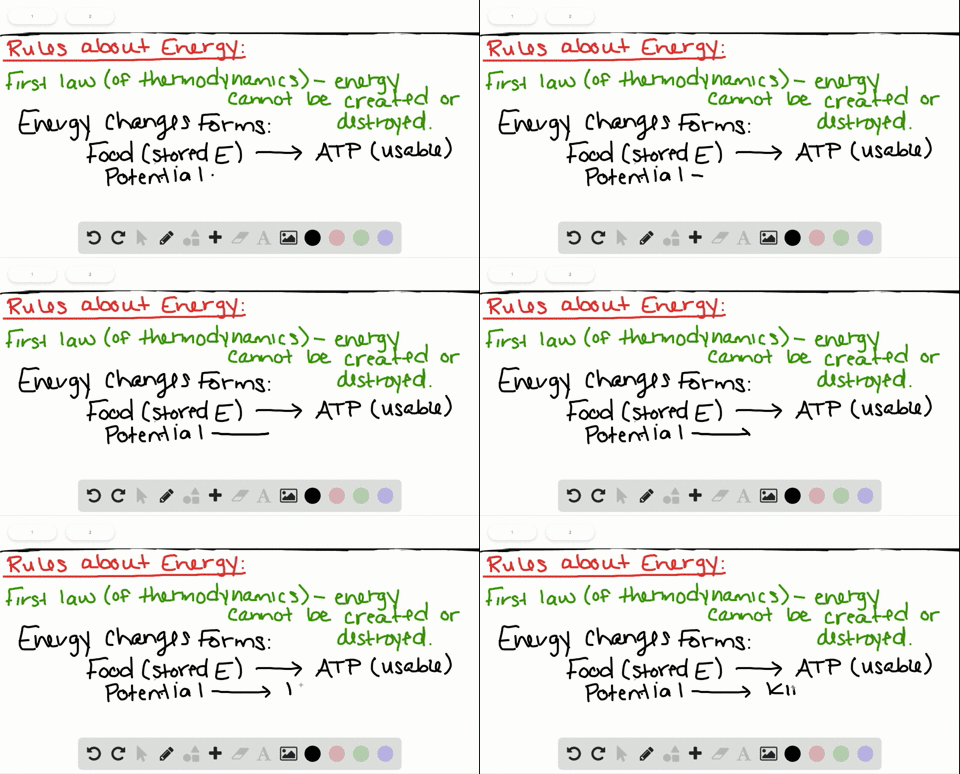
a. Energy cannot be created or destroyed.
b. Energy cannot change from one form to another.
c. Energy tends to disperse spontaneously.

Chapter 4: Energy and Metabolism
Marissa Mota
03:11
Biology Today and Tomorrow with Physiology

If we liken a reaction to an energy hill, then a reaction that __________ is an uphill run.
a. requires energy
b. releases energy
c. runs backward
d. uses an enzyme and a cofactor

Chapter 4: Energy and Metabolism
Marissa Mota
01:53
Biology Today and Tomorrow with Physiology

In an energy-requiring reaction, activation energy is a bit like ___________.
a. a burst of speed at the top of a reaction
b. products coasting downhill
c. a hill that reactants must climb

Chapter 4: Energy and Metabolism
Marissa Mota
1 2 3