Bryce Werts

Wright State University
Researcher

Biography

I am a high-achieving student with a knack for rapid learning, and I have often been implored to tutor others because of it. When I have tutored, I have been met with great success, and I am interested in trying my hand at something more difficult than one-on-one tutoring. I spend much of my free time at home on my computer, and I have been in dire need of something to do during that time.

Education

BS Chemistry
Wright State University

Educator Statistics

Numerade tutor for 5 years
210 Students Helped

Topics Covered

Explore the Fascinating World of Nuclear Chemistry
Mastering Chemical Reactions and Stoichiometry for Optimal Results
Unlocking the Power of Chemical Reactions: A Comprehensive Guide
Discover the Power of Alkynes: Properties, Reactions, and Applications
Acids and bases
Acid-Base Equilibria: Understanding the Balance
Understanding Acids and Bases: A Comprehensive Guide
Understanding Chemical Equilibrium: A Comprehensive Guide
Atoms, Molecules, and Ions: Understanding the Building Blocks of Matter
Discover the Wonders of Chemistry: Your Introductory Guide
Understanding Electronic Structure: A Comprehensive Guide
Unlocking the Power of Periodic Table Properties | Boost Your Knowledge
Unlocking the Power of Composition: Tips and Techniques
Understanding Structure and Bonding: A Comprehensive Guide
Understanding Chemical Bonding: The Key to Molecular Structure
Discover the Power of Gases: Benefits and Applications

Bryce's Textbook Answer Videos

04:08
Chemistry: Structure and Properties

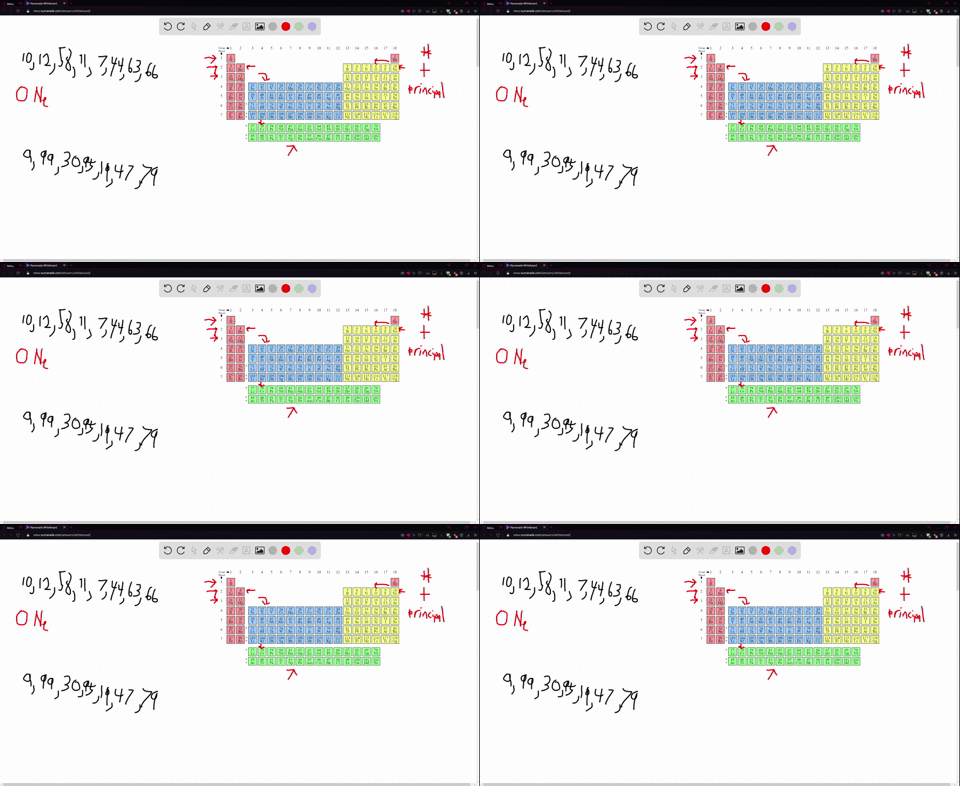
You have cracked a secret code that uses elemental symbols to spell words. The code uses numbers to designate the elemental symbols. Each number is the sum of the atomic number and the highest principal quantum number of the highest occupied orbital of the element whose symbol is to be used.
Messages may be written forward or backward. Decode the following messages:

a. 10, 12, 58, 11, 7, 44, 63, 66
b. 9, 99, 30, 95, 19, 47, 79

Chapter 3: Periodic Properties of the Elements
Bryce Werts
03:56
Chemistry: Structure and Properties

A mixture of 50.0 g of S and 1.00 * 102 g of Cl2 reacts completely to form S2Cl2 and SCl2. What mass of S2Cl2 forms?

Chapter 4: Molecules and Compounds
Bryce Werts
02:59
Chemistry The Central Science

Make the following conversions: (a) $72^{\circ} \mathrm{F}$ to $^{\circ} \mathrm{C},$ (b) $216.7^{\circ} \mathrm{C}$ to $^{\circ} \mathrm{F},(\mathbf{c}) 233^{\circ} \mathrm{C}$ to $\mathrm{K},(\mathbf{d}) 315 \mathrm{K} \mathrm{to}^{\circ} \mathrm{F},(\mathbf{e}) 2500^{\circ} \mathrm{Fto} \mathrm{K},(\mathbf{f}) 0 \mathrm{K}$ to $^{\circ} \mathrm{F}$

Chapter 1: Introduction: Matter, Energy, and Measurement
Bryce Werts
01:33
Chemistry The Central Science

Only two isotopes of copper occur naturally: 63 Cu (atomic mass $=62.9296$ amu; abundance 69.17$\%$ and 65 (atomic mass $=64.9278$ amu; abundance 30.83$\%$ ). Calculate the atomic weight (average atomic mass) of copper.

Chapter 2: Atoms, Molecules, and lons
Bryce Werts
01:55
Chemistry The Central Science

A compound whose empirical formula is $X F_{3}$ consists of 65$\%$ F by mass. What is the atomic mass of $X ?$

Chapter 3: Chemical Reactions and Reaction Stoichiometry
Bryce Werts
03:53
Chemistry The Central Science

(a) What is meant by the term isomer? (b) Among the four alkanes, ethane, propane, butane, and pentane, which is capable of existing in isomeric forms?

Chapter 2: Atoms, Molecules, and lons
Bryce Werts
1 2 3 4 5 ... 13

Bryce's Quick Ask Videos

02:51
Chemistry 101

Cyclopropane is an interesting hydrocarbon. Instead of having three carbons in a row, the three carbons form a ring, as shown in this perspective drawing (see Figure 2.18 for a prior
example of this kind of drawing): Cyclopropane was at one time used as an anesthetic, but its use was discontinued, in part because it is highly flammable. (a) What is the empirical formula of cyclopropane? How does it differ from that of propane? (b) The three carbon atoms are necessarily in a plane. What do the different wedges mean? (c) What change would you make to the structure shown to illustrate chlorocyclopropane? Are there isomers of chlorocyclopropane?

Bryce Werts
06:24
Chemistry 101

Write the balanced equation, then outline the steps necessary to determine the information requested in each of the following:
(a) The number of moles and the mass of chlorine, $\mathrm{Cl}_{2},$ required to react with 10.0 $\mathrm{g}$ of sodium metal, Na, to produce
sodium chloride, NaCl.
(b) The number of moles and the mass of oxygen formed by the decomposition of 1.252 $\mathrm{g}$ of mercury(II) oxide.
(c) The number of moles and the mass of sodium nitrate, required to produce 128 $\mathrm{g}$ of oxygen. (\textrm{NaNO} _ { 2 } \text { is } the other product.)
(d) The number of moles and the mass of carbon dioxide formed by the combustion of 20.0 $\mathrm{kg}$ of carbon in an
excess of oxygen.
(e) The number of moles and the mass of copper(II) carbonate needed to produce 1.500 $\mathrm{kg}$ of copper(II) oxide. $\left(\mathrm{CO}_{2}\right.$
is the other product.)
(f)

Bryce Werts
01:33
Chemistry 101

Only two isotopes of copper occur naturally: 63 Cu (atomic mass $=62.9296$ amu; abundance 69.17$\%$ and 65 (atomic mass $=64.9278$ amu; abundance 30.83$\%$ ). Calculate the atomic weight (average atomic mass) of copper.

Bryce Werts
00:49
Chemistry 101

If an aspirin tablet contains 325 mg aspirin, how many grams of aspirin does it contain?

Bryce Werts
03:22
Chemistry 101

How many protons, neutrons, and electrons are in each of the following atoms or ions?
a. $_{12}^{24} \mathrm{Mg}$
b. $_{12}^{24} \mathrm{Mg}^{2+}$
c. $_{27}^{59} \mathrm{Co}^{2+}$
d. $_{27}^{59} \mathrm{Co}^{3+}$
e. $_{2}^{59} \mathrm{Co}$
f. $_{34}^{79} \mathrm{Se}$
g. $_{34}^{79} \mathrm{Se}^{2-}$
h. $_{28}^{63} \mathrm{Ni}$
i. $_{28}^{59} \mathrm{Ni}^{2+}$

Bryce Werts
03:37
Chemistry 101

Write the formula for each of the following compounds:
a. ammonium hydrogen phosphate
b. mercury(I) sulfide
c. silicon dioxide
d. sodium sulfite
e. aluminum hydrogen sulfate
f. nitrogen trichloride
g. hydrobromic acid
h. bromous acid
i. perbromic acid
j. potassium hydrogen sulfide
k. calcium iodide
l. cesium perchlorate

Bryce Werts
1 2 3 4 5 ... 22