I’m an uprising sophomore at the University of San Francisco, pursuing my undergraduate studies in physics while obtaining my teaching credentials and Masters in Teaching. I have had experience as a tutor ever since High School, both formally and informally through the many extracurricular activities I have been involved in.
I was born in Bolivia, where I lived for 14 years, and then I moved to Panama for 5 years. Living in these two countries has taught me a lot about the education gap and made me passionate about dedicating my career to become an educator that can contribute to closing the gap, especially through science. This is why my goal after college is to teach High School science at a public school.
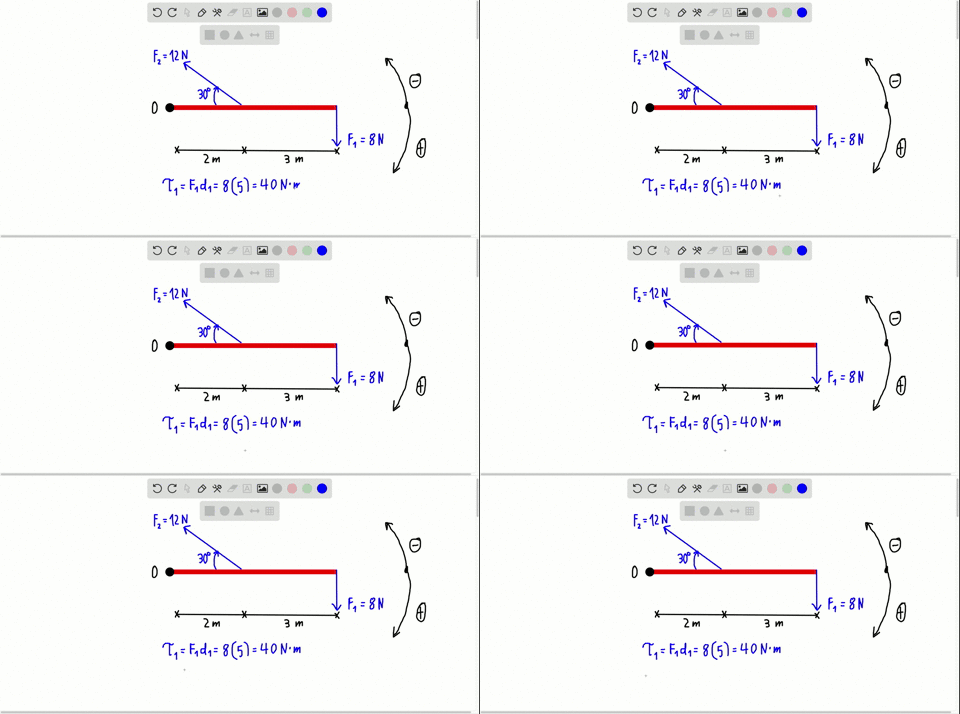
Calculate the net torque about point O for the two forces applied as in $\textbf{Fig. E10.2.}$ The rod and both forces are in the plane of the page.Figure E10.2 (CAN'T COPY THE FIGURE)
An 8.00-kg block of ice, released from rest at the top of a 1.50-m-long frictionless ramp, slides downhill, reaching a speed of 2.50 m/s at the bottom. (a) What is the angle between the ramp and the horizontal? (b) What would be the speed of the ice at the bottom if the motion were opposed by a constant friction force of 10.0 N parallel to the surface of the ramp?
In a laboratory experiment on friction, a 135-N block resting on a rough horizontal table is pulled by a horizontal wire. The pull gradually increases until the block begins to move and continues to increase thereafter. $\textbf{Figure E5.26}$ shows a graph of the friction force on this block as a function of the pull. (a) Identify the regions of the graph where static friction and kinetic friction occur. (b) Find the coefficients of static friction and kinetic friction between the block and the table. (c) Why does the graph slant upward at first but then level out? (d) What would the graph look like if a 135-N brick were placed on the block, and what would the coefficients of friction be?Figure e5.26(Figure Cant copy)
A small car with mass 0.800 kg travels at constant speed on the inside of a track that is a vertical circle with radius 5.00 m (Fig. E5.45). If the normal force exerted by the track on the car when it is at the top of the track (point $B$) is 6.00 N, what is the normal force on the car when it is at the bottom of the track (point $A$)?
Two blocks connected by a cord passing over a small, frictionless pulley rest on frictionless planes $\textbf{(Fig. P5.90).}$ (a) Which way will the system move when the blocks are released from rest? (b) What is the acceleration of the blocks? (c) What is the tension in the cord? Figure e5.90(Figure Cant copy)
Block $A$ in $\textbf{Fig. P5.76}$ weighs 60.0 N. The coefficient of static friction between the block and the surface on which it rests is 0.25. The weight w is 12.0 N, and the system is in equilibrium. (a) Find the friction force exerted on block $A$. (b) Find the maximum weight $w$ for which the system will remain in equilibrium. Figure e5.76(Figure Cant copy)
could you assist to help me solve this problem? Thank you!
The maximum gauge pressure in a hydraulic lift is 126,349 Pa. What is the largest-weight vehicle (N) it can lift if the area of the output line is 0.07 m2?
In a laboratory experiment on friction, a 135-N block resting on a rough horizontal table is pulled by a horizontal wire. The pull gradually increases until the block begins to move and continues to increase thereafter. $\textbf{Figure E5.26}$ shows a graph of the friction force on this block as a function of the pull. (a) Identify the regions of the graph where static friction and kinetic friction occur. (b) Find the coefficients of static friction and kinetic friction between the block and the table. (c) Why does the graph slant upward at first but then level out? (d) What would the graph look like if a 135-N brick were placed on the block, and what would the coefficients of friction be?
Two blocks connected by a cord passing over a small, frictionless pulley rest on frictionless planes $\textbf{(Fig. P5.90).}$ (a) Which way will the system move when the blocks are released from rest? (b) What is the acceleration of the blocks? (c) What is the tension in the cord?
A 75.0-kg person stands on a scale in an elevator. What does the scale read (in N and in kg) when ($a$) the elevator is at rest, ($b$) the elevator is climbing at a constant speed of 3.0 m/s, ($c$) the elevator is descending at 3.0 m/s, ($d$) the elevator is accelerating upward at 3.0 m/s$^2$, ($e$) the elevator is accelerating downward at 3.0 m/s$^2$?
Three balls of different masses are thrown straight upward with initial speeds as indicated.a. From fastest to slowest, rank the speeds of the balls 1 s after being thrown.b. From greatest to least, rank the accelerations of the balls 1 s after being thrown. (Or are the accelerations the same?)