I have multiple years of teaching experience and am certified to teach Biology grades 7-12. I have a bachelors degree in biology from The Ohio State University and a masters degree in education from Johns Hopkins University.
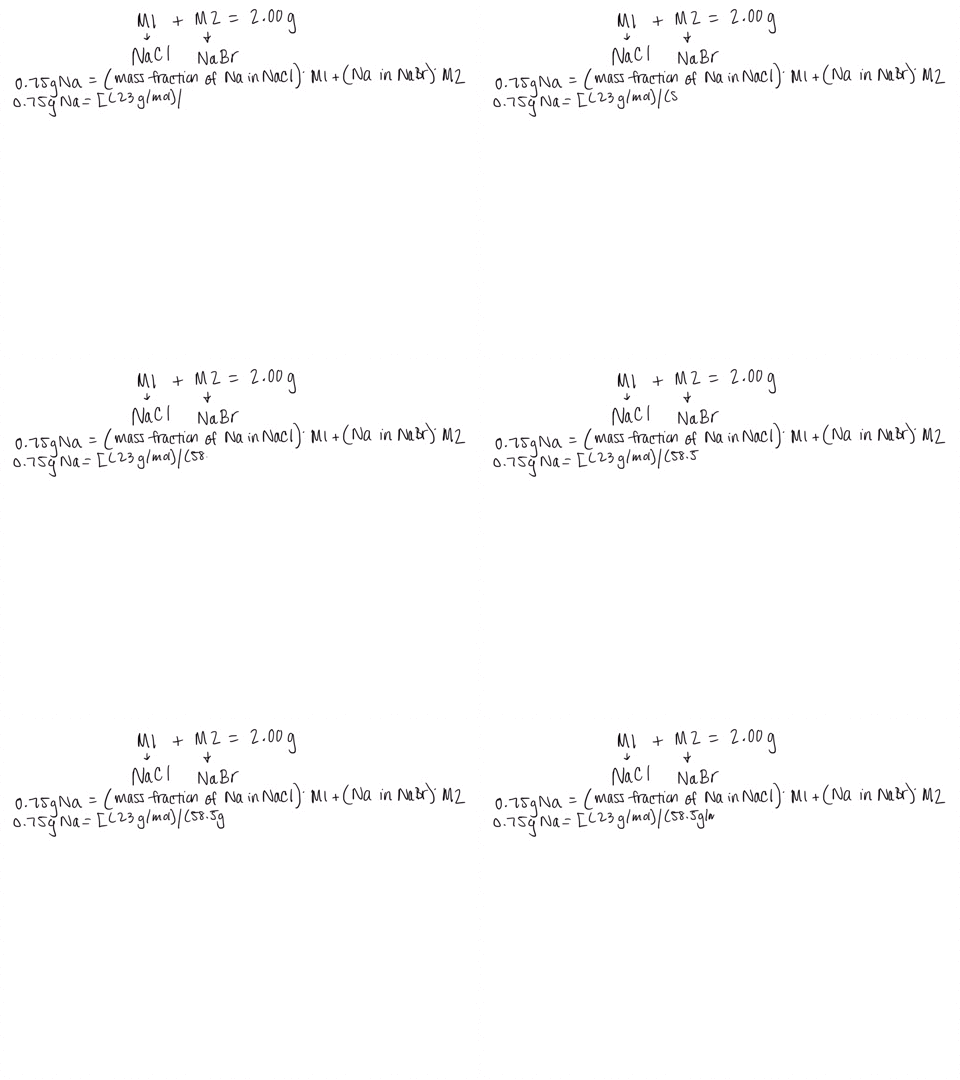
A mixture of NaCl and NaBr has a mass of 2.00 g and contains 0.75 g of Na. What is the mass of NaBr in the mixture?
HOW DO YOU SEE IT? How would you describe the instantaneous rate of change of an automobile's position on a highway/
Which of the following processes are spontaneous? Which are nonspontaneous?(a) Diffusion of perfume molecules from one side of a room to the other(b) Heat flow from a cold object to a hot object(c) Decomposition of rust $\left(\mathrm{Fe}_{2} \mathrm{O}_{3} \cdot \mathrm{H}_{2} \mathrm{O}\right)$ to iron metal, oxygen, and water(d) Decomposition of solid $\mathrm{CaCO}_{3}$ to solid CaO and gaseous $\mathrm{CO}_{2}$ at $25^{\circ} \mathrm{C}$ and 1 atm pressure $\left(K_{\mathrm{p}}=1.4 \times 10^{-23}\right)$
Silver chloride has a solubility of 0.007 $\mathrm{mg} / \mathrm{mL}$ in water at $5^{\circ} \mathrm{C} .$ What is the osmotic pressure in atmospheres of a saturated solution of AgCl?
Simplify each expression.$$\sqrt{\frac{81}{5}}$$
Lunch: Sweet and sour deep-fried chicken with white riceDinner: Burger with bacon and cheese served with fries
(a) What is the health concern of this menu in terms of fat content if Mary always has this menu? (5 marks)(b) List out the food items in the above menu which are protein food group. According to MyPlate, what are the recommendations for the intake of the Protein group? (5 marks)(c) If Mary always faces the problem of constipation, suggest some ways to modify the above menu in order to prevent constipation with an explanation. (10 marks)(d) Mary likes to use a lot of soy sauce and salt to cook. Suggest at least 3 ways with examples for Mary to reduce the risk of high sodium intake in her diet. State the risk of high sodium intake in the diet. (10 marks)
Sometimes mutations are silent, having no effect on the protein produced. Other times, the mutation can have a serious impact on the protein that is produced. Return to your original DNA strand. Below, is a mutated copy of that strand. Both of the following mutations are point mutations; that is, one nucleotide is substituted, added, or deleted.
DNAT A C A T G T A T C A G A C G A C C C C C G A C A T CmRNAAmino acidsFigure 0.6 Translating the mRNA message from mutated DNA into a polypeptideEnter the complimentary mRNA sequence into Figure 12.6.Use the genetic code to determine which amino acids will be needed and in what order they will be delivered to the ribosome. Using the genetic code from Figure 12.5, complete the diagram in Figure 12.6.Study Figure 12.6 carefully. Check this version of the DNA with the original base by base until you find the mutation.Locate the mutation and circle it.What type of mutation occurred here?Compare the protein produced by this mutated sequence to the original protein (seen in Figure 12.4). Do you think this new protein will function the same as the original one? Why or why not?
How many of the following compounds can exist as a single enantiomer in solution?None of themOneTwoAll of them
Mitochondria is one of the organelles that are reorganized and redistributed during cell division and you would like to observe the movement of mitochondria for each stage of mitosis, if they are affected by viral infection.
a. How do you prepare your samples to observe under microscope to allow tracking the movement of mitochondria, explain the steps to do this (2 points)?
b. What type of microscope would you use to visualize your sample and why (2 points)?
Write the recurring decimal 0.123 as a fraction in its simplest form.
In normal healthy adult, Calculate the Gain of control system of cold temperature if A cold exposure is expected to bring the body temperature down to 20°C but brings it down only to 36.5°C?