Ace - AI Tutor
Ask Our Educators
Textbooks
My Library
Flashcards
Scribe - AI Notes
Notes & Exams
Download App
eduardo leanos

eduardo l.

Divider

Books Assigned

Hydrodynamics of Suspensions: Fundamentals of Centrifugal and Gravity Separation

Hydrodynamics of Suspensions:…

Professor Dr.… 1st Edition
Achievement 1,202 solutions

Viewed Questions

For a given point the instantaneous flow field properties (e.g., density and velocity) have been recorded vs. time; we are interested in the time averages. The averaging interval is $\tau^*$, and let $\tau_f^*(f=C$ or $D)$ denote the union of sub-intervals in $\tau^*$ during which the component $f$ occupied the point (i.e., $\tau^*=\tau_D^*+\tau_C^*$ ). For the dependent variable $\mathcal{Y}$ we define the phase-averaged $\left\langle\mathcal{Y}_f\right\rangle$ and the mass weighted phase-averaged $\langle\mathcal{Y}\rangle_{\text {mw }}$ by $$ \left\langle\mathcal{Y}_f\right\rangle=\frac{1}{\tau_f^*} \int_{\mathrm{r}^* \epsilon \tau_f^*} \mathcal{Y}(t) d t ;\left\langle\mathcal{Y}_f\right\rangle_{\mathrm{mw}}=\frac{\left\langle\left(\rho_f \mathcal{Y}_f\right)\right\rangle}{\left\langle\rho_f\right\rangle} $$ Write particular expressions for the phase-averaged $\mathcal{Y}=1, \mathcal{Y}=\rho^*$ and $\mathcal{Y}=\mathbf{v}^*$, for $f=D$ and $C$ and give interpretations. Show that for constant $\rho_D^*$ and $\rho_C^*$ we obtain $\left\langle\mathcal{Y}_f\right\rangle=\left\langle\mathcal{Y}_f\right\rangle_{\mathrm{mw}}$.

Hydrodynamics of Suspensions: Fundamentals of Centrifugal and Gravity Separation

Using the curved arrows as a guide to placing the electrons, write a resonance structure for each of the compounds shown. The resonance structure should include formal charges where appropriate.

Using the curved arrows as a guide to placing the electrons, write a resonance structure for each of the compounds shown. The resonance structure should include formal charges where appropriate.

Chemistry

Assume that one ventricle of a child's heart has an EDV of $90 \mathrm{~mL}$, an ESV of $60 \mathrm{~mL}$, and a cardiac output of $2.55 \mathrm{~L} / \mathrm{min}$. What are the child's stroke volume (SV), ejection fraction (EF), and heart rate (HR)? a. $\mathrm{SV}=60 \mathrm{~mL} ; \mathrm{EF}=33 \% ; \mathrm{HR}=85 \mathrm{bpm}$ b. $S V=30 \mathrm{~mL} ; \mathrm{EF}=60 \% ; \mathrm{HR}=75 \mathrm{bpm}$ c. $S V=150 \mathrm{~mL} ; E F=67 \% ; \mathrm{HR}=42 \mathrm{bpm}$ d. $S V=30 \mathrm{~mL} ; E F=33 \% ; \mathrm{HR}=85 \mathrm{bpm}$ e. Not enough information is given to calculate these.

Anatomy and Physiology

To get from the right atrium to the right ventricle, blood flows through a. the pulmonary valve. b. the tricuspid valve. c. the bicuspid valve. d. the aortic valve. e. the mitral valve.

Anatomy and Physiology

Questions asked

ANSWERED

Tavis Lam verified

Numerade educator

2. Determine the final product after the following steps are carried out: 4) \( \mathrm{H}_{2} \mathrm{O} \)

View Answer
divider
ANSWERED

T. L. verified

Numerade educator

3. Draw two resonance structures better than the structure provided. Draw curvy arrows to show how you determined the structures. Note; The lone pair(s) suggested by the formal charge are not shown. Place any lone pairs in the original and subsequent structures.

View Answer
divider
ANSWERED

Tavis Lam verified

Numerade educator

can you explain what a beter resonance structurw is for number.

View Answer
divider
INSTANT ANSWER

can you help me with this practice quiz

View Answer
divider
INSTANT ANSWER

what vales prevent backflow from the ventricles

View Answer
divider
ANSWERED

Ivan Kochetkov verified

Numerade educator

7) (6 pts) A proposed two-step mechanism is shown below. Step 1: G2(g) ? 2 G(g) Step 2: G(g) + AHG3(g) ? HG(g) + AG3(g) Step 3: G(g) + AG3(g) ? AG4(g) a. Write the rate law for each of the elementary steps. b. Write the overall reaction. c. Identify any intermediates in the reaction. d. Identify any catalysts in the reaction. e. What is the overall predicted rate law if the first step is the slow step?

View Answer
divider
ANSWERED

Jenny Wu verified

Numerade educator

5) (5 pts) Given the reaction energy diagram to the right, label the location of the reactants, products, transition state, activation energy, and enthalpy change. Does this diagram show an endothermic or exothermic reaction? Using a dotted line, show how the diagram would change if a catalyst is added. 6) (6 pts) Calculate the activation energy, in kJ/mol, for a given reaction if the rate constant increases from 2.50 s?¹ at a temperature of 22.0°C to 12.5 s?¹ at a temperature of 35.0°C.

View Answer
divider
ANSWERED

Chareen Guzman verified

Numerade educator

3) (5 pts) If the half-life of a first order reaction is 115.7 seconds and the initial reactant concentration is 0.995 M, how long does it take for the concentration of the reactant to go to 38.2 % completion? 4) (8 pts) A second order reaction (A ? 2B) has a rate constant of 0.128 M?¹min?¹. and initial reactant concentration of 0.156 M. a. What is its half life? b. What is the concentration of A remaining after 1950 seconds? c. How long does it take to reach a concentration of 0.0156 M?

View Answer
divider
INSTANT ANSWER

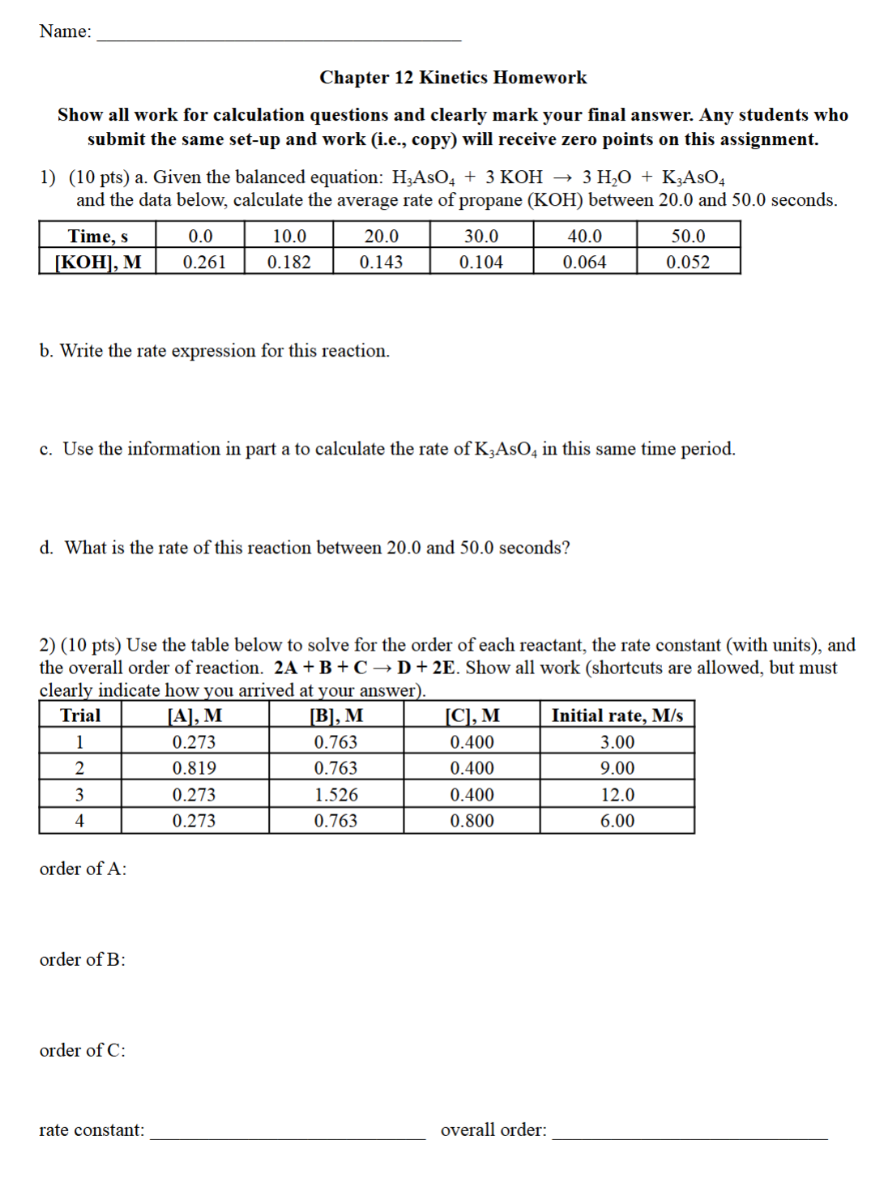
Name: \( \qquad \) Chapter 12 Kinetics Homework Show all work for calculation questions and clearly mark your final answer. Any students who submit the same set-up and work (i.e., copy) will receive zero points on this assignment. 1) ( 10 pts ) a. Given the balanced equation: \( \mathrm{H}_{3} \mathrm{AsO}_{4}+3 \mathrm{KOH} \rightarrow 3 \mathrm{H}_{2} \mathrm{O}+\mathrm{K}_{3} \mathrm{AsO}_{4} \) and the data below, calculate the average rate of propane \( (\mathrm{KOH}) \) between 20.0 and 50.0 seconds. \begin{tabular}{|c|c|c|c|c|c|c|} \hline Time, \( \mathbf{s} \) & 0.0 & 10.0 & 20.0 & 30.0 & 40.0 & 50.0 \\ \hline\( [\mathbf{K O H}], \mathbf{M} \) & 0.261 & 0.182 & 0.143 & 0.104 & 0.064 & 0.052 \\ \hline \end{tabular} b. Write the rate expression for this reaction. c. Use the information in part a to calculate the rate of \( \mathrm{K}_{3} \mathrm{AsO}_{4} \) in this same time period. d. What is the rate of this reaction between 20.0 and 50.0 seconds? 2) ( 10 pts) Use the table below to solve for the order of each reactant, the rate constant (with units), and the overall order of reaction. \( \mathbf{2 A}+\mathbf{B}+\mathbf{C} \rightarrow \mathbf{D}+\mathbf{2 E} \). Show all work (shortcuts are allowed, but must clearly indicate how you arrived at your answer). \begin{tabular}{|c|c|c|c|c|} \hline Trial & {\( [\mathbf{A}], \mathbf{M} \)} & {\( [\mathbf{B}], \mathbf{M} \)} & {\( [\mathbf{C}], \mathbf{M} \)} & Initial rate, M/s \\ \hline 1 & 0.273 & 0.763 & 0.400 & 3.00 \\ \hline 2 & 0.819 & 0.763 & 0.400 & 9.00 \\ \hline 3 & 0.273 & 1.526 & 0.400 & 12.0 \\ \hline 4 & 0.273 & 0.763 & 0.800 & 6.00 \\ \hline \end{tabular} order of A: order of \( B \) : order of C : rate constant: \( \qquad \) overall order: \( \qquad \)
View Answer
divider
INSTANT ANSWER

BIO182 Review Fungi 1. What are the groups of fungi. What are the characteristics that distinguish each group? 2. Know the anatomy of a fungus. For each group what kind of reproductive structures are present? 3. What is the definition of a fungus? How are fungi different than plants and animals. 4. What are lichens and what organisms make up lichens. What is the role of each of these organisms in the mutualistic relationship? Animal Development 1. Understand the developmental phases of an animal from zygote to gastrula (cleavage). 2. What is a tissue and which tissue will each embryonic germ layer become? 3. Compare and contrast diploblastic and triploblastic cleavage. 4. Compare and contrast deuterostomes and protostomes. 5. Compare and contrast radial cleavage and spiral cleavage. 6. Compare and contrast determinant and indeterminant cleavage. 7. What are the three types of symmetry, can you explain each? 8. Define the term animal. 9. Compare and contrast the two types of metamorphosis. Invertebrates 1. Define the term invertebrate. 2. For each of the groups of organisms listed below know examples of animals, unique characteristics that define each group, there developmental characteristics (cleavage, symmetry, ect..), and where they occur on the cladogram. Also know any smaller divisions we outlined in class, for example the different divisions of the Arthropods. a. Porifera b. Cnidaria c. Mollusca d. Platyhelminthes e. Annelida f. Nematoda g. Arthropoda h. Echinodermata i. Two invertebrate chordates, urochordate and cephalochordate) Chordates 1. Define the term chordate. 2. What are the four anatomical features that all chordates possess sometime in their lifecycle. What is the function of each and what will they become? 3. For each of the groups of organisms listed below know examples of animals, unique characteristics that define each group, there developmental characteristics (cleavage,

View Answer
divider