Mark Scythian

Western Michigan University
Teacher

Biography

Hi! My name is Mark Scythian. I am a Physics Educator here at Numerade. Feel free to contact me regarding any questions you may have. Thanks! September 17, 2024

Education

BS Aviation Technical Operations
Western Michigan University

Educator Statistics

Numerade tutor for 6 years
1319 Students Helped

Topics Covered

Find Your Dream Job: Discover the Best Work Opportunities
Unlock the Power of Kinetic Energy: Boost Your Efficiency Today
Unlocking the Power of Potential Energy: Discover the Benefits
Discovering the Fundamentals: Newton's Laws of Motion Explained
Mastering Newton's Laws: Tips for Applying Them Effectively
Understanding Reflection and Refraction of Light: A Comprehensive Guide
Explore the Fascinating World of Wave Optics - Unleash Its Potential
Understanding the First Law of Thermodynamics: Key Concepts
Understanding the Second Law of Thermodynamics: Key Principles
Master Direct Current Circuits with Our Expert Guide
Understanding Alternating Current: A Comprehensive Guide
Understanding Inductance: A Comprehensive Guide
Capacitance and Dielectrics: Understanding the Basics
Understanding Moment Impulse and Collisions for Better Physics
Understanding Temperature and Heat: A Comprehensive Guide
Discover the Science of Sound and Hearing: Your Guide to Better Listening
Exploring the Fascinating World of Mechanical Waves
Understanding Electromagnetic Waves: A Comprehensive Guide
Kinetic Theory Of Gases

Mark's Textbook Answer Videos

08:12
Physics: Principles with Applications

A mass $m$ is attached to a spring which is held stretched a distance $x$ by a force F, Fig. 6-45, and then released. The spring pulls the mass to the left, towards its natural equilibrium length. Assuming there is no friction, determine the speed of the mass m when the spring returns: (a) to its normal length ($x =$ 0); (b) to half its original extension($x$/2). FIGURE 6-45(Figure Cant copy)

Chapter 6: WORK AND ENERGY
Mark Scythian
03:20
University Physics with Modern Physics

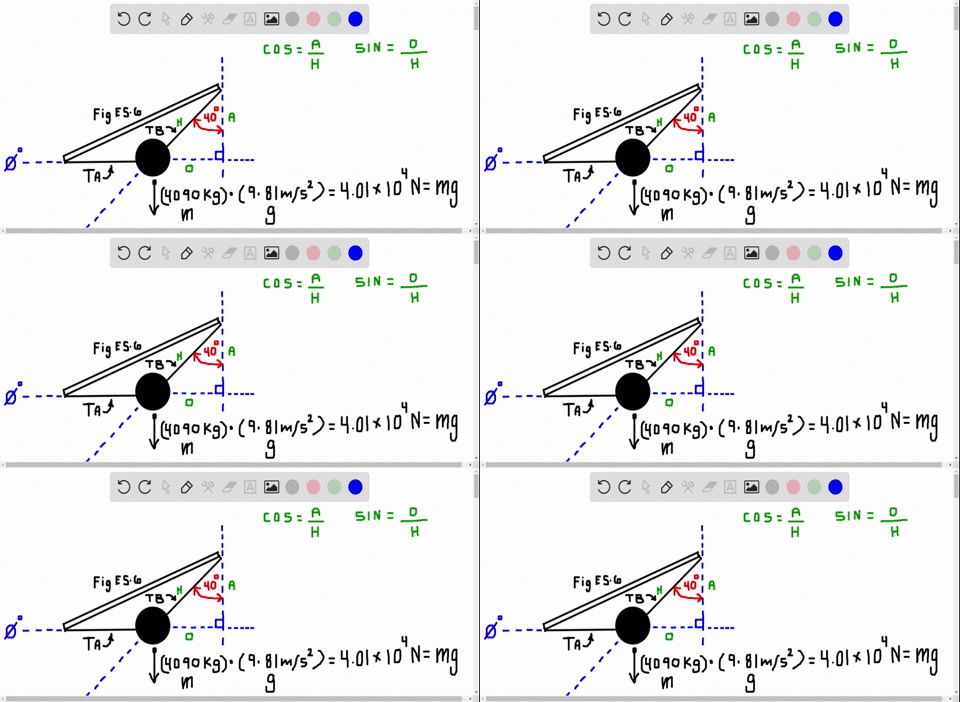
A large wrecking ball is held in place by two light steel cables (Fig. E5.6). If the mass $m$ of the wrecking ball is $4090 \mathrm{kg},$ what are (a) the tension $T_{B}$ in the cable that makes
an and (b) the cable that makes cal and (b) the tension $T_{A}$ in the horizontal cable?

Chapter 5: Applying Newton's Laws
Mark Scythian
05:46
University Physics with Modern Physics

In Fig. E5.10 the weight $w$ is 60.0 $\mathrm{N}$ . (a) What is the ten-sion in the diagonal string? (b) Find the magnitudes of the horizontal forces $\vec{F}_{1}$ and $\vec{F}_{2}$ that must be applied to hold the system in the
position shown.

Chapter 5: Applying Newton's Laws
Mark Scythian
09:03
University Physics with Modern Physics

Genesis Crash. On September $8,2004,$ the Genesis spacecraft crashed in the Utah desert because its parachute did not open. The 210 -kg capsule hit the ground at 311 $\mathrm{km} / \mathrm{h}$ and penetrated the soil to a depth of 81.0 $\mathrm{cm}$ .
(a) Assuming it to be constant, what was its acceleration (in $\mathrm{m} / \mathrm{s}^{2}$ and in $g^{\prime} \mathrm{s} )$ during the crash? \right.
(b) What force did the ground exert on the capsule during the crash? Express the force in newtons and as a multiple of the capsule's weight. (c) For how long did this force last?

Chapter 5: Applying Newton's Laws
Mark Scythian
03:57
University Physics with Modern Physics

Three sleds are being pulled horizontally on frictionless horizontal ice using horizontal ropes (Fig. E5.14). The pull is of magnitude 125 $\mathrm{N} .$ Find (a) the acceleration of the system and (b) the tension in ropes $A$ and $B .$

Chapter 5: Applying Newton's Laws
Mark Scythian
03:00
University Physics with Modern Physics

A light rope is attached to a block with mass 4.00 kg that rests on a frictionless, horizontal surface. The horizontal rope
passes over a frictionless, massless pulley, and a block with mass $m$
is suspended from the other end. When the blocks are released, the
tension in the rope is 10.0 $\mathrm{N}$ (a) Draw two free-body diagrams, one for the $4.00-$ kg block and one for the block with mass $m$ .
(b) What is the acceleration of either block? (c) Find the mass $m$ of
the hanging block. (d) How does the tension compare to the weight
of the hanging block?

Chapter 5: Applying Newton's Laws
Mark Scythian
1 2 3 4 5 ... 25

Mark's Quick Ask Videos

03:13
Algebra

Janine is 19 years old. She opens an account that pays 4.4% interest compounded annually. She sets a goal of saving $2,000 each year. By the time she is 30 years old, how much will her account be worth? Include your work with your answer.

Mark Scythian
04:22
Physics 101 Mechanics

A place-kicker must kick a football from a point 34.0 m from the goal, and half the crowd hopes the ball will clear the crossbar, which is 3.05 m high. When kicked, the ball leaves the ground with a speed of 8.5 m/s at an angle of 30.7° to the horizontal. How high is the ball when it reaches the crossbar?

Mark Scythian
13:43
Physics 101 Mechanics

1. A small, 300 gg cart is moving at
1.60 m/s on a frictionless track when it collides with a
larger, 1.00 kg cart at rest. After the collision,
the small cart recoils at 0.830 m/s .
What is the speed of the large cart after the collision?
Express your answer with the appropriate units.
2. A 3.0 kg block of wood sits on a frictionless
table. A 3.0 gg bullet, fired horizontally at a
speed of 380 m/s , goes completely through the
block, emerging at a speed of 180 m/s .
What is the speed of the block immediately after the bullet
exits?
Express your answer with the appropriate units.
3. A tennis player swings her 1000 gg racket with
a speed of 11 m/s . She hits a
60 gg tennis ball that was approaching her at a speed of
17 m/s . The ball rebounds at 37 m/s .
B. How fast is her racket moving immediately after the impact?
You can ignore the interaction of the racket with her hand for the
brief duration of the collision.
Express your answer in meters per second.
A. If the tennis ball and racket are in contact for
9.0 ms , what is the average force that the racket exerts
on the ball?
Express your answer in newtons.

Mark Scythian
02:21
Physics 101 Mechanics

What is the maximum speed with which a 1500-kg car can make a
turn around a curve of radius 20.0 m on a level (unbanked) road
without sliding? The coefficient of static friction (μs) for rubber
tires on pavement is 0.97. What centripetal force is exerted on the
car as it rounds the curve at the maximum speed?

Mark Scythian
06:33
Physics 101 Mechanics

Suppose the pressure (kPa) was measured in other absolute pressure units (say torr), how would that change your answer for absolute zero? How to identify?

Mark Scythian
03:23
Physics 101 Mechanics

How will adding more mass change the slope of the angular velocity vs time graph? Why?
a. The slope will not change because the angular acceleration will not be related to the mass.
b. The slope will decrease because the angular acceleration is inversely proportional to the added mass.
c. The slope will increase because the angular acceleration is proportional to the added mass.

How does the shape of the graph for angular velocity versus time compare to the shape of the graph for linear velocity versus time?
a. They are the same.
b. They are the same until a certain point.
c. They are different.

Mark Scythian
1 2 3 4 5 ... 157