Bruce Edelman

Purdue University
Graduate Teaching Assisstant

Biography

I received my Bachelor's of Science in Physics from Purdue University in 2017, my Master's of Science in Physics from University of Oregon in 2020 and am currently pursuing my PhD in Physics from University of Oregon. My research is in Gravitational Wave Astronomy, specifically applying Bayesian statistical inference to gravitational wave data from LIGO.

Education

BS Physics
Purdue University
Phd Physics
University of Oregon
MS Physics
University of Oregon

Educator Statistics

Numerade tutor for 7 years
561 Students Helped

Topics Covered

Understanding Reflection and Refraction of Light: A Comprehensive Guide
Master the Fundamentals of Physics: Learn Physics Basics
Electromagnetic Induction: Understanding the Science and Applications
Understanding Inductance: A Comprehensive Guide
Understanding Electromagnetic Waves: A Comprehensive Guide
Explore the Fascinating World of Wave Optics - Unleash Its Potential
Understanding Temperature and Heat: A Comprehensive Guide
Understanding Electric Charge and Field: A Comprehensive Guide
Understanding Gauss's Law: A Comprehensive Guide
Unlocking the Power of Electric Potential: Exploring its Benefits
Capacitance and Dielectrics: Understanding the Basics
Calculating Electrical Power: Resistance and EMF
Master Direct Current Circuits with Our Expert Guide
Unlocking the Power of Magnetic Fields and Forces
Discovering the Sources of Magnetic Fields: A Comprehensive Guide
Exploring the Fascinating World of Quantum Physics
Exploring the Wonders of Atomic Physics: A Comprehensive Guide
Mastering Motion: Achieving Efficiency Along a Straight Line
Unlock the Power of Kinetic Energy: Boost Your Efficiency Today
Unlocking the Power of Potential Energy: Discover the Benefits
Save Energy and Money with Effective Conservation Techniques
Understanding Moment Impulse and Collisions for Better Physics
Understanding Equilibrium and Elasticity: A Comprehensive Guide

Bruce's Textbook Answer Videos

03:32
University Physics with Modern Physics

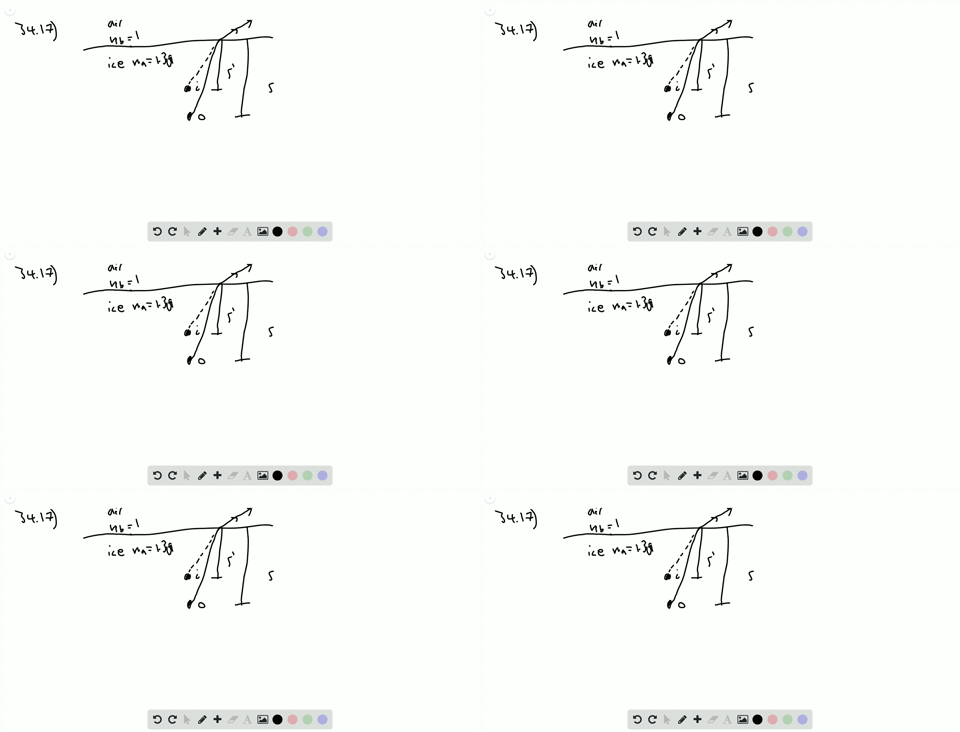
A speck of dirt is embedded 3.50 cm below the surface of a sheet of ice $(n = 1.3092)$. What is its apparent depth when viewed at normal incidence?

Chapter 34: Geometric Optics
Section 3: Refraction at a Spherical Surface
Bruce Edelman
04:24
University Physics with Modern Physics

A person swimming 0.80 m below the surface of the water in a swimming pool looks at the diving board that is directly overhead and sees the image of the board that is formed by refraction at the surface of the water. This image is a height of 5.20 m above the swimmer. What is the actual height of the diving board above the surface of the water?

Chapter 34: Geometric Optics
Section 3: Refraction at a Spherical Surface
Bruce Edelman
05:45
University Physics with Modern Physics

A small tropical fish is at the center of a water-filled, spherical fish bowl 28.0 cm in diameter. (a) Find the apparent position and magnification of the fish to an observer outside the bowl. The effect of the thin walls of the bowl may be ignored. (b) A friend advised the owner of the bowl to keep it out of direct sunlight to avoid blinding the fish, which might swim into the focal point of the parallel rays from the sun. Is the focal point actually within the bowl?

Chapter 34: Geometric Optics
Section 3: Refraction at a Spherical Surface
Bruce Edelman
03:00
University Physics with Modern Physics

The glass rod of Exercise 34.22 is immersed in oil $(n = 1.452)$. An object placed to the left of the rod on the rod's axis is to be imaged 1.20 m inside the rod. How far from the left
end of the rod must the object be located to form the image?

Chapter 34: Geometric Optics
Section 3: Refraction at a Spherical Surface
Bruce Edelman
03:43
University Physics with Modern Physics

Repeat Exercise 34.24 for the case in which the end of the rod is ground to a $concave$ hemispherical surface with radius 4.00 cm.

Chapter 34: Geometric Optics
Section 3: Refraction at a Spherical Surface
Bruce Edelman
05:43
University Physics with Modern Physics

An insect 3.75 mm tall is placed 22.5 cm to the left of a thin planoconvex lens. The left surface of this lens is flat, the right surface has a radius of curvature of magnitude 13.0 cm, and the index of refraction of the lens material is 1.70. (a) Calculate the location and size of the image this lens forms of the insect. Is it real or virtual? Erect or inverted? (b) Repeat part (a) if the lens is reversed.
Chapter 34: Geometric Optics
Section 4: Thin Lenses
Bruce Edelman
1 2 3 4 5 ... 93