Brooke Bussoletti

University of Arizona

Biography

Brooke received her Masters of Accounting from The University of Arizona. She now teaches math and business at a high school in Arizona.

Education

MS Masters of Accounting
University of Arizona

Educator Statistics

Numerade tutor for 6 years
1905 Students Helped

Topics Covered

The Power of Algebraic Language: Unlocking Mathematical Potential
Mastering Equations and Inequalities: Your Guide to Mathematical Success
Understanding Complex Numbers: A Comprehensive Guide
Mastering Polynomials: Essential Tips and Tricks | [Brand Name]
Rational Functions: Understanding Their Properties and Applications
Introduction to Sequences and Series
The Economics of Labor Markets: Understanding the Dynamics
The Long-Term Impact of the Real Economy: Insights and Analysis
Master Geometry Basics for a Strong Foundation
Unlocking the Power of Geometric Proof: A Comprehensive Guide
Discover the Power of Similarity - Boost Your Results Today!
Exploring Relationships Within Triangles
Vision
Hearing
The Other Senses
Balancing Markets and Welfare: Striving for Equilibrium
Maximizing Accuracy with Effective Sampling and Data Analysis
Unlocking Insights with Descriptive Statistics: A Comprehensive Guide
How Markets Work: Understanding the Dynamics of Supply and Demand
Unlocking Insights: Macroeconomic Data Analysis
Foundations for Geometry: Building Blocks for Mathematical Understanding
Master Algebra Basics: Your Introduction to Algebra
Osmoregulation and Excretion: Maintaining Balance and Eliminating Waste

Brooke's Textbook Answer Videos

02:33
Principles of Economics

In June 2009, at the trough of the Great Recession, the Bureau of Labor Statistics announced that of all adult Americans, 140,196,000 were employed, 14,729,000 were unemployed, and 80,729,000 were not in the labor force. Use this information to calculate:

a. the adult population

b. the labor force

c. the labor-force participation rate

d. the unemployment rate

Chapter 28: Unemployment
Brooke Bussoletti
01:05
Geometry A Common Core Curriculum

In Exercises $17-24,$ sketch the figure described.

plane M and $\mathrm{NB}$ intersecting at $\mathrm{B}$

Chapter 1: Basics of Geometry
Section 1: Points, Lines, and Planes
Brooke Bussoletti
01:04
Principles of Accounting, Volume 2: Managerial Accounting

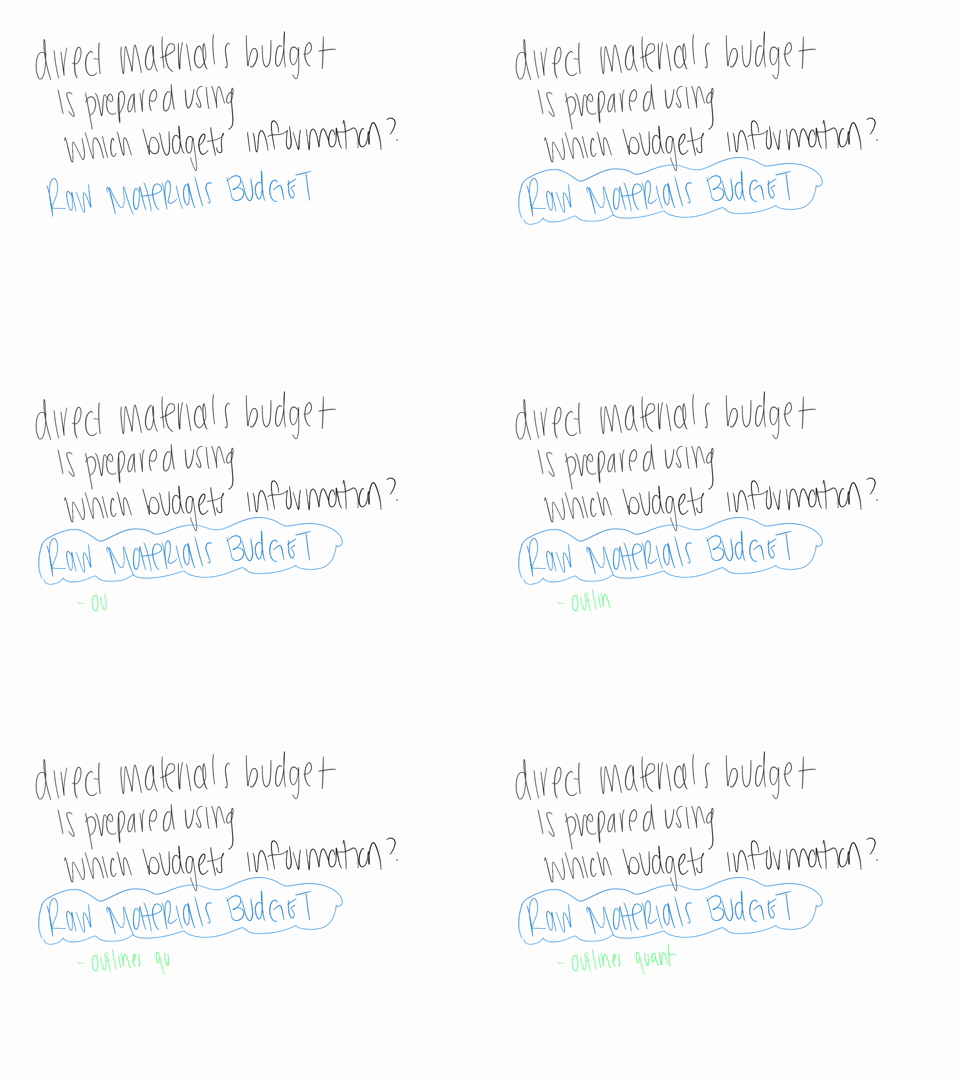
The direct materials budget is prepared using which budget’s information?
A. cash payments budget
B. cash receipts budget
C. production budget
D. raw materials budget

Chapter 7: Budgeting
Section 2: Prepare Operating Budgets
Brooke Bussoletti
02:06
Elementary Statistics a Step by Step Approach

List the steps you should perform when conducting a statistical study.

Chapter 1: The Nature of Probability and Statistics
Section 4: Experimental Design
Brooke Bussoletti
02:18
Elementary Geometry for College Students

Given: $\quad \triangle A B C$ (not shown) is isosceles with
$$
\begin{array}{l}
\mathrm{m} \angle A B C=\mathrm{m} \angle C=72^{\circ} ; \overrightarrow{B D} \text { bisects } \angle A B C \\
\text { and } A B=1
\end{array}
$$
Find: $B C$

Chapter 5: Similar Triangles
Section 6: Segments Divided Proportionally
Brooke Bussoletti
1 2 3 4 5 ... 23

Brooke's Quick Ask Videos

01:25
Precalculus

thoughtful 1672320257

Brooke Bussoletti
01:19
Algebra

If the insured incurs a $6,000 in-network medical bill after the annual deductible has been paid, how much will the health plan pay?

Brooke Bussoletti
01:37
Algebra

What interest will be earned if $6000 is invested
for 7 years at 11% compounded monthly? (Round your
answer to the nearest cent.)

Brooke Bussoletti
01:45
Geometry

A deposit is made every half-year into a savings account
paying 3% interest compounded semiannually. The balance after 7
years is $10,000. Calculate the rent of the increasing annuity. The
rent is ____$

Brooke Bussoletti
01:00
Algebra

1. On March 8, you sign a $5000 note with simple
interest of 10% for 240 days. You make partial payments
of $1300 on May 26 and $2300 on July 31. How
much will you owe on the date of maturity?

Brooke Bussoletti
02:38
Algebra

Here are two stories:
A family buys 6 tickets to a show. They also each spend $3 on a snack. They spend $24 on the show.
Diego has 24 ounces of juice. He pours equal amounts for each of his 3 friends, and then adds 6 more ounces for each.
Here are two equations:
3(x + 6) = 24
6(x + 3) = 24
Which equation represents which story?
What does x represent in each equation?
Find the solution to each equation. Explain or show your reasoning.
What does each solution tell you about its situation?
Brooke Bussoletti
1 2 3 4 5 ... 250