Guilherme Barros

Universidade Estadual Paulista
Master's degree

Biography

I conducted several seminars and gave talks at international conferences, explaining my work. Communicating my results is an integral part of my work as a theoretical physicist. My research field is General Relativity and analog gravity models.

Education

MS Theoretical Physics
Universidade Estadual Paulista
BS Physics
Universidade de Sao Paulo

Educator Statistics

Numerade tutor for 6 years
2033 Students Helped

Topics Covered

Understanding Equilibrium and Elasticity: A Comprehensive Guide
Mastering Motion: Achieving Efficiency Along a Straight Line
Motion in 2d or 3d
Discovering the Fundamentals: Newton's Laws of Motion Explained
Understanding Electromagnetic Waves: A Comprehensive Guide
Exploring the Fascinating World of Quantum Physics
Exploring the Wonders of Atomic Physics: A Comprehensive Guide
Unlock the Secrets of Fluid Mechanics with Our Expert Guide
Discover the Fascinating World of Nuclear Physics
Discover the Power of Gravitation: Exploring the Science Behind It
Master the Fundamentals of Physics: Learn Physics Basics
Understanding Electric Charge and Field: A Comprehensive Guide
Unlock the Power of Kinetic Energy: Boost Your Efficiency Today
Unlocking the Power of Potential Energy: Discover the Benefits
Save Energy and Money with Effective Conservation Techniques
Mastering the Rotation of Rigid Bodies: Tips & Techniques
Explore the Fascinating Dynamics of Rotational Motion
Understanding Moment Impulse and Collisions for Better Physics
Exploring the Fascinating World of Mechanical Waves
Explore the Fascinating World of Wave Optics - Unleash Its Potential
Discover the Fascinating World of Particle Physics Today
Explore the Fascinating World of Periodic Motion - Learn More Today!
Mastering Newton's Laws: Tips for Applying Them Effectively
Relativity
Understanding Reflection and Refraction of Light: A Comprehensive Guide
Calculating Electrical Power: Resistance and EMF
Master Direct Current Circuits with Our Expert Guide
Electromagnetic Induction: Understanding the Science and Applications
Understanding Alternating Current: A Comprehensive Guide
Discover the Science of Sound and Hearing: Your Guide to Better Listening
Find Your Dream Job: Discover the Best Work Opportunities
Understanding Gauss's Law: A Comprehensive Guide
Unlocking the Power of Electric Potential: Exploring its Benefits
Capacitance and Dielectrics: Understanding the Basics
Unlocking the Power of Magnetic Fields and Forces
Understanding Temperature and Heat: A Comprehensive Guide
Unlocking the Secrets of Thermal Properties: Understanding Matter
Understanding the First Law of Thermodynamics: Key Concepts
Understanding the Second Law of Thermodynamics: Key Principles
Discovering the Sources of Magnetic Fields: A Comprehensive Guide
Understanding Inductance: A Comprehensive Guide
Oscillatory Motion
Kinetic Theory Of Gases

Guilherme's Textbook Answer Videos

04:27
University Physics with Modern Physics

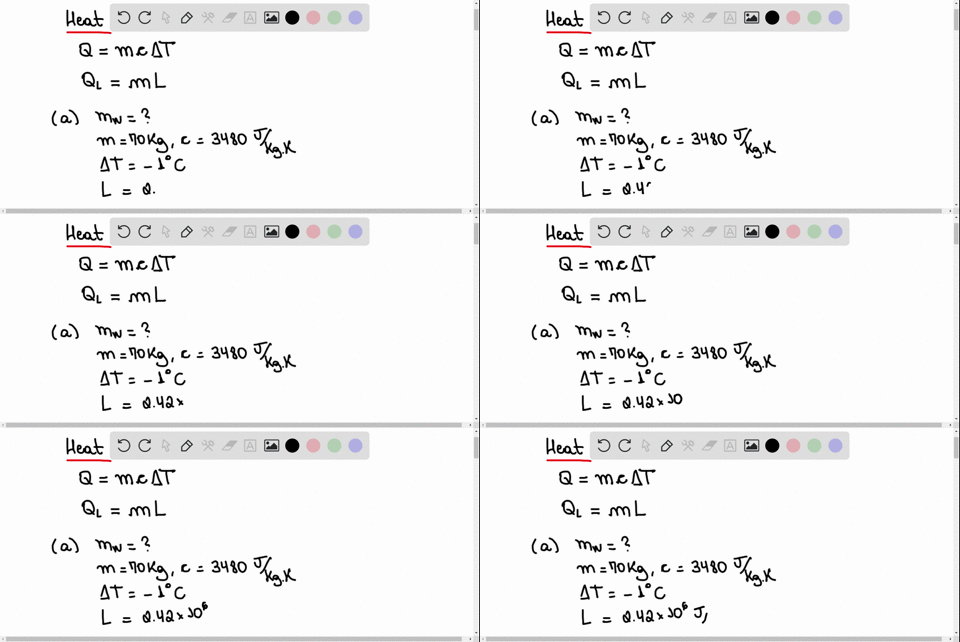
Evaporation of sweat is an important mechanism for temperature control in some warm-blooded animals. (a) What mass of water must evaporate from the skin of a 70.0-kg man to cool his body 1.00 C$^\circ$? The heat of vaporization of water at body temperature (37$^\circ$C) is $2.42 \times 10{^6} J/kg$. The specific heat of a typical human body is 3480 J/kg $\cdot$ K (see Exercise 17.25). (b) What volume of water must the man drink to replenish the evaporated water? Compare to the volume of a soft-drink can (355 cm$^3$).

Chapter 17: Temperature and Heat
Section 6: Calorimetry and Phase Changes
Guilherme Barros
03:04
University Physics with Modern Physics

At what temperature is the root-mean-square speed of nitrogen molecules equal to the root-mean-square speed of hydrogen molecules at 20.0$^\circ$C? ($Hint$: Appendix D shows the molar mass (in g/mol) of each element under the chemical symbol for that element. The molar mass of H$_2$ is twice the molar mass of hydrogen atoms, and similarly for N$_2$.)

Chapter 18: Thermal Properties of Matter
Section 3: Kinetic-Molecular Model of an Ideal Gas
Guilherme Barros
13:33
University Physics with Modern Physics

A thin-walled, hollow spherical shell of mass $m$ and radius $r$ starts from rest and rolls without slipping down a track ($\textbf{Fig. P10.68}$). Points $A$ and $B$ are on a circular part of the track having radius $R$. The diameter of the shell is very small compared to $h_0$ and $R$, and the work done by rolling friction is negligible. (a) What is the minimum height $h_0$ for which this shell will make a complete loop-the-loop on the circular part of the track? (b) How hard does the track push on the shell at point $B$, which is at the same level as the center of the circle? (c) Suppose that the track had no friction and the shell was released from the same height $h_0$ you found in part (a). Would it make a complete loop-the-loop? How do you know? (d) In part (c), how hard does the track push on the shell at point $A$, the top of the circle? How hard did it push on the shell in part (a)?
Figure P10.68
(CAN'T COPY THE FIGURE)

Chapter 10: Dynamics of Rotational Motion
Section 7: Gyroscopes and Precession
Guilherme Barros
12:58
University Physics with Modern Physics

When an object is rolling without slipping, the rolling friction force is much less than the friction force when the object is sliding; a silver dollar will roll on its edge much farther than it will slide on its flat side (see Section 5.3). When an object is rolling without slipping on a horizontal surface, we can approximate the friction force to be zero, so that $a_x$ and $a_z$ are approximately zero and $v_x$ and $\omega_z$ are approximately constant. Rolling without slipping means $v_x = r\omega_z$ and $a_x = r\alpha_z$ . If an object is set in motion on a surface $without$ these equalities, sliding (kinetic) friction will act on the object as it slips until rolling without slipping is established. A solid cylinder with mass $M$ and radius $R$, rotating with angular speed $\omega_0$ about an axis through its center, is set on a horizontal surface for which the kinetic friction coefficient is $\mu_k$. (a) Draw a free-body diagram for the cylinder on the surface. Think carefully about the direction of the kinetic friction force on the cylinder. Calculate the accelerations $a_x$ of the center of mass and $a_z$ of rotation about the center of mass. (b) The cylinder is initially slipping completely, so initially $\omega_z = \omega_0$ but $v_x =$ 0. Rolling without slipping sets in when $v_x = r\omega_z$ . Calculate the $distance$ the cylinder rolls before slipping stops. (c) Calculate the work done by the friction force on the cylinder as it moves from where it was set down to where it begins to roll without slipping.

Chapter 10: Dynamics of Rotational Motion
Section 7: Gyroscopes and Precession
Guilherme Barros
15:19
University Physics with Modern Physics

Find the tension $T$ in each cable and the magnitude and direction of the force exerted on the strut by the pivot in each of the arrangements in $\textbf{Fig. E11.13.}$ In each case let w be the weight of the suspended crate full of priceless art objects. The strut is uniform and also has weight $w$. Start each case with a free-body diagram of the strut.
Figure e11.13
(CAN'T COPY THE FIGURE)

Chapter 11: Equilibrium and Elasticity
Section 3: Solving Rigid-Body Equilibrium Problems
Guilherme Barros
08:38
University Physics with Modern Physics

A nonuniform beam 4.50 m long and weighing 1.40 kN makes an angle of 25.0$^\circ$ below the horizontal. It is held in position by a frictionless pivot at its upper right end and by a cable 3.00 m farther down the beam and perpendicular to it ($\textbf{Fig. E11.20}$). The center of gravity of the beam is 2.00 m down the beam from the pivot. Lighting equipment exerts a 5.00-kN downward force on the lower left end of the beam. Find the tension $T$ in the cable and the horizontal and vertical components of the force exerted on the beam by the pivot. Start by sketching a free-body diagram of the beam.
Figure E11.20
(CAN'T COPY THE FIGURE)

Chapter 11: Equilibrium and Elasticity
Section 3: Solving Rigid-Body Equilibrium Problems
Guilherme Barros
1 2 3 4 5 ... 331

Guilherme's Quick Ask Videos

05:54
Physics 101 Mechanics

a remote controlled toy car of mass 2.7 kg is moving with a velocity of 9.3 m/s along x- axis makes a complete inelastic collission with another identical car at rest ( stick together and move with same velocity along the same direction ). what is the change in the kinetic energy of the system?

Guilherme Barros
04:28
Physics 101 Mechanics

The gravitational field on the surface of the earth is 9.8N/kg. What is the gravitational field at 5 earth radii ABOVE THE SURFACE of Earth?

Guilherme Barros
05:06
Physics 101 Mechanics

calculate the speed of a satellite moving in a stable circular orbit about the earth at a height of 3600Km.

Guilherme Barros
05:18
Physics 103

An unpolarized laser light with an intensity of Io passes through three polarizer filters in series. The polarization angle of the third filter is set at right angle to the polarization angle of the first filter. After the light passes through the first two filters, it has an intensity of 0.30 Io. What is the intensity of the beam after it passes through all three filters?

Guilherme Barros
02:27
Physics 101 Mechanics

A pendulum bob of mass 0.15 kg is suspended from a fixed point by a thread of a fixed length. The bob is given a push so that it moves along a circular path of radius 1.82 m in a horizontal plane at a steady speed, taking 18.0 s to make 10 complete revolutions. Calculate: a) the linear speed of the bob
b) the centripetal acceleration of the bob

Guilherme Barros
02:28
Physics 101 Mechanics

Two charged dust particles exert a force of 7.0×10?2 N on each other. What will be the force if they are moved so they are only one-eighth as far apart?

Guilherme Barros
1 2 3 4