Mayukh Banik

University of California, Irvine
Science Teacher

Biography

After completing my PhD from University of California Irvine, I have joined Woodstock School as a science teacher. Despite of joining an industry position, I have decided to stay in the field of education sheerly guided by passion. I have received immense pleasure in tutoring high school and college students all over orange county, and while acting as a TA at UC Irvine. I have guided an uncountable number of students with all fields in science and their professional and personal development.

Education

Phd Chemistry
University of California, Irvine
MS Chemistry
University of California, Irvine
MS Physics
Indian Institute of Technology Kharagpur

Educator Statistics

Numerade tutor for 6 years
7169 Students Helped

Topics Covered

Unlocking the Power of Functions: Boost Your Programming Skills
Discover the Basics of Trigonometry: Your Introduction to Triangles
Electromagnetic Induction: Understanding the Science and Applications
Understanding Electromagnetic Waves: A Comprehensive Guide
Understanding Reflection and Refraction of Light: A Comprehensive Guide
Explore the Fascinating World of Wave Optics - Unleash Its Potential
Explore the Fascinating World of Periodic Motion - Learn More Today!
Exploring the Fascinating World of Mechanical Waves
Unlocking the Power of Magnetic Fields and Forces
Discovering the Sources of Magnetic Fields: A Comprehensive Guide
Understanding Alternating Current: A Comprehensive Guide
Unlocking the Power of Electric Potential: Exploring its Benefits
Capacitance and Dielectrics: Understanding the Basics
Unlock the Secrets of Fluid Mechanics with Our Expert Guide
Understanding Temperature and Heat: A Comprehensive Guide
Find Your Dream Job: Discover the Best Work Opportunities
Unlock the Power of Kinetic Energy: Boost Your Efficiency Today
Unlocking the Power of Potential Energy: Discover the Benefits
Save Energy and Money with Effective Conservation Techniques
Unlocking the Secrets of Thermal Properties: Understanding Matter
Understanding the First Law of Thermodynamics: Key Concepts
Understanding the Second Law of Thermodynamics: Key Principles
Mastering the Rotation of Rigid Bodies: Tips & Techniques
Explore the Fascinating Dynamics of Rotational Motion
Understanding Equilibrium and Elasticity: A Comprehensive Guide
Calculating Electrical Power: Resistance and EMF
Master Direct Current Circuits with Our Expert Guide
Mastering Motion: Achieving Efficiency Along a Straight Line
Motion in 2d or 3d
Discovering the Fundamentals: Newton's Laws of Motion Explained
Discover the Power of Gravitation: Exploring the Science Behind It
Mastering Newton's Laws: Tips for Applying Them Effectively
Master the Fundamentals of Physics: Learn Physics Basics
Understanding Electric Charge and Field: A Comprehensive Guide
Understanding Gauss's Law: A Comprehensive Guide
Exploring the Wonders of Atomic Physics: A Comprehensive Guide
Discover the Fascinating World of Nuclear Physics
Discover the Fascinating World of Particle Physics Today
Understanding Inductance: A Comprehensive Guide
Understanding Moment Impulse and Collisions for Better Physics
Discover the Science of Sound and Hearing: Your Guide to Better Listening
Exploring the Fascinating World of Quantum Physics
Relativity
Gravity, Planetary Orbits

Mayukh's Textbook Answer Videos

01:50
University Physics with Modern Physics

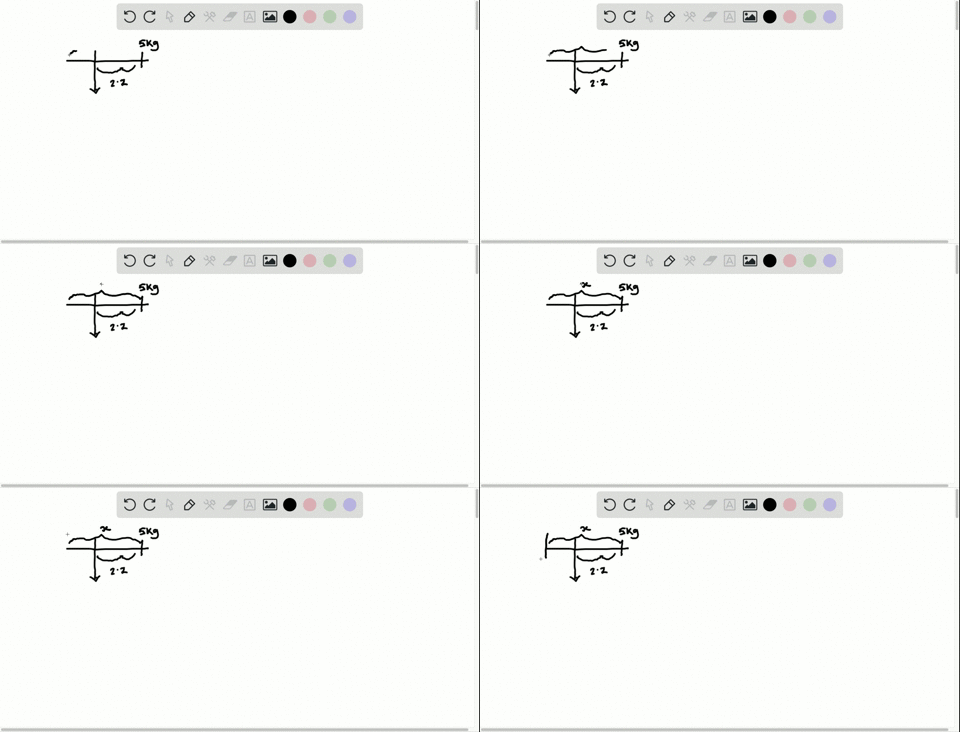
The center of gravity of a 5.00 -kg integular object is shown in Fig. E11.2. You need to move the center of gravity 2.20 $\mathrm{cm}$ to the left by gluing on a 1.50 -kg mass, which will then be considered as part of the object. Where should the center of gravity of this additional mass be located?

Chapter 11: Equilibrium and Elasticity
Mayukh Banik
01:12
University Physics with Modern Physics

A uniform rod is 2.00 $\mathrm{m}$ long and has 1.80 $\mathrm{kg} . \mathrm{A}$ $2.40-$ -kg clamp is attached to the rod. How far should the center of gravity of the clamp be from the left-hand end of the rod in order for the center of gravity of the composite object to be 1.20 $\mathrm{m}$ from the left-hand end of the rod?

Chapter 11: Equilibrium and Elasticity
Mayukh Banik
02:16
University Physics with Modern Physics

Raising a Ladder. A ladder carried by a fire truck is 20.0 $\mathrm{m}$ long. The ladder weighs 2800 $\mathrm{N}$ and its center of gravity is at its center. The ladder is pivoted at one end $(A)$ about a pin
(Fig. E11.5); you can ignore the friction torque at the pin. The ladder is raised into position by a force applied by a hydraulic piston at $C .$ Point $C$ is 8.0 $\mathrm{m}$ from $A$ , and the force $\vec{\boldsymbol{F}}$ exerted by the piston makes an angle of $40^{\circ}$ with the ladder. What magnitude must $\vec{\boldsymbol{F}}$ have to just lift the ladder off the support bracket at $B ?$ Start with a free-body diagram of the ladder.

Chapter 11: Equilibrium and Elasticity
Mayukh Banik
03:55
University Physics with Modern Physics

The horizontal beam in Fig. E11.14 weighs $150 \mathrm{N},$ and its center of gravity is at its center. Find (a) the tension in the cable and (b) the horizontal and vertical components of the force exerted on the beam at the wall.

Chapter 11: Equilibrium and Elasticity
Mayukh Banik
03:01
University Physics with Modern Physics

BIO Push-ups. To strengthen his arm and chest muscles, an 82 -kg athlete who is 2.0 m tall is doing push-ups as shown in Fig. E11. $15 .$ His center of mass is 1.15 $\mathrm{m}$ from the bottom of his feet, and the centers of his palms are 30.0 $\mathrm{cm}$ from the top of his head. Find the force that the floor exerts on each of his feet and on each hand, assuming that both feet exert the same force and both palms do likewise. Begin with a free-body diagram of the athlete.

Chapter 11: Equilibrium and Elasticity
Mayukh Banik
02:13
University Physics with Modern Physics

You take your dog Clea to the vet, and the doctor decides he must locate the little beast's center of gravity. It would be awkward to hang the pooch from the ceiling, so the vet must devise another method. He places Clea's front feet on one scale and her hind feet on another. The front scale reads $157 \mathrm{N},$ while the rear scale reads 89 $\mathrm{N}$ . The vet next measures Clea and finds that
her rear feet are 0.95 $\mathrm{m}$ behind her front feet. How much does Clear weigh, and where is her center of gravity?

Chapter 11: Equilibrium and Elasticity
Mayukh Banik
1 2 3 4 5 ... 1038

Mayukh's Quick Ask Videos

03:30
Physics 101 Mechanics

A replacement spring for a ballistic pendulum is needed. To
determine the spring constant, you launch a 66.4 g steel ball from
a horizontal table 102 cm high. The spring is initially compressed
4.90 cm and the ball hits the ground 3.65 m horizontally from the
launch point

Mayukh Banik
01:45
Physics 101 Mechanics


Four identical particles (mass of each = 0.24 kg) are placed at
the vertices of a rectangle (2.0 m × 3.0 m) and held in
those positions by four light rods which form the sides of the
rectangle. What is the moment of inertia of this rigid body about
an axis that passes through the center of mass of the body and is
parallel to the shorter sides of the rectangle?

Mayukh Banik
04:46
Physics 101 Mechanics

A student decides to give his bicycle a tune up. He flips it
upside down (so there's no friction with the ground) and applies a
force of 35 N over 1.1 seconds to the pedal, which has a length of
16.5 cm. If the back wheel has a radius of 33.0 cm and moment of
inertia of 1200 kg cm^2, what is the tangential velocity of the rim
of the back wheel in m/s? Assume he rides a fixed gear bicycle so
that one revolution of the pedal is equal to one revolution of the
tire.

Mayukh Banik
00:57
Physics 101 Mechanics

The writing on the passenger-side mirror of your car says
"Warning! Objects in mirror are closer than they appear" (Figure
1). There is no such warning on the driver's mirror. Consider a
typical convex passenger-side mirror with a focal length of -80 cm.
A 1.8-m-tall cyclist on a bicycle is 22 m from the mirror. You are
1.0 m from the mirror, and suppose, for simplicity, that the
mirror, you, and the cyclist all lie along a line
Part A
How far are you from the image of the cyclist?
Part B
How far would you have been from the image if the mirror were
flat?
Part C
What is the image height?
Part D
What would the image height have been if the mirror were
flat?
Express your answer with the appropriate units.

Mayukh Banik
03:08
Physics 101 Mechanics


Blood velocities were measured by a Doppler ultrasound with a
frequency of 8 MHz. The angle between the blood vessel and the
ultrasound beam for the Doppler measurements is 45 degrees. The
ultrasound speed in the tissue is 1540 m/s. If a Doppler shift of 2
kHz was measured at a location, what is the blood velocity at that
location?
A. 27.2 cm/s
B. 54.4 cm/s
C. 13.6 cm/s
D. 20 cm/s

Mayukh Banik
04:58
Physics 101 Mechanics

Two 11 cm-long thin glass rods uniformly charged to +14 nC are placed side by side, 4.0 cm apart. What are the electric field strengths E1, E2, and E3 at distances 1.0 cm, 2.0 cm, and 3.0 cm to the right of the rod on the left, along the line connecting the midpoints of the two rods?
Specify the electric field strength E1.
Specify the electric field strength E2.
Specify the electric field strength E3.

Mayukh Banik
1 2 3 4 5 ... 147