Meghan Miholics

McMaster University
Instructor

Biography

I am a student turned educator! After completing two degrees, B. Sc. in Math and Physics and M. Sc. in Physics and Astronomy, I have pursued anything and everything teaching. I currently work for a charity organization called Scientists in School - an organization that provides half day science workshops to elementary aged children. I also work for an online teaching company called VIPKID teaching English as a Second Language to young Chinese learners. I also work for a company called the Princeton Review. I teach first year level physics for students studying for the MCAT.

Education

BS Mathematics & Physics
McMaster University
MS Physics & Astronomy
McMaster University

Educator Statistics

Numerade tutor for 6 years
317 Students Helped

Topics Covered

Capacitance and Dielectrics: Understanding the Basics
Mastering Motion: Achieving Efficiency Along a Straight Line
Motion in 2d or 3d
Discovering the Fundamentals: Newton's Laws of Motion Explained
Mastering Newton's Laws: Tips for Applying Them Effectively
Master the Fundamentals of Physics: Learn Physics Basics
Understanding Electric Charge and Field: A Comprehensive Guide
Understanding Gauss's Law: A Comprehensive Guide
Unlocking the Power of Electric Potential: Exploring its Benefits
Discover the Power of Gravitation: Exploring the Science Behind It
Understanding Reflection and Refraction of Light: A Comprehensive Guide
Mastering the Rotation of Rigid Bodies: Tips & Techniques
Explore the Fascinating Dynamics of Rotational Motion
Understanding Equilibrium and Elasticity: A Comprehensive Guide
Exploring the Fascinating World of Mechanical Waves
Understanding Moment Impulse and Collisions for Better Physics
Explore the Fascinating World of Wave Optics - Unleash Its Potential
Discover the Fascinating World of Particle Physics Today
Master Direct Current Circuits with Our Expert Guide
Calculating Electrical Power: Resistance and EMF
Understanding the First Law of Thermodynamics: Key Concepts
Understanding Temperature and Heat: A Comprehensive Guide
Unlock the Secrets of Fluid Mechanics with Our Expert Guide
Unlock the Power of Kinetic Energy: Boost Your Efficiency Today
Understanding the Second Law of Thermodynamics: Key Principles
Find Your Dream Job: Discover the Best Work Opportunities
Save Energy and Money with Effective Conservation Techniques
Unlocking the Secrets of Thermal Properties: Understanding Matter
Unlocking the Power of Potential Energy: Discover the Benefits
Unlocking the Power of Magnetic Fields and Forces
Electromagnetic Induction: Understanding the Science and Applications
Current and Direct Current Circuits
Discover the Science of Sound and Hearing: Your Guide to Better Listening

Meghan's Textbook Answer Videos

06:58
University Physics with Modern Physics

(a) Calculate the magnitude of the angular momentum of the earth in a circular orbit around the sun. Is it reasonable to model it as a particle? (b) Calculate the magnitude of the angular momentum of the earth due to its rotation around an axis through the north and south poles, modeling it as a uniform sphere. Consult Appendix E and the astronomical data in Appendix F.

Chapter 10: Dynamics of Rotational Motion
Section 5: Angular Momentum
Meghan Miholics
07:16
University Physics with Modern Physics

A hot-air balloon stays aloft because hot air at atmospheric pressure is less dense than cooler air at the same pressure. If the volume of the balloon is 500.0 m$^3$ and the surrounding air is at 15.0$^\circ$C, what must the temperature of the air in the balloon be for it to lift a total load of 290 kg (in addition to the mass of the hot air)? The density of air at 15.0$^\circ$C and atmospheric pressure is 1.23 kg/m$^3$.

Chapter 18: Thermal Properties of Matter
Meghan Miholics
06:59
University Physics with Modern Physics

A cylinder 1.00 m tall with inside diameter 0.120 m is used to hold propane gas (molar mass 44.1 g/mol) for use in a barbecue. It is initially filled with gas until the gauge pressure is 1.30 $\times$ 10$^6$ Pa at 22.0$^\circ$C. The temperature of the gas remains constant as it is partially emptied out of the tank, until the gauge pressure is 3.40 $\times$ 10$^5$ Pa. Calculate the mass of propane that has been used.

Chapter 18: Thermal Properties of Matter
Meghan Miholics
03:48
College Physics

$\bullet$ A 12.0 g plastic ball is dropped from a height of 2.50 $\mathrm{m}$ and
is moving at 3.20 $\mathrm{m} / \mathrm{s}$ just before it hits the floor. How much
mechanical energy was lost during the ball's fall?

Chapter 7: Work and Energ
Meghan Miholics
07:13
Physics for Scientists and Engineers with Modern Physics

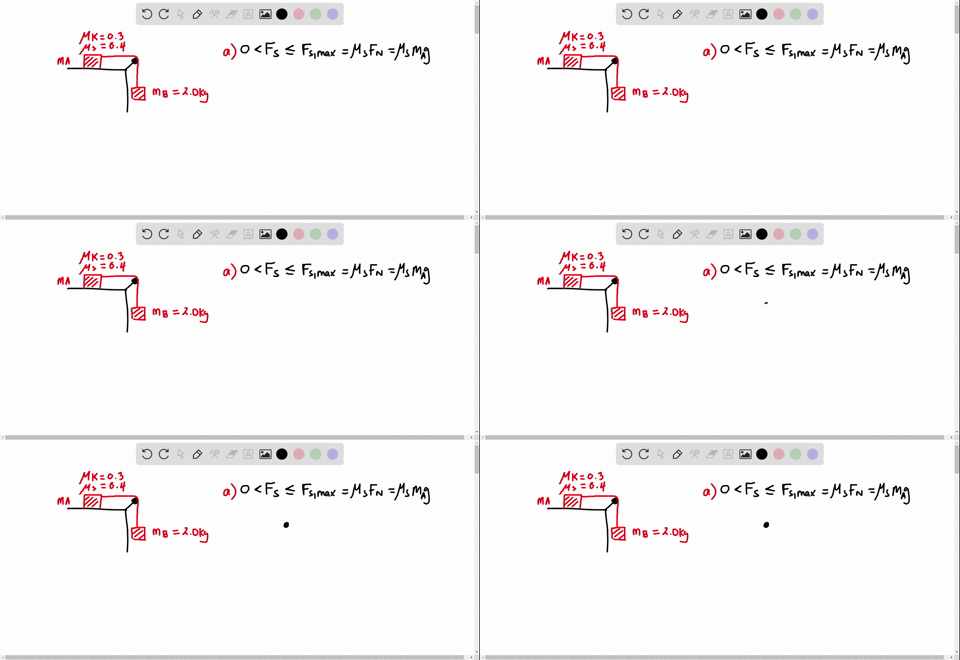
(II) In Fig. 35 the coefficient of static friction between mass
$m_{\mathrm{A}}$ and the table is $0.40,$ whereas the coefficient of kinetic
friction is 0.30$(a)$ What
minimum value of $m_{A}$
will keep the system
from starting to move?
(b) What value(s) of $m_{A}$
will keep the system
moving at constant
speed?

Chapter 5: Using Newton's Laws: Friction, Circular Motion, Drag Forces
Meghan Miholics
14:24
Physics for Scientists and Engineers with Modern Physics

(II) An object moving vertically has $\vec{\mathbf{v}}=\vec{\mathbf{v}}_{0}$ at $t=0$ .
Determine a formula for its velocity as a function of time
assuming a resistive force $F=-b v$ as well as gravity for
two cases: $(a) \vec{\mathbf{v}}_{0}$ is downward and $(b) \vec{\mathbf{v}}_{0}$ is upward.

Chapter 5: Using Newton's Laws: Friction, Circular Motion, Drag Forces
Meghan Miholics
1 2 3 4 5 ... 53

Meghan's Quick Ask Videos

04:37
Physics 101 Mechanics

Starting from rest what force will be required to cause a 2500 kg car to exit a quarter mile long tunnel in 1.5 minutes?

Meghan Miholics
1