Hi, My name is Yujie Wang and I'm a sophomore Engineering student. I really love my major and I have really good grades. I'm also a member of Phi Theta Kappa, which is a honor society of highly achieving student.
I had almost 3 years of tutoring experience. I really love help other people to solve complex math problem and helo them reach their full potential. All my students love my teaching style and experienced a rapid growth in their study. I hope I can help more students here at Numerade. Thanks.
Differentiate the function.
$ h(x) = \ln (x + \sqrt {x^2 - 1}) $
1-2 Plot the point whose polar coordinates are given. Then findtwo other pairs of polar coordinates of this point, one with $r>0$and one with $r<0 .$$$(a)(2, \pi / 3) \quad \text { (b) }(1,-3 \pi / 4) \quad \text { (c) }(-1, \pi / 2)$$
1-2 Plot the point whose polar coordinates are given. Then findtwo other pairs of polar coordinates of this point, one with $r>0$and one with $r<0 .$$$\begin{array}{lll}{\text { (a) }(1,7 \pi / 4)} & {\text { (b) }(-3, \pi / 6)} & {\text { (c) }(1,-1)}\end{array}$$
Use like bases to solve the exponential equation.$\left(\frac{1}{64}\right)^{3 n} \cdot 8=2^{6}$
For the following exercises, find all solutions exactly on the interval $0 \leq \theta<2 \pi$$$2 \sin \theta=\sqrt{3}$$
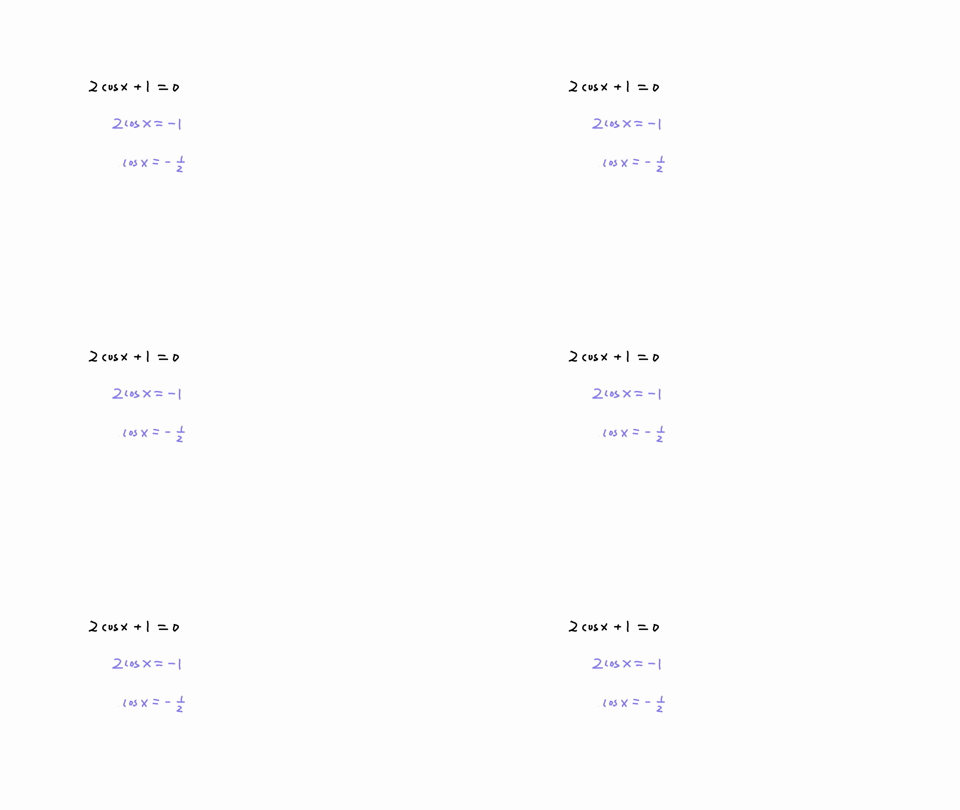
In Exercises $25-34,$ solve the equation.$$2 \cos x+1=0$$
The sum of three numbers is 40. The first number is five more than the second number. It is also twice the third. Find the numbers
A graphing calculator is recommended.
A fish swims at a speed v relative to the water, against a current of 7 mi/h. Using a mathematical model of energy expenditure, it can be shown that the total energy E required to swim a distance of 14 mi is given byE(v) = 2.73v^3 * (14 / (v - 7)).Biologists believe that migrating fish try to minimize the total energy required to swim a fixed distance.
Find the value of v that minimizes energy required.v =
can i please get some assistance with this question thank you
Write the equation for the function graphed below.
You have developed a linear regression equation, y = -58.2 + 1.5467x, that models the expected grade in Calculus II (y), based on the earned grade in Calculus I (x). If a student earns the grade of 90 in Calculus I, what is the expected grade for that student in Calculus II? (Round to the nearest whole number.)
You can afford a $450 per month car payment. You've found a 5year loan at 4% interest. How big of a loan can you afford?