Aman Gupta

Numerade Educator
Tutor

Biography

I have tutored 1000+ students on various topics ranging from Calculus, Statistics, Probability, MATLAB, Structural Engineering, Aerospace Engineering, Mechanical Engineering and a lot others. I engaged in live sessions and clarified their doubts using basic principles. With a background enriched in aerospace engineering and data science, I bring a unique blend of academic rigor and practical insight to the table.

Understanding challenging subjects shouldn't be daunting. That's why I strive to make learning an enjoyable journey by simplifying intricate topics into bite-sized pieces. Whether it's unraveling the mysteries of mathematics or diving into the intricacies of learning, I'm here to guide you through every step.

Education

Aman has not yet added their education credentials.

Educator Statistics

Numerade tutor for 5 years
6988 Students Helped

Topics Covered

Exploring the World of Derivatives: A Comprehensive Guide
Master Algebra Basics: Topics Reviewed at Semester Start
Introduction to Conic Sections
Master Trigonometry with Our Comprehensive Guide
Introduction to Combinatorics and Probability
Discover the Wonders of Geometry: An Introduction to Shapes and Space
Functions
Mastering Linear Functions: A Comprehensive Guide
Mastering Equations and Inequalities: Your Guide to Mathematical Success
Discover the Basics of Trigonometry: Your Introduction to Triangles
Discover the Best Series to Binge-Watch | Your Ultimate Guide
Mastering Integrals: Tips and Tricks for Calculus Success
Unlocking the Power of Functions: Boost Your Programming Skills
Breaking Limits: Unlock Your Potential with Our Expert Solutions
Stand Out with Differentiation Strategies | Boost Your Business
Mastering the Basics of Parametric Equations: A Comprehensive Guide
Polar Coordinates: Understanding the Basics and Applications
Mastering Multiple Integrals: Techniques and Tips
Solving Systems of Equations and Inequalities: A Comprehensive Guide
Mastering Partial Derivatives: Essential Techniques and Tips
Unlocking the Power of Geometric Proof: A Comprehensive Guide
Introduction to Combinatorics & Probability: Understanding the Basics
Introduction to Sequences and Series
Unlock the Power of Vectors: Discover Their Limitless Possibilities
Find Your Dream Job: Discover the Best Work Opportunities
Unlock the Power of Kinetic Energy: Boost Your Efficiency Today
Unlocking the Power of Potential Energy: Discover the Benefits
Discovering the Fundamentals: Newton's Laws of Motion Explained
Discover the Power of Gravitation: Exploring the Science Behind It
Differential Equations Made Simple: Expert Tips & Resources
Mastering Exponential and Logarithmic Functions: Your Ultimate Guide
Exploring Probability Topics: From Basics to Advanced Strategies
Mastering Polynomials: Essential Tips and Tricks | [Brand Name]
Master Geometry Basics for a Strong Foundation
Discover the Relationship Between Parallel and Perpendicular Lines
Mastering Integration Techniques for Optimal Results
Circles: Exploring the Beauty and Significance of Circular Shapes
Unlocking the Power of Probability: A Guide to Making Informed Decisions
Sequences and Series
Normal, Binomial, and Geometric Models
Mastering Sequences and Series: A Comprehensive Guide
Limits
Derivative
Matrices and Determinants
Understanding Complex Numbers: A Comprehensive Guide
Applications of Integration: Exploring Real-World Solutions
Unlock the Power of Sequences: Boost Your Productivity
Mastering Matrices: An Introduction to the Fundamentals
Rational Functions: Understanding Their Properties and Applications
Trig Integrals
Unlock Insights with Data-Driven Graphs & Statistics
Discovering Conic Sections: An Introduction
Unlocking Insights with Descriptive Statistics: A Comprehensive Guide
Unlocking the Power of Confidence Intervals: A Comprehensive Guide
Unlocking the Power of Thermodynamics: A Comprehensive Guide
Exploring the Fascinating World of Thermochemistry | Learn More Today
Integration
Applications of the Derivative
Oscillatory Motion
Computer Science Overview
Data Types and Variables
Mastering Exponents and Polynomials: A Comprehensive Guide
Mastering Sequences and Series: An Introduction
Applications of Trigonometric Functions
Powers and Polynomial
Master Algebra Basics: Your Introduction to Algebra
Exploring the Functions of Multiple Variables
ACT Math - Probability and Statistics
SAT Math - Probability and Statistics
first order differential equations
Maximize Your Results with our Percent-Based Solutions
Mastering Quadratic Functions: Unlocking Their Power
The Power of Algebraic Language: Unlocking Mathematical Potential
Differential Equations
Mastering Second Order Differential Equations: Tips and Techniques
Mastering Vectors: An Introduction to Vector Basics
Maximizing Accuracy with Effective Sampling and Data Analysis
Master Probability and Counting Rules for Better Outcomes
Volume
Explore the Power of Continuous Functions: Boost Your Mathematical Skills
Parametric Equations
Vector Functions: Understanding the Basics
Foundations for Geometry: Building Blocks for Mathematical Understanding
Mastering Fractions and Mixed Numbers: A Comprehensive Guide
Understanding the Normal Distribution: A Comprehensive Guide
Understanding Discrete Random Variables: A Comprehensive Guide
Understanding Discrete Probability Distributions: A Comprehensive Guide
Master Algebra and Trigonometry with Our Expert Courses
Graphing Trigonometry Functions
Master Vector Calculus with Our Comprehensive Guide
Understanding Continuous Random Variables: Key Concepts
Integration
Graph Linear Functions
Series Tests
The Cross Product
Taylor Series

Aman's Textbook Answer Videos

01:42
Calculus: Early Transcendentals

In the theory of relativity, the Lorentz contraction formula
$$ L = L_0 \sqrt{1 - v^2/c^2} $$
expresses the length $ L $ of an object as a function of its velocity $ v $ with respect to an observer, where $ L_0 $ is the length of the object at rest and $ c $ is the speed of light. Find $ \displaystyle \lim_{v \to c}-L $ and interpret the result. Why is a left-hand limit necessary?

Chapter 2: Limits and Derivatives
Section 3: Calculating Limits Using the Limit Laws
Aman Gupta
01:52
Calculus: Early Transcendentals

Find a formula for the inverse of the function.

$ y = \dfrac{1 - e^{-x}}{1 + e^{-x}} $

Chapter 1: Functions and Models
Section 5: Inverse Functions and Logarithms
Aman Gupta
02:47
Calculus: Early Transcendentals

A right circular cylinder is inscribed in a cone with height $ h $ and base radius $ r $. Find the largest possible volume of such a cylinder.

Chapter 4: Applications of Differentiation
Section 7: Optimization Problems
Aman Gupta
01:42
Calculus: Early Transcendentals

Show that the curve with parametric equations $ x = t^2 $, $ y = 1 - 3t $, $ z = 1 + t^3 $ passes through the points $ (1, 4, 0) $ and $ (9, -8, 28) $ but not through the point $ (4, 7, -6) $.

Chapter 13: Vector Functions
Section 1: Vector Functions and Space Curves
Aman Gupta
04:38
Precalculus with Limits

A manufacturer wants to enlarge an existing manufacturing facility such that the total floor area is $ 1.5 $ times that of the current facility. The floor area of the current facility is rectangular and measures $ 250 $ feet and $ 160 $ feet. The manufacturer wants to increase each dimension by the same amount.

(a) Write a function that represents the new floor area $ A $.

(b) Find the dimensions of the new floor.

(c) Another alternative is to increase the current floors length by an amount that is twice an increase in the floors width. The total floor area is $ 1.5 $ times that of the current facility. Repeat parts(a) and (b) using these criteria.

Chapter 2: Polynomial and Rational Functions
Section 5: Zeros of Polynomial Functions
Aman Gupta
02:57
Fundamentals of Differential Equations

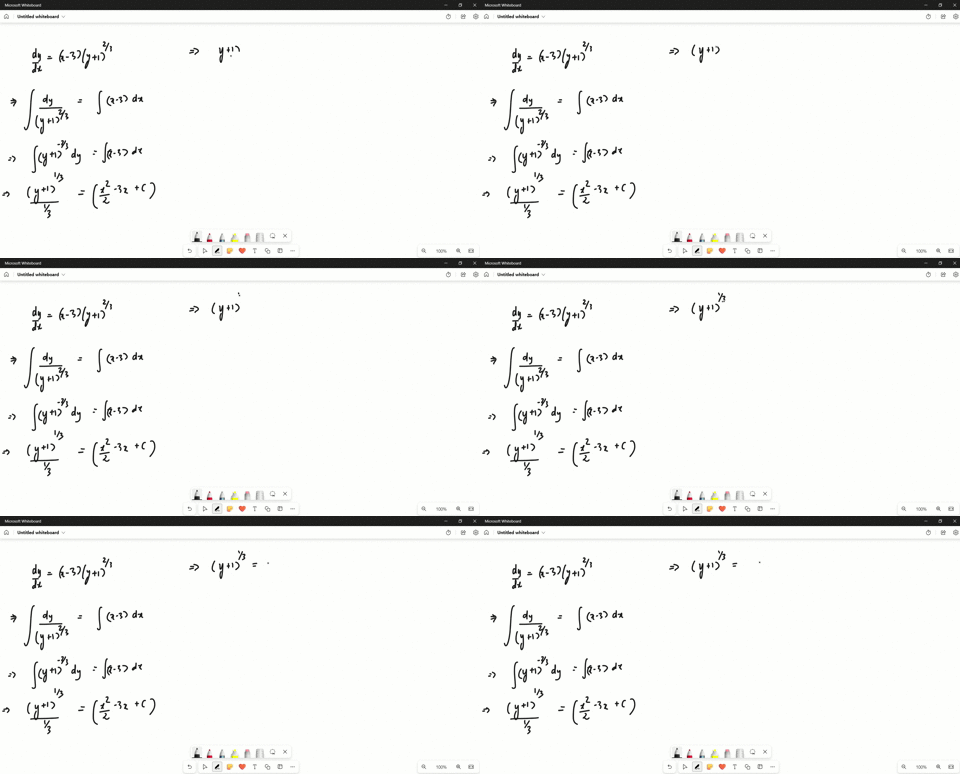
As stated in this section, the separation of equation (2) on page 42 requires division by $ p(y) $, and this may disguise the fact that the roots of the equation $ p(y)=0 $ are actually constant solutions to the differential equation.
(a) To explore this further, separate the equation
$$ \frac{d y}{d x}=(x-3)(y+1)^{2 / 3} $$
to derive the solution,
$$ y=-1+\left(x^{2} / 6-x+C\right)^{3} $$
(b) Show that $ y \equiv-1 $ satisfies the original equation $ d y / d x=(x-3)(y+1)^{2 / 3} $
(c) Show that there is no choice of the constant $ C $ that will make the solution in part (a) yield the solution $ y \equiv-1 $ Thus, we lost the solution $ y=-1 $ when we divided by $(y+1)^{2 / 3}$.

Chapter 2: First-Order Differential Equations
Section 2: Separable Equations
Aman Gupta
1 2 3 4 5 ... 900

Aman's Quick Ask Videos

03:11
Calculus 1 / AB

Find two positive real numbers x and y such that their product is 1250 and x+2y is as small as possible.

Aman Gupta
11:26
Algebra

A small fair charges $1.50 for students, $1 for children, and $2 for adults. In one day, three times as many children as adults attended. A total of 800 tickets were sold for a total revenue of $1,050. How many of each type of ticket was sold. (Solve by creating the system of equations and then use matrices to solve)

Aman Gupta
08:40
Calculus 1 / AB

Let $(s_{n})$ be a sequence that converges.
[(a)] Show that if $s_{n} \ge a$ for all but finitely many $n$, then $\lim s_{n} \ge a$.
[(b)] Show that if $s_{n} \le b$ for all but finitely many $n$, then $\lim s_{n} \le b$.

[(c)] Conclude that if all but finitely many $s_{n}$ belong to $[a, b]$, then
$\lim s_{n}$ belongs to $[a,b]$.

Aman Gupta
03:03
Calculus 1 / AB

A rectangular prism box is to be constructed out of different
types of wood. The wood on the bottom of the box costs 35 cents per
cm2. The wood on the long sides costs 25 cents per cm2. The wood on
the ends costs 30 cents per cm2. The ends are square, and the box
is to be open at the top. The box needs to hold a capacity of 3
litres (3000 cm3). What are the dimensions (length, width, height)
that will minimize the cost of the box?

Aman Gupta
01:27
Precalculus

5 points) A CD has diameter of 110 millimeters. When playing
audio, the angular speed varies to keep the linear speed constant
where the disc is being read. When reading along the outer edge of
the disc, the angular speed is about 320 RPM (revolutions per
minute). Find the linear speed in centimeters per second. What is
the angular speed in radians per second?

Aman Gupta
02:40
Calculus 1 / AB

Minimizing Packaging Costs
A rectangular box is to have a square base and a volume of 72 ft^3. If the material for the base costs $0.54/ft^2, the material for the sides costs $0.15/ft^2, and the material for the top costs $0.26/ft^2, determine the dimensions (in ft) of the box that can be constructed at minimum cost. (Refer to the figure below.)
A closed rectangular box has a length of x, a width of x, and a height of y.
x = ft
y = ft

Aman Gupta
1 2 3 4 5 ... 227